“Big plate chicken” spice pack from Urumchi

I’m not big on non-perishables that are loaded with chemicals and preservatives.  I really appreciate fresh ingredients and the time taken to produce a beautiful stew.  That said, I couldn’t resist this very unusual find today at a local market in Chinatown (the meat market next to Kosher Vegetarian Restaurant on Cherry St. called “Grocery Market” or 永順內食食品市場) [Update 25Nov2018: That meat market/grocery is now a warehouse and is no longer a store to the public].

dapanji_spice

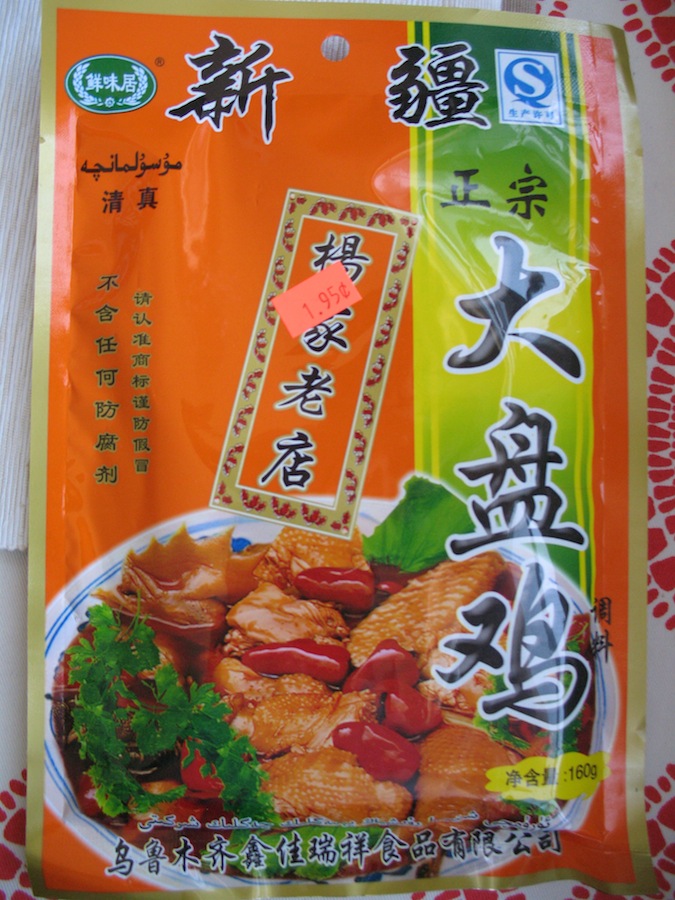
Spice pack for “Xinjiang big plate chicken” — a halal product of Urumchi

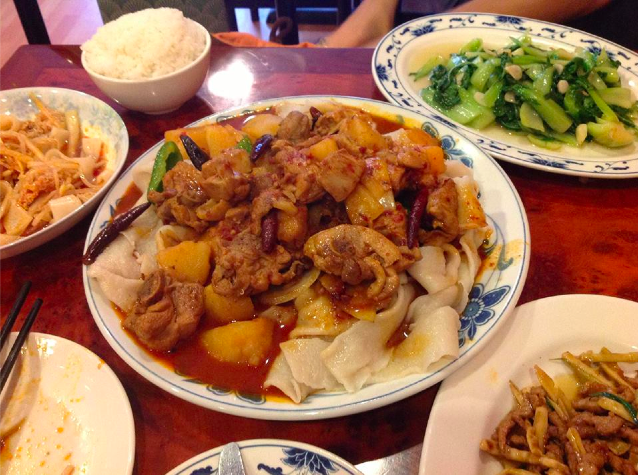
It’s an instant spice pack for a well-known Xinjiang specialty called dapanji 大盘鸡, or “big plate chicken”.  Here is a nice image found in the wiki commons for this dish:

“big plate chicken” image by pravit

Big plate chicken” is a chicken stew that is much loved in western China.  It was supposedly invented by a migrant from Sichuan to Xinjiang, and it is popular among Han and Uyghurs (and Americans).  The spices vary from something that closely resembles Chinese 5-spice to something more like traditional Uyghur qordaq (a meat and root vegetable stew native to Xinjiang).

This dish is often served with a plate of flat handmade wheat noodles, that can be dumped into the stew.

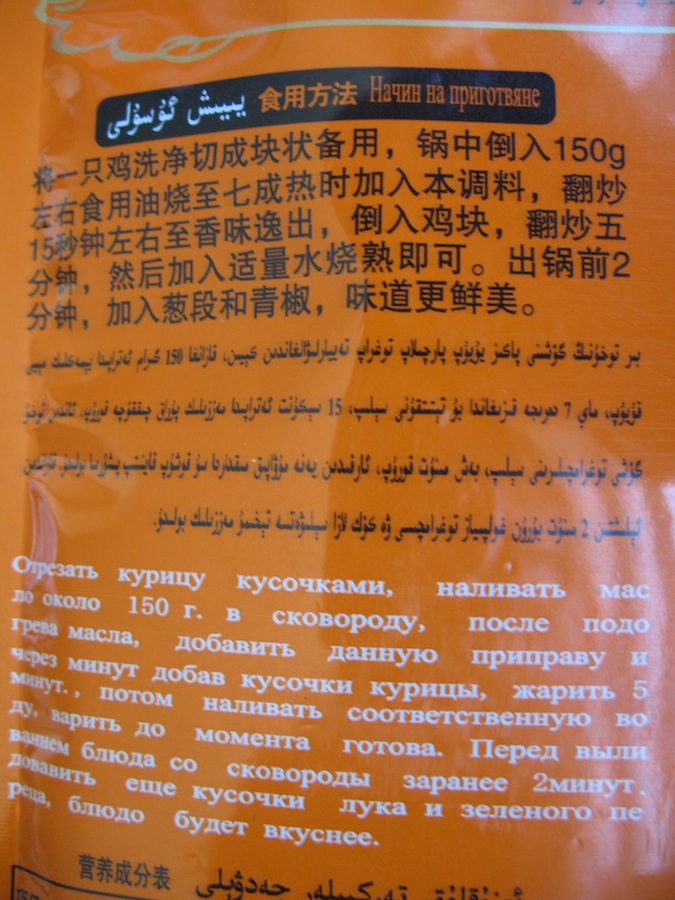
The reason I bought this (and hey, it was only $1.95) was the packaging.  This is the first product I’ve noticed in a store in the US with Uyghur writing on it.  You may notice the bag is written in three languages, Chinese, Uyghur, and Russian.  It is a halal product of Urumchi.

dapanji_spice2

Chinese, Uyghur, and Russian instructions

Inside there is a red package of paste.  Spices and oil.  It closely resembles the look and aroma of Kang shifu brand instant beef noodles (complete with meat packet).  For a detailed post on that popular food item, see here.

If you would like to try a non-instant, decent version of this dish, Xi’an Sizzling Woks on Arch and 9th does it pretty well, a spiced chicken and potato stew complete with handmade noodles. Here is an image of that, courtesy of La:

XianSizzlingWoks_dapanji

“Big plate chicken” at Philly’s Xi’an Sizzling Woks

Posted in - Featured Food Discoveries, Central Asia/Uyghur food, Chinese food | Tagged , , , | 4 Comments

Purslane, fried as vegetable

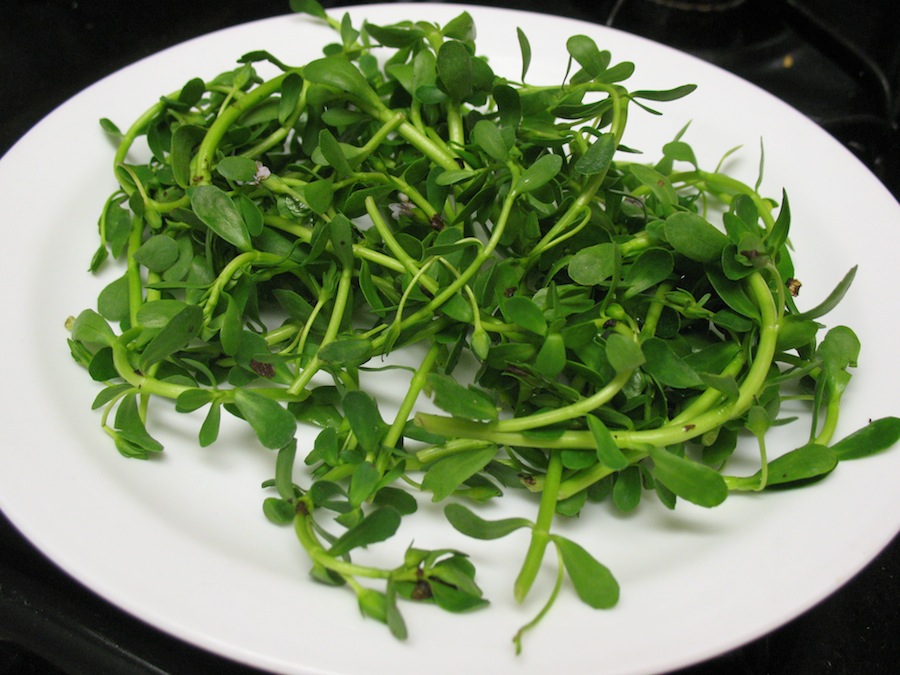
I came across this vegetable recently in a local store.  It is known as purslane in English, machixian (馬齒莧) in Mandarin, and semiz otu in TurkishI provide these names as I know of its culinary use in China and Turkey (folks in the states eat it too).  This vegetable–or weed, depending on perspective–can be found at 1st Oriental Supermarket (東方超級市場) on Washington Ave in Philly. A big bag costs around $3.

semiz_otu2

Purslane at 1st Oriental Supermarket

I chose to fry this, first as I would do normally with something like watercress or spinach.  Garlic, salt, and a little sugar on high heat for a very short time.  The result was kind of bitter, but enjoyable.  It is not as quite as bitter as bitter melon, just to give you a reference point.

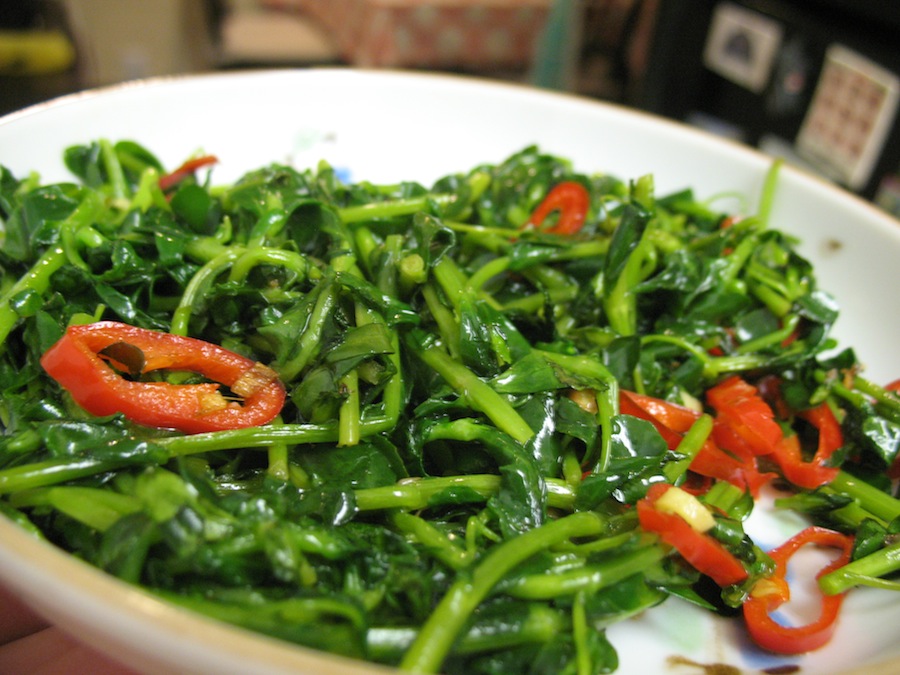
My second try took advice from Fuchsia Dunlop’s Revolutionary Chinese Cookbook, which is based on Hunan recipes, several of which are home-style.  For this version I first blanched the vegetable before stir frying it on high heat with salt, ginger and a splash of rice vinegar.  This I enjoyed very much.  It was still a little bitter, but it had a more complex flavor.  A nice compliment to rice and other spiced dishes.

semiz_otu_cooked

My try at Fuchsia Dunlop’s recipe for fried purslane

This vegetable is also used in Turkish cooking, where it is known as semiz otu “fat grass”.  The one way I know this used in Turkey is as a meze.  It is chopped raw, and mixed with yogurt, garlic, salt, and oil.  Here is a link to such a recipe.

Posted in - Featured Food Discoveries, Chinese food, Turkish food | Tagged , , , , | Leave a comment

Long peppers found

I have been looking for this spice for quite some time.  Online references imply that it should be easily found at South Asian markets.  I finally ended up finding it at a local North Philly Cambodian market. This spice is of course, the long pepper.

long_pepper2

The elusive long pepper.

The long pepper is also known as pippali, cabe jawa, dipli, changjiao, pilpilmoya, etc. It is very similar to black pepper, but it is a little spicier.  I first noticed it in markets in Xinjiang and central China, where this is used for medicine more than cooking.

So… why was I looking for it in the first place?  Well, I traveled to Northern Thailand a few years ago, and I was introduced to many new and exciting flavors.  I had previously lived in Thailand, and thought I knew the extent of Thai culinary diversity.  I am wiser now, and I see there is much, much to learn.  Dishes like northern-style laap ลาบ (sour and spicy minced-meat salad) and yamjingai ยำจิ้นไก่ (a spiced shredded chicken salad) really surprised me–there was such a combination of spices…. what were these new flavors?  Some of them are familiar to India, and some are familiar to Southern China.  In particular: makhwaen มะแขว่น, a fruitier cousin to China’s famous “Sichuan pepper” huajiao 花椒 (Update: click here for a later post detailing this family of spices), white cardamom, and the topic of this post, dipli ดีปลี or “long pepper”.

The Cambodian market on Old York Road where I found this item labeled the bag as “dey pley spice”. You can also find this spice online, but it is kind of pricey.

Long pepper is also known as “pipali”.  It is used in medicine and cooking from India to Indonesia, and in lands in between.  It was even known to the ancient greeks for its medicinal properties.

If you are looking for northern Thailand spice ingredients (i.e. you are using Andy Ricker’s delightful Pok Pok cookbook), you should know about this one.  More coming soon, on this and other key northern Thai spices, and what delicious dishes you can make with them. Update 13Dec2014: I finally put out a post for a dish in which this is an important ingredient, yamjingai.

Posted in - Featured Food Discoveries, Cambodian food, Central Asia/Uyghur food, Thai/Lao food | Tagged , , , , , | 4 Comments

Yellow figs from Xinjiang and Turkey

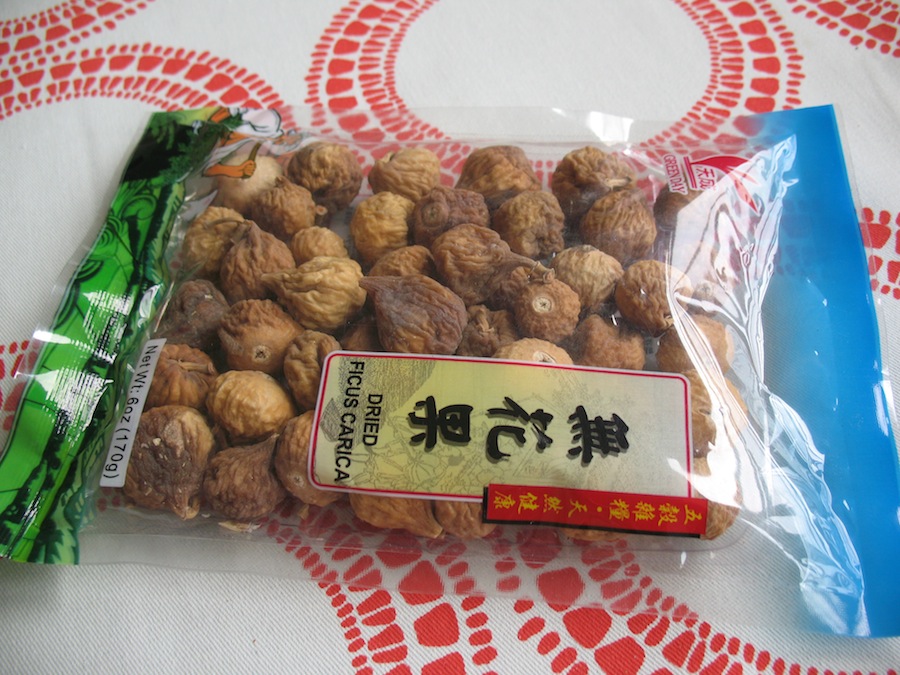
I was surprised to come across yellow figs at a local market several weeks ago.  I was used to having a double-take every time I saw dried Chinese chestnuts (they look quite similar), but alas we really do now have western Chinese figs available in Philly.  Now that I’ve seen them at one market, I seem to be seeing them everywhere.

For those of you who haven’t yet tried dried figs of western China (the Chinese name 無花果 means “flowerless fruit”), they are full of flavor.  They taste a lot like breaded Fig Newtons (for me this is a positive association).

figs

Dried figs (or Ficus Carica, if that name means anything to you) are now available from many of the large Asian markets around town.

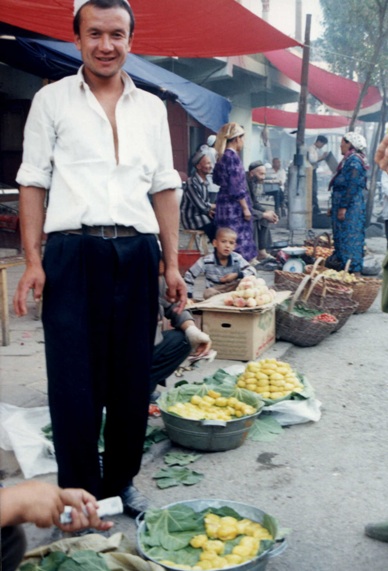
The figs above are fully dehydrated, and they are about the size of a penny.  This is really different than how they are fresh, plump and full of water.  Here is a picture of a fig seller on the streets of Kashgar, Xinjiang back in the 90s:

FigSeller

Uyghur fig seller in Kashgar, 1990s

As you might be able to see, fresh figs in Xinjiang are much larger, about the size of a lime or a small lemon.  Fresh figs of course have a much more subtle flavor.

By coincidence, I have noticed that most Asian markets around town are now carrying Turkish yellow figs as well.  These figs are usually sold in the produce area, tightly packed together in a wheel.  These figs are very similar to the Xinjiang variety, but they are larger and slightly less concentrated.  They are also delicious, and have a consistency more like a dried apricot–Perhaps they are only partially dehydrated?  Below is a size comparison between the Xinjiang fig and the Turkish one now available at markets ranging from H-mart to Whole Foods.

fig_comparison

Size comparison between Xinjiang and Turkish figs

Posted in - Featured Food Discoveries, Central Asia/Uyghur food, Turkish food | Tagged , , , | 4 Comments

Lanzhou pulled noodles and “secret” ingredients

For those who have experienced it, a trip to a hand-pulled noodle (lamian 拉面 in Mandarin) shop is a culinary highlight of China.  Often these shops are named after their product: “beef noodles”(牛肉面), or “Lanzhou pulled noodles” (兰州拉面). In China, many of these shops are run by Chinese Muslim families, as the noodle is particularly famous in the Chinese Muslim (aka Hui) heartland of central China. Expert noodle cooks pull noodles per order, thick or thin.  Generally you can watch the cooks as they pull, so you can see for yourself how fresh the noodles are.  They certainly make it look easy!  Try to do this at home however, and you’ll find it all but impossible.  You pull the dough and it will break, repeatedly.  How do they do it?  Here I highlight some of the issues in trying to pull your own noodles.

Nan Zhou's version of beef noodles

A bowl of beef noodles from Philly’s Nan Zhou Hand Drawn Noodle House

First of all, you have to see it to believe it.  Here are some links to some videos: a clip from a much loved CCTV documentary called 舌尖上的中国 “A Taste of China”, acrobatics and pulling noodles through the eye of a needle (in Mandarin with a bored daytime TV host).

Second of all, you need to eat it for yourself.  So that you know this is worth obsessing over. In Philly, you should try the one pictured above.  For me, it is a near-religious experience.

Flours have a different gluten contents.  Some flours are better for pulling noodles than others.  East Asian flours have less gluten than typical U.S. all-purpose flour.  Luke Rymarz, an unusual hobbyist in noodle-pulling, has an excellent site where he explains his testing of flours. He has a recipe to emulate East Asian wheat flours for the best pulled noodles.  That, along with very useful step-by-step pulling instruction videos, can be found at his site.  Too much gluten will make the dough hard to pull, and a lot of manual (or machine) labor is crucial to beat the dough into a clay-like or silly putty-like consistency. The idea is not to massage the dough to build gluten, but rather to beat it up and knead it into submission.

Noodle dough needs some time to relax.  If you notice, noodle cooks take a chunk of dough out of a bin where a bunch of pre-sized doughs are resting.  Dough needs to relax before it becomes elastic.

A little alkaline can help give some elasticity to the dough.  Alkalines can be added as a solution or powder, but in very small quantities.  This step is actually optional, and in some noodle-pulling traditions (in Xinjiang for example, with the classic Uyghur dish laghman) noodle recipes are simply flour, water, and a little salt.

Alkalines are often cited as the “secret ingredient” in hand-pulled noodles.  Lye water, or particular mineral waters are often used. For noodles in central China (Gansu, Shaanxi), of the Lanzhou tradition, the alkaline of choice is penghui (蓬灰).  This is made by taking a local tumbleweed (bitter fleabane) and burning it into ash.  The resulting powder is added to water to create a solution that is then rubbed onto dough before pulling. This so-called “secret” was “exposed” on Nanjing TV in 2011, apparently leading to much anger among noodle restaurant owners.  Penghui has long been used for Lanzhou lamian, and it is hardly unknown.  Pulling noodles at home is however, a very labor-intensive process, with or without penghui.  Restaurant owners should have very little to fear that their business would end with people making their own at home.

Back in the ’90s when I was teaching English in Guangzhou, a colleague at the school learned I was interested in learning noodle pulling.  She had a relative in central China send a bag of penghui.  I used it, and the dough was made more elastic by applying the solution during kneading.  I frequently used too much of it however, and the noodles had a kind of sulfury taste too them.  Now when I eat lamian in China, I can detect this flavor at certain shops.

I have yet to find penghui for sale in the states.  It is of course for sale in China, here is a link to a search on taobao.

[UPDATE 19Sept2017]: See a much longer post on the theme of Lanzhou-style pulled noodles and issues with noodle pulling: “Lanzhou pulled-noodles, Lanzhou-style”

If you haven’t yet tried hand-pulled noodles, places are popping up in the U.S. We are lucky in Philadelphia to have two specialized hand-pulled noodle restaurants, Nan Zhou Hand Drawn Noodle House, and Spice C Hand Drawn Noodle, both in Philly’s Chinatown. I don’t detect the taste of penghui at our local establishments, but they do serve up delicious Lanzhou-style noodles.

Posted in - Featured Food Discoveries, Chinese food | Tagged , , , , , , , , , , , , , , , | 13 Comments