Flowering garlic chives

Many Chinese vegetables available at the markets are sold in multiple forms and maturities. Vegetables that are going into flower are also appreciated and are usually labeled with an indication with a final word or character hua 花.

IMG_2453

Today’s item is a stem of the garlic chive plant (allium tuberosum), and it is crunchy and delicious. Its name in Mandarin and Cantonese (Languages most common in Philly’s Chinatown) is jiucai hua/gauchoy faa 韭菜花.

I’ve eaten this most commonly with stir fry dishes like the one below, but I’ve also eaten it as kimchi (called buchu kimchi)

The leaves of this vegetable are delicious in Chinese dumplings and omelets, and the leaves are marketed simply as jiucai/gauchoy 韭菜.  A nice image of these leaves can be found here.  I’ve also seen this labeled at some Chinese markets with a variant name of 九菜.

IMG_2474You can find this veg in Chinatown, and at Korean and Southeast Asian markets.  I got this from the underground market at Chinatown.

Tonight we made a simple stir fry with flowering garlic chives.  We used pork, fresh Thai chiles, garlic, soy sauce, oyster sauce, sugar:

IMG_2480

I find the fibrous crunchy texture of this vegetable particularly attractive. It is naturally full of flavor, and is great simply with a little soy sauce.

Posted in - Featured Food Discoveries, Chinese food | Tagged , , , , , | 3 Comments

Deep-fried Thai snakeskin gourami

IMG_2518

Snakeskin gourami found! I puzzled over this fish during a recent browse through the freezer section of my local Cambodian market. It was labeled “Marinated gourami”. I wasn’t sure if that meant it was fermented or what. I am pleased to now make the connection–this is in fact the mainland Southeast Asian freshwater fish known as pla salid ปลาสลิด in Thailand. There it is widely enjoyed salted, dried, and deep-fried.

The fish was marketed under the brand Gusto, (here is a link to its website with product list) the same brand that is responsible for my recent find of “Rotten” bean sheets. Looks like the company is focusing on items that are not yet mainstream imports. Gusto is also importing frozen yanang leaves (here is a Google image search–I still haven’t found these fresh in the States).

In Thailand, these fish are best known from a particular area, Banphaew District (บ้านแพ้ว) of Samut Sakhon Province (Central Thailand).

Besides having a nice flavor of its own, it is a really nice crunchy accompaniment to papaya salad.

Note: fit for human consumption

Note: fit for human consumption

La thawed it out and made some incisions across its body. She then deep fried the fish over medium heat until it was golden (I think it was like 15 minutes). The result was just as I remember these to be in Thailand, so crisp that you can even eat the bones and fins.

IMG_1782-1

Great to know we have these available in Philadelphia!

Posted in - Featured Food Discoveries, Thai/Lao food | Tagged , , , | 3 Comments

Green papaya and papaya salads

Papaya salad, with a side of pork cracklings

Papaya salad, with a side of pork cracklings

A regular meal at our house is green papaya salad, usually eaten together with roasted meats, lettuce, pork skin, and sticky rice. In Thai it is known as somtam (literally “pounded sour”).  In Isaan and Laos it is known as “pounded papaya”, or tam bak-hung ตำบักหุ่ง.  This salad is incredibly popular in Thailand and Laos, and nearly every street corner will have someone ready to pound a salad for you at a mobile cart, complete with mortar and pestle (an essential Thai/Lao cooking device). There is a big difference, though, between the salads of Central Thailand and the salads of Isaan and Laos: in the East they use Fermented fish.  A separate post will come later on this magical ingredient of Isaan/Lao cuisine, but for now know that it is a smelly and necessary ingredient for a big portion of cooking in Thailand’s northeast.

For tonight’s salad at our house, we are actually doing a mostly Central Thai version (i.e. more sour and sweet than funky umami).  We have other strong flavored items to eat together with it though, that will make for a nice pairing: Prahok ti (full of fermented fish flavor) from Seng Hong market, and sour pork sausages (and a few Mexican chorizo).

Green papaya can be found at a few East Asia-focused markets around Philadelphia (Spring Garden market has them), but your best bet on good firm papayas will be at Southeast Asian markets of North and South Philly, especially Cambodian and Lao markets. You can occasionally find green papayas at larger mainstream markets, but they are usually just on the verge of ripening, and those wouldn’t make a nice crunchy salad.

IMG_2488

Green papaya. Buy them firm and fresh.

This big one (sometimes I can’t find nice smaller ones) will provide for probably 4 salads. Usually I buy smaller sized papaya that will do about two meals (since this salad isn’t great for leftovers, and it’s best freshly shredded and eaten. Update 14Dec2014: for another great use of this fruit (especially if you have some leftover from a salad) is soup. Sour soup with green papaya and fried salmon post.

IMG_2489

Peel the skin off

IMG_2490

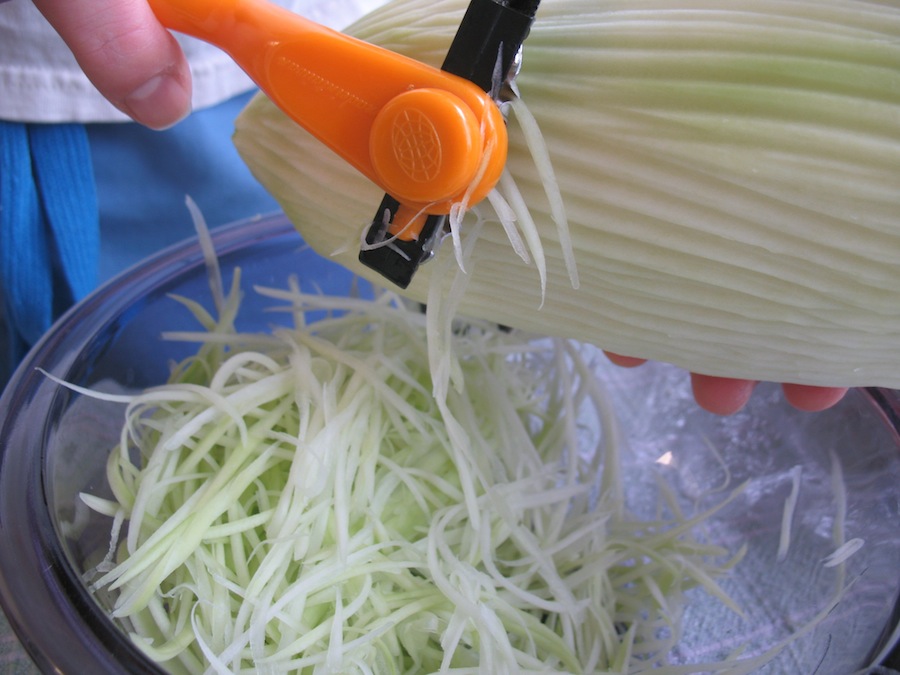
I use a shredder like this

IMG_2493

scrape the surface to make long strands


Key ingredients to a papaya salad include fresh garlic cloves, fresh Thai bird’s eye chiles,  tomatoes, lime, sugar, and fish sauce.  Crushed peanuts and dried shrimp are common ingredients to the Central Thai version, as is occasional use of tamarind water. In Laos and Isaan, fermented fish is often used, as is fermented field crabs and or fermented crayfish.

IMG_2497

the salad needs to be pounded in a mortar and pestle, or khrok in Thai.  This kind is wood and clay, is made specifically for this salad. For the salad, first garlic and chile, then green beans (if using), tomato, and sugar, fish sauce and any other seasoning. Pound those after each addition.  Finally shredded papaya goes in.  Pound to get the flavor into the papaya.

IMG_2503

IMG_2506

Part of your complete breakfast. Clockwise from left to right: sticky rice, pork rinds, somtam, Cambodian prahok ti, chorizo, sour pork sausages, fresh ginger slices and grilled tomatoes.  Off camera: lettuce.

Posted in - Featured Food Discoveries, - Recipes, Thai/Lao food | Tagged , , , , , , | 8 Comments

Ivy gourd leaves and a simple clear soup

pak tamleung found!

pak tamleung found!

In Southeast Asian cooking traditions of Thailand, Cambodia, and Laos, a wide variety of leaves, vines, and flowers are used for cooking that are little known for culinary purposes elsewhere.  Ivy gourd leaves are one such delicious variety of edible leaves that we can find here in Philly.  Lately I’ve been studying our local offerings, collecting images and experimenting with many flavors.

In the coming new year, I will add a new feature to this blog, an identification guide for Asian greens.  So far I’ve found ivy gourd vines at markets in North and South Philly.

This vegetable is known by many names.  In English it might be called Scarlet gourd or tindora (here is a nice introduction to this vine and gourd at Green Deane’s Eat the Weeds).  At Cambodian markets it is labeled with latinized Khmer name, sluck bah tammin, also known in khmer as sleuk bas បាស. In Laos it goes by a similar name, pak tammim ຜັກຕຳນີນ and in Thai it is known as pak tamleung ผักตำลึง.

This vegetable can be cooked very gently, and for soups it would be added at the very end of cooking.  Some cooks prefer to simply fill a bowl with leaves before pouring hot soup over the top.

If you have access to very fresh, young vines and leaves, you can add vine stems into the soup as well.  This batch that I got is a little older, and some of the vines are tough.  I chose to only use the leaves for our “bland soup” gaeng jeud แกงจืด.

If you spot some vines in a box at the market, this might be it.  Look at the leaves.  The shape should be something like a small fat maple leaf, and sometimes the leaves look more heart-shaped.  here are a few leaf samples:

IMG_2466 IMG_2469

Recipe: “Bland soup” with ivy gourd leaves Gaeng jeud tamleung แกงจืดตำลึง

The genre of “bland soups” in Thai cooking are generally simple clear meat broths with minimal accompaniment.  Recipe ingredients vary widely depending on what is available.  Frequent ingredients include ground pork, egg tofu, cellophane noodles, ground white pepper (prik Thai พริกไทย), fried garlic, green onion, and cilantro.  Many recipes can be found online for this soup.  Here are two good ones, Rachel Cooks Thai, and here’s another nice step by step from “Pim’s kitchen” (in Thai) ครัวบ้านพิม.

Tonight's "bland soup" with ground pork and ivy gourd leaves

Tonight’s “bland soup” with ground pork and ivy gourd leaves

This soup is very simple, it is hard to screw up.

1. Boil some water or stock in a pot.

2. Mix ground pork in a bowl with crushed garlic, with some crushed cilantro root and ground white pepper, fish sauce, and any other seasonings. Form into balls. Plop them into the soup pot. Skim any fatty foam off the top to keep the broth clear.

3. Boil meat balls and or any other ingredients except ivy leaves. Taste broth for flavoring.  It should be a simple meat stock. Flavor with fish sauce or salt and sugar. Today we used sliced carrots and pre-soaked cellophane (mung bean) noodles.  When ingredients are cooked through (i.e. tofu, carrots, noodles), you are good to go.

4. Add or combine ivy leaves and cilantro and green onion if using. Top off with fried garlic and ground white pepper.

Posted in - Featured Food Discoveries, - Recipes, Thai/Lao food | Tagged , , , , , , , , , , | 1 Comment

Yibin yacai in Sichuan-style stir fry dishes

IMG_2391

Sichuan Yibin yacai, found in whole form at Philly Chinatown underground market

I was pleased to find the full-sized Sichuan preserved vegetable yacai 芽菜 recently at the underground market in Philadelphia’s Chinatown (Asia Supermarket 亞洲超級市場).  Yacai has long been available in US Asian markets, but I was only aware of the pre-chopped variety, labeled as such, “suimi yacai” 碎米芽菜, usually sold alongside other small packets of specialty pickled vegetables.  Most of the yacai that I’ve noticed in the States–the box above and also the pre-chopped small packets (image available on Fuchsia Dunlop’s blog from a few years ago), are produce of Sichuan’s Yibin city.

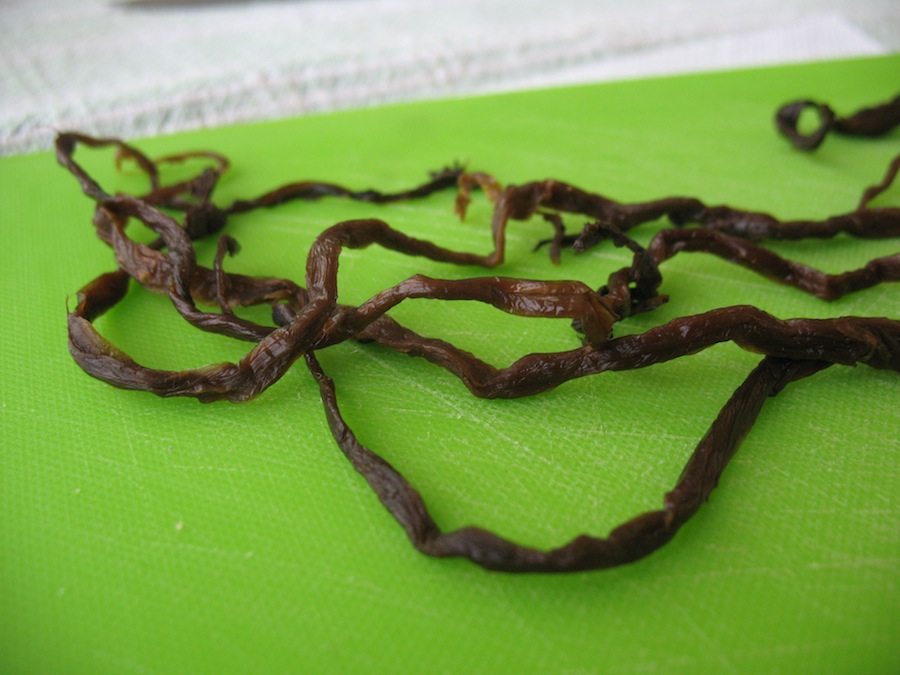
A few sprouts of yacai, soon to be included in a bowl of dandan mian 担担面

A few strings of yacai, soon to be included in a bowl of dandan mian 担担面

What is this fibrous alien-looking vegetable, and why should I eat it?  It is a cruncy, sweet, salty, and fragrant pickle.  It is supposed to be high in B vitamins, and it is a nice accompaniment to rice porridge.  It is also delicious fried with chile and ground meats as exemplified below.

The vegetable is actually a kind of young and tender Chinese mustard green (芥菜 gai choy in Cantonese, or jiecai in Mandarin–something similar to what I used in my recent sour pork rib soup), cut into chopstick-sized thicknesses, and sun dried. Later the vegetable is pressed and cured in earthenware for a year or so with salt and spices (sometimes huajiao and star anise).

IMG_2407

Chopped yacai to be used in ganbian siji dou

I was happy to find the whole pickled vegetable, but the small packets are just as usable.  Most recipes call for the veg to be chopped anyway.  If you are using the full-size vegetable like I have above, feel around for hard or tough stems that you might not want in your dish and cut these out.

Dandan mian 担担面

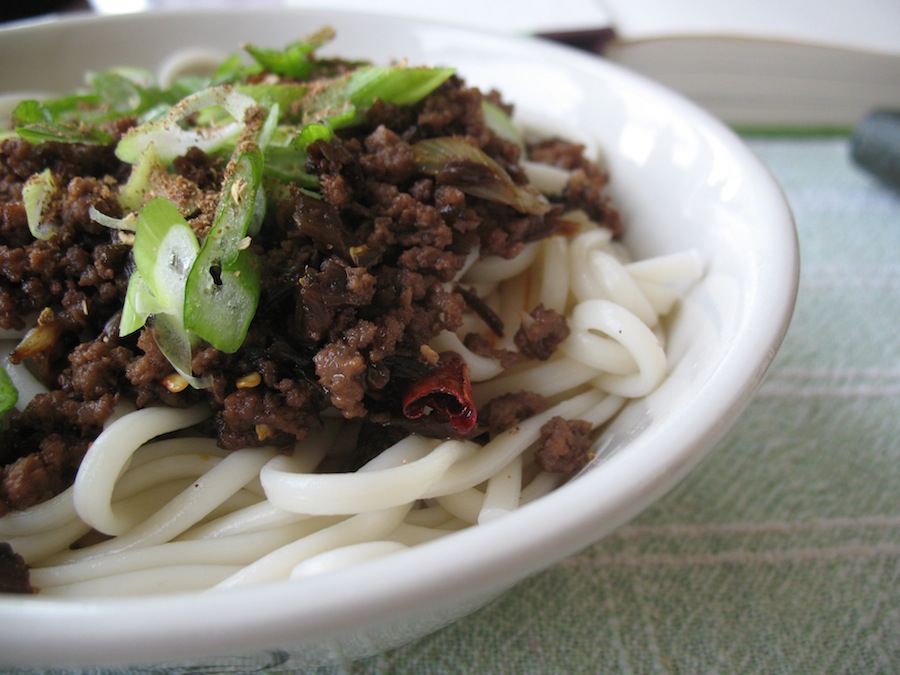
I often have a craving for dandan mian, and I usually prepare it based on what’s in the pantry.  Some restaurants prepare this with a thick sesame (or peanut butter)-based sauce.  I prefer it with chile oil and a little black rice vinegar (i.e. not so thick and saucy).  Here is a quick version I made for lunch today, with ground beef, green onions, dried chiles, and a dusting of ground huajiao and green onions:

IMG_2438

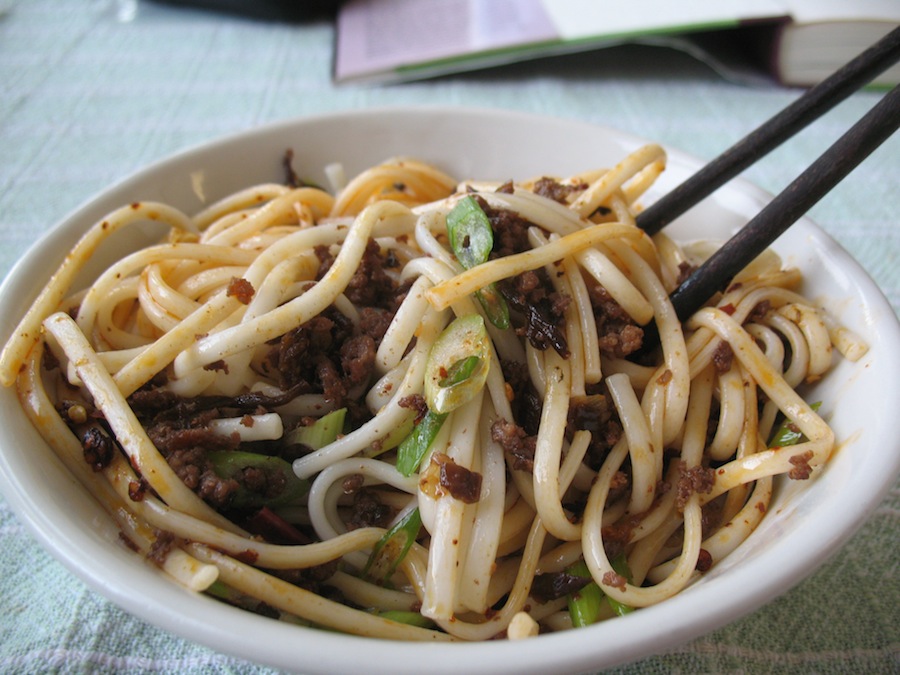
Mixing and eating my dandan mian

Mixing and eating my dandan mian

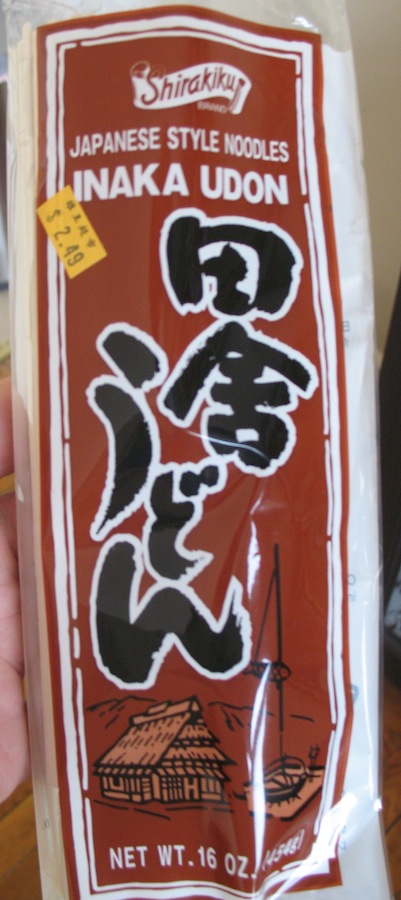
The cooking process is very simple.  Boil some wheat noodles (ingredients wheat flour, salt, water–they can be fresh, frozen, or dried) until cooked.  Frozen thin “Shanghai noodles” are a nice option that I find in most Asian market freezer sections.  Here are some nice dry noodles that I used today:

pantry noodles I use for dandan mian.  Shirakiku brand Inaka Udon

noodles for today’s dandan mian. Shirakiku brand Inaka Udon

IMG_2435At the same time, prepare meat topping.  This step is almost identical to using yacai in the green bean dish below.  Heat some peanut oil in a frying pan or wok and toss in a handful of yacai. If using dried chiles you can also add those.  Add in ground meat (no need to use too much, just to add a little flavor).  Splash some rice wine to help break up the meat to be small.  When the meat is just about cooked through and starting to dry,  season with soy sauce. Meat topping done.

Stage your noodles dry (without soup or noodle broth) in a bowl, add a little black vinegar and chile oil, top with meat and yacai mixture.  Slice some green onions over the top.  Yummy.

Dry fried four season beans Ganbian siji dou 干煸四季豆

The following dish’s major flavor component is done very similarly to the topping for dandan mian above.

IMG_2409This dish is generally done with long beans in China, but US fresh green beans also work well (I used green beans here).  Frying the beans long enough to get them to appear almost grilled is the trick.

1. Cut beans to 2″ lengths.

2. Fry on medium (i.e. not too hot) in a pan or wok with 3-4 tablespoons of oil (or you could deep fry them).  Remove beans that are cooking through before the others to a paper towel-covered plate or equivalent (to absorb excess oil).  Continue until all beans are cooked to the above likeness and take off heat.

3. Remove some of the oil from frying pan or wok and fry the yacai and meat topping mentioned above for dandan mian.  Before seasoning with soy sauce, return beans to the pan.  Adjust for seasoning if necessary.

Posted in - Featured Food Discoveries, - Featured Markets, - Recipes, Chinese food | Tagged , , , , , , , , , , | 2 Comments

Thai rotten bean sheets and sour spare rib soup with greens

I am back in Philly after a fulfilling two-week visit to Ulaanbaatar, Mongolia.  More posts are still to come on Ulaanbaatar/Mongolia food themes, but for now it is time to return to Philadelphia-based posts.

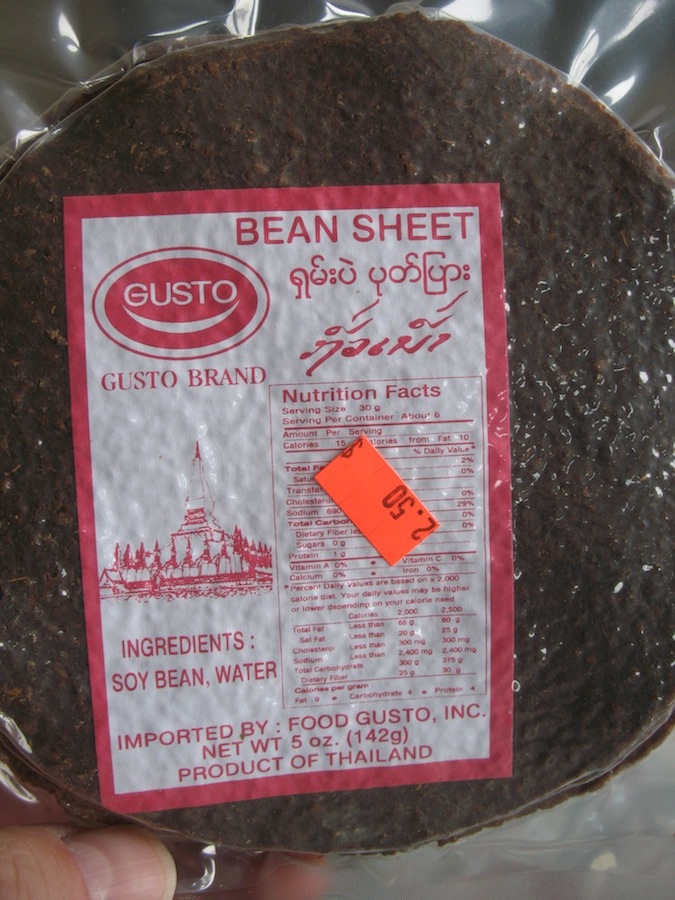
After coming back to the states, it was time to go shopping for Southeast Asian home-style ingredients. I went down to 7th street’s Friendly Market and happily found something I haven’t yet seen before in the US: “rotten bean” sheets (tua nao ถั่วเน่า/ຖັ່ວເນັ່າ) from Northern Thailand.

IMG_2327

tua nao ถั่วเน่า found! Gusto Brand from 7th St’s Friendly Market. Packaging in English, Burmese ရှမ်းပဲ ပုတ်ပြား, and Lao ຖັ່ວເນັ່າ

Like many items at Friendly Market, this item is likely primarily geared towards Burmese audience, but of course, many flavors are regional and cross-border.  Northern Laos and Northern Thailand share a love of this unique food.  This is a fermented soy bean product similar in make to the perhaps better-known Japanese natto 納豆.

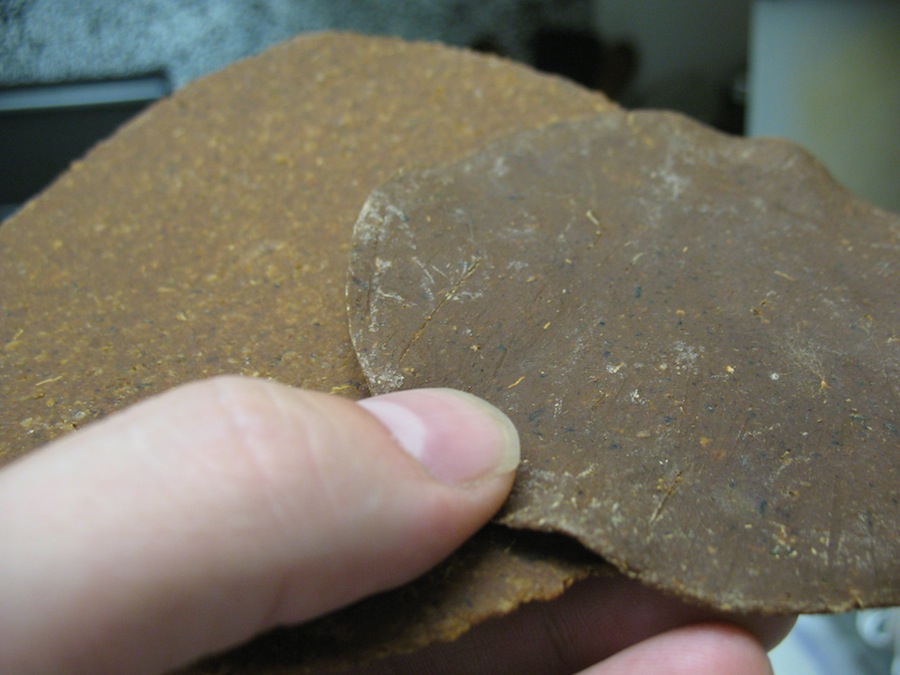
This version of tua nao is a little bigger than the kind we brought back from Northern Thailand last time we were there.  Here is an image of that package, and a size comparison between the two kinds:

IMG_2381IMG_2384

You can see that the size, color, and consistency is a little bit different.

Thaifoodmaster blog has a nice introduction to this ingredient.  Check out that post here.

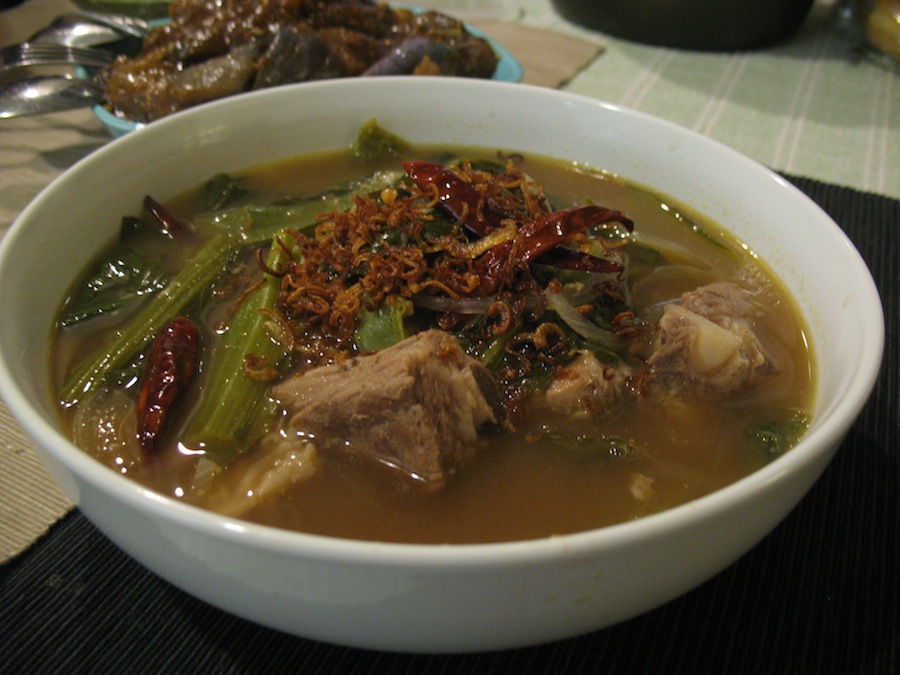
What kinds of things can you make with this?  So far, my repertoire is limited with this, but I know how to make a delicious soup with it.  The soup is a favorite in Northern Thailand, and it is called jau phakgaad จอผักกาด “boiled greens”.

IMG_2378

jau phakgaad จอผักกาด, Northern Thai comfort food.

Andy Ricker’s recent Pok Pok cookbook has a good version of this recipe, called “Jaw Phak Kat” (by the way that whole book is excellent), although he assumes this tua nao ingredient unavailable in the US and suggests replacing it with Thai yellow bean sauce (see here for a blog post on that item from shesimmers.  You can also find this recipe online from Thai sources.  This is a nice step-by-step from Chiang Mai University.

Recipe: Jau phakgaad จอผักกาด “boiled greens”

This soup is straightforward enough.  The only hard part is preparing the ingredients.  The soup paste should be pounded first, and then the bean sheets need to be toasted and pounded.  Otherwise it’s a simple boil.

Ingredients:

  • About 12 Thai dried chiles (6 for the paste and 6 for the end)
  • About 8 cloves of garlic
  • About 8 Asian shallots (of those 3 shallots for the crispy topping)
  • 1 T kapi (Thai fermented shrimp paste)
  • 2 lbs pork spare ribs, cut into individual ribs
  • 3/4 cup tamarind water
  • 1 sheet tua nao
  • 1 lb green leafy veg, usually Cantonese-style yu choy 油菜 is used, I used a gai choy 芥菜 more bitter mustard green
  • 1/4 thinly-sliced yellow onion
  • water
  • salt
  • fish sauce

Procedure:

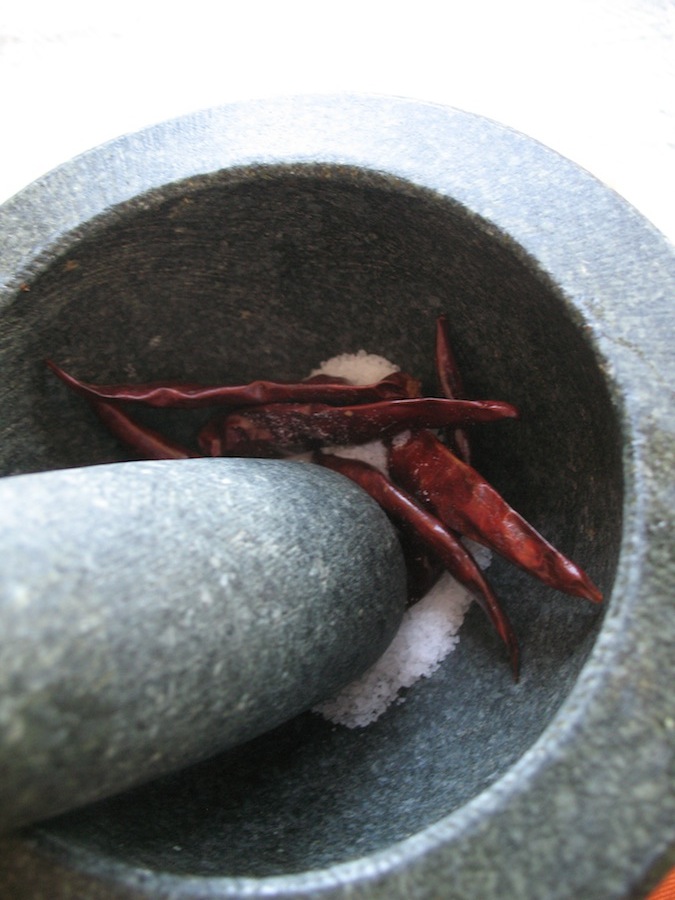
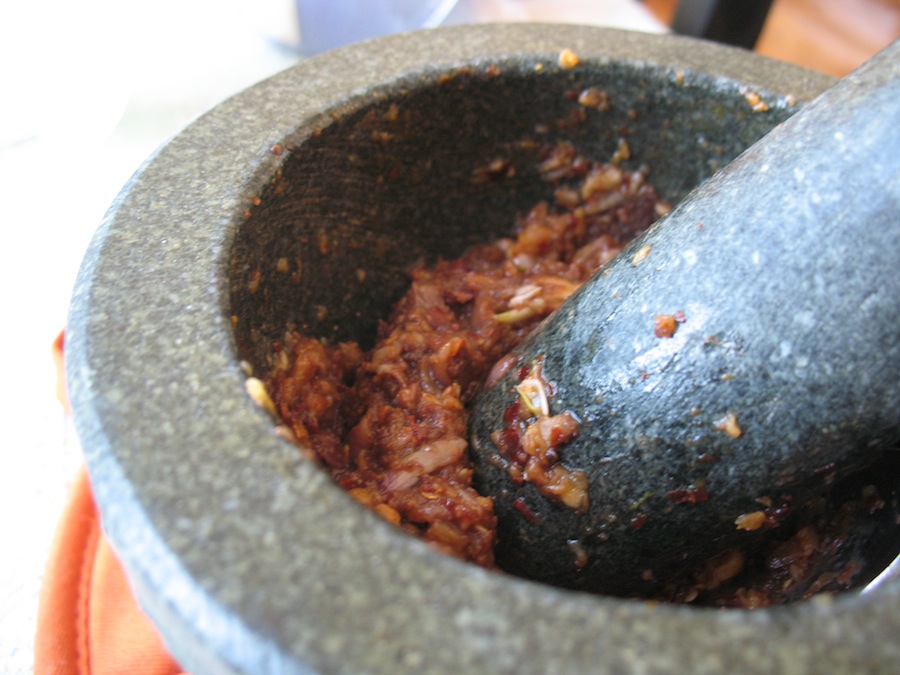
1. Mash the paste, peppers, about 1 T salt, garlic, shallots, kapi.

IMG_2329

1. starting the paste with salt and peppers

5 shallots are going in the mix too, along with these ingredients

five shallots are going in the mix too, along with these: garlic and kapi paste

3. Looking good.

finishing the paste. Looking good.

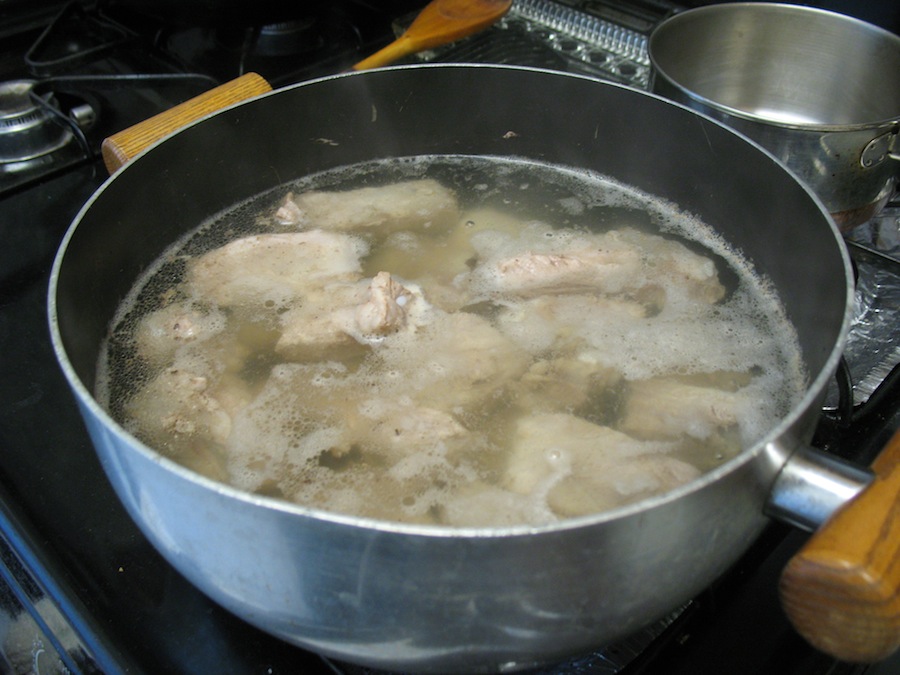
2. Cover spare ribs with water and bring to boil.  Skim the scum off and reduce to low heat.  Add paste.  Simmer for about 40 minutes, or until meat is tender.  Taste for saltiness, should be salty–add salt if it is not.

IMG_2349

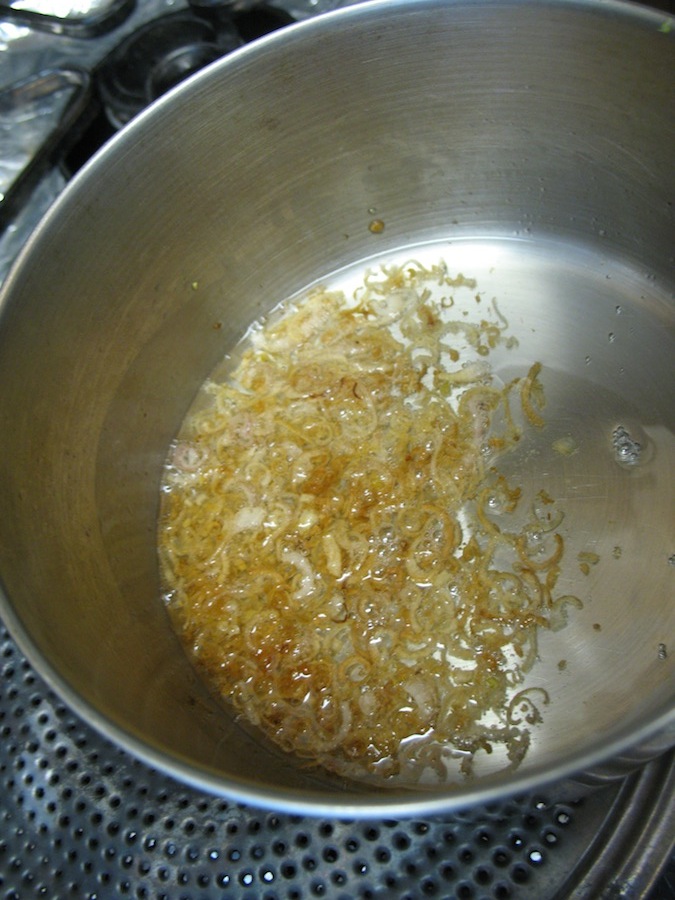
3. While ribs are simmering prepare fried crunchy shallots for topping.  Take the remaining shallots and slice them as thinly as possible. Heat about 4 T of vegetable oil in a small pot. This is not a simple fry on high flame. Care must be used to fry these on very low heat over about 15 minutes.  The result should be golden, dry, crispy shallots. My solution to not burning them was to use a heat diffuser under my pot on low heat. When the shallots are golden, strain them and lay on a paper towel.  Set aside.

IMG_2356

About 12 minutes in and almost there.

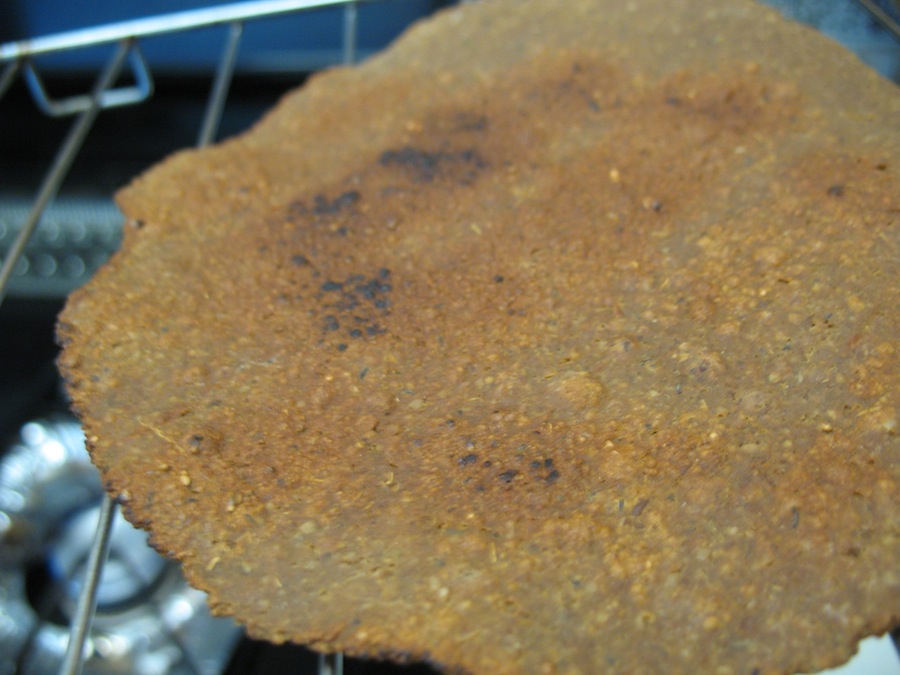
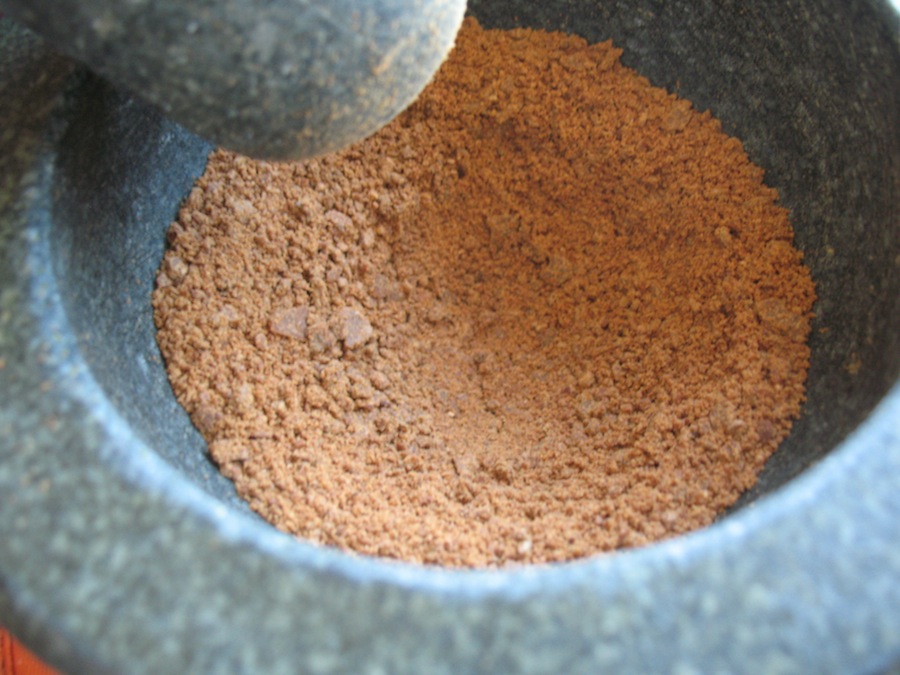
4. lightly toast bean sheets over a flame (ideally wood fire coal).  The color will change a little.  Break up the sheet and pound to a powder.  Bring heat back up and add this into the soup.

IMG_2365

A little uneven toasting on my part

IMG_2368

ground tua nao, ready to put in the soup.

5. Prepare tamarind water, chop vegetables into 2″ lengths and wash, cut onion.

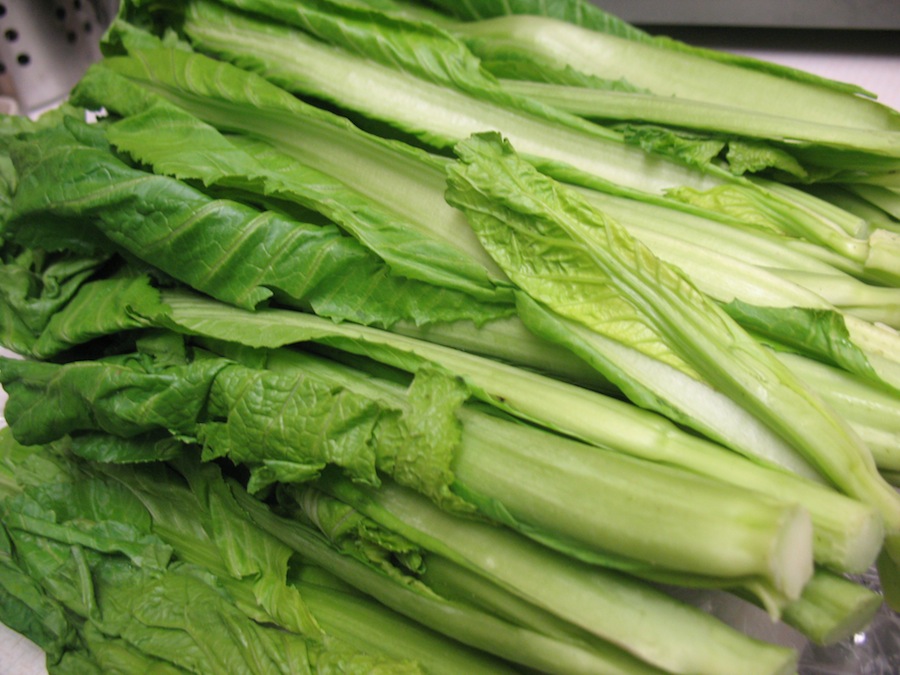
my gai choy, ready for washing and chopping

my gai choy, ready for washing and chopping

6.  Add in the vegetables and onions, along with the strained tamarind water.  Add in remaining whole chiles.

7.  Bring heat back down and simmer for 10 minutes or until the veg is just cooked.  Taste for seasoning.  If not enough flavor-saltiness, add fish sauce.

8.  Take off heat and top with crunchy fried shallots.

Eat together with steamed white rice or sticky rice.

IMG_2378

Posted in - Featured Food Discoveries, - Featured Markets, - Recipes, Thai/Lao food | Tagged , , , , , , , , , , , , , | 8 Comments

Ulaanbaatar post #2: Korean UB

In last week’s post I mentioned that Korean staple food items could be found not only at Ulaanbaatar’s specialty “Asian Markets”, but also at “regular” grocery stores all around the city.  That was probably an understatement. Items such as kimchi, gochujang, seaweed wraps, kimbab, tofu, nongshim instant noodles, are virtually everywhere.  In fact, the Korean presence and influence in Ulaanbaatar can be seen far beyond simple items in the grocery store. To those new to Ulaanbaatar, this heavy Korea influence may come as a surprise.

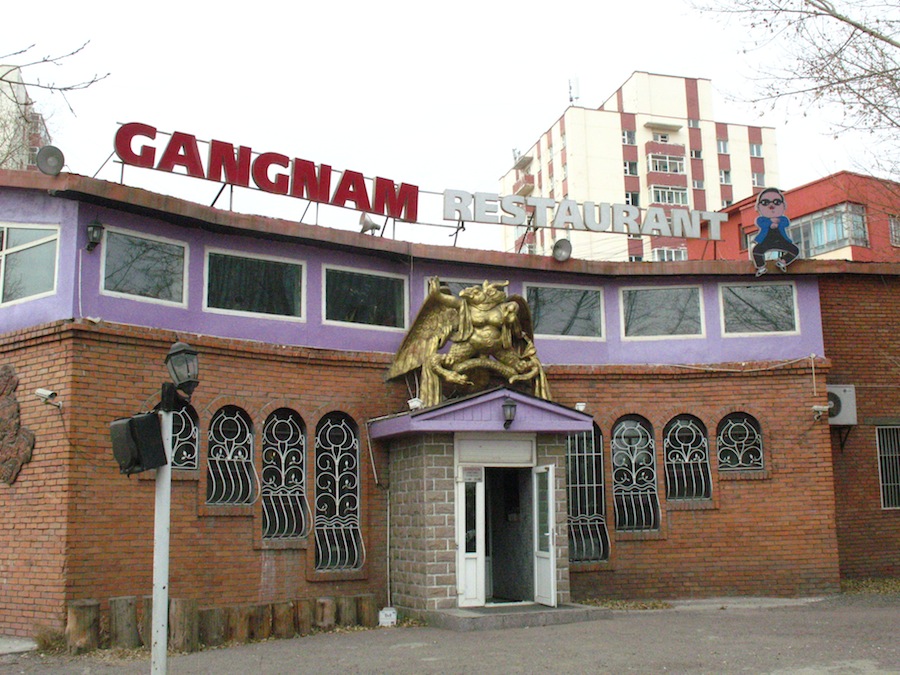
Gangnam restaurant

Gangnam Restaurant, just south of Dund Gol River, so it is aptly named.  Just off Chinggis Ave, south of Peace Bridge.  Notice Psi, together with Ulaanbaatar’s city protector, the Khangarid (Хангарьд) or garuda above the door.

One of the first things newcomers to UB will notice is the popular street of restaurants and clubs just off of Sukhbaatar Square–I mean Chinggis Khan Square of course–Seoul Street.  Seoul Street (Сөүлийн гудамж) took the place of Natsagdorj Street, and was established at a time when important investors (and sister-cities?) in Mongolia’s capital were given naming rights.  Besides Seoul Street you can also find similar investments in UB with Ankara Street, Beijing Street, Tokyo Street, etc. You can find a nice image of the entrance to Seoul Street here.

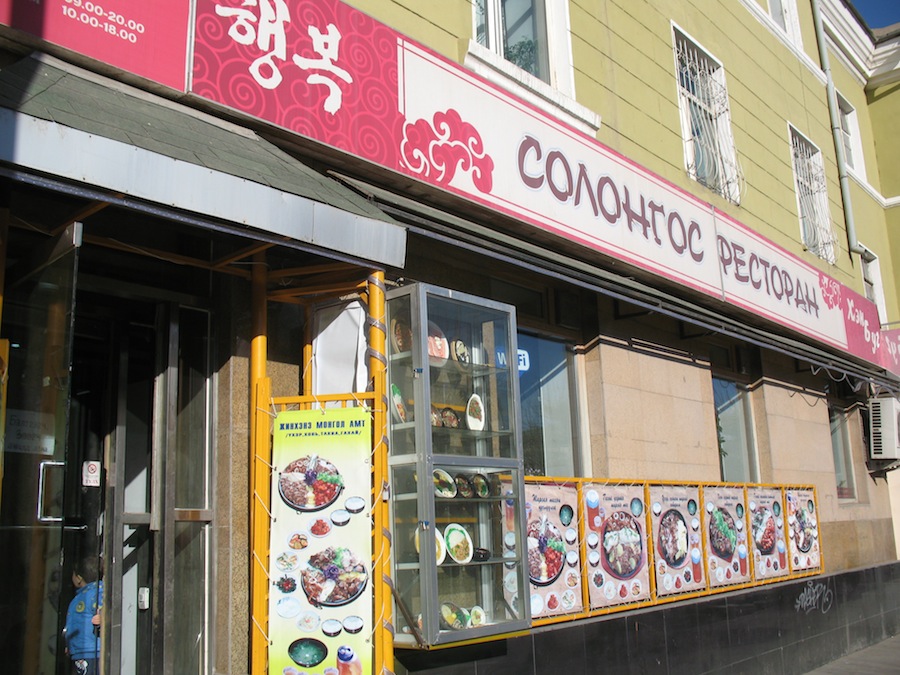
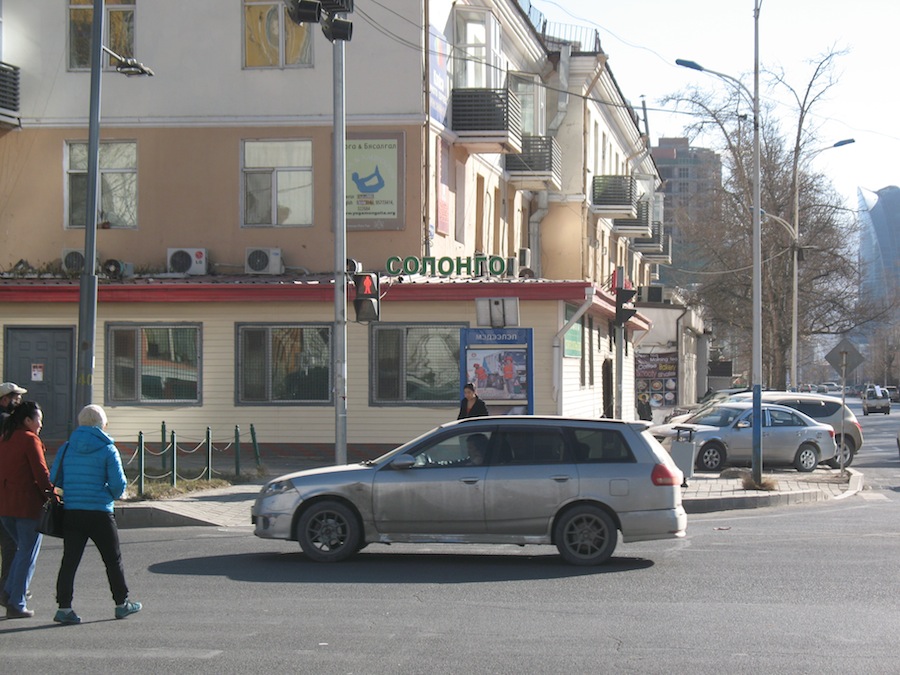
Even more, after you learn the Cyrillic alphabet and start reading signs you realize that practically every other shop or restaurant is Korea-themed.  For reasons that remain unclear and arguable, the name for Korea in Mongolian is “Solongos” (Солонгос).  Some say this is due to the rainbow-colored sleeves of ancient Korean soldiers, some say the name to be a corruption of the Manchu or Jurchen rendition of the capital of Silla.  Regardless, the word is abundant in signage throughout UB.

Solongos Restaurant. This one actually has a title in Hanggul too, which is rare in UB. Generally signage is in Mongolian and/or English only.

Solongos restoran. This one actually has a title “happiness” in Hangul too, which is rare in UB. Generally signage is in Mongolian and/or English only.

The reasons behind the heavy Korean influence in UB are numerous.  One is the early investment put into Mongolia from Korea in the 90s.  Another is the large Mongolian population in Korea (largest diaspora population of Mongols anywhere in the world). Surely yet another reason for the demand for all things Korean is South Korea’s popular media: TV Dramas (of course there are Korean channels, even on over-the-air TV), music, movies.

I took some long walks around the city and snapped several photo examples of Korean shops and restaurants.  Here are a few:

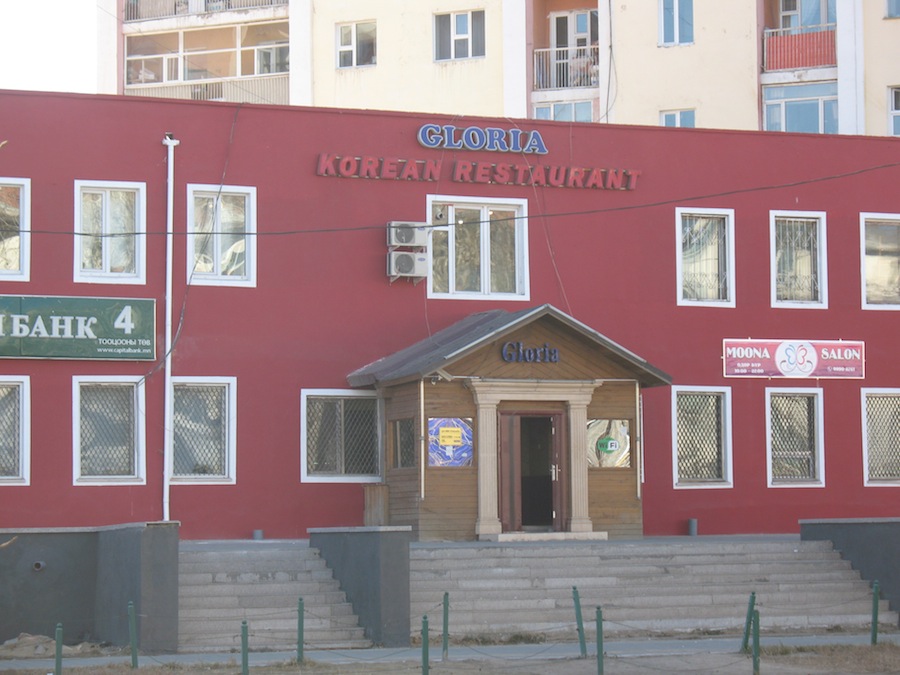
Gloria

Gloria Korean Restaurant, Inner Ring Road

IMG_2231

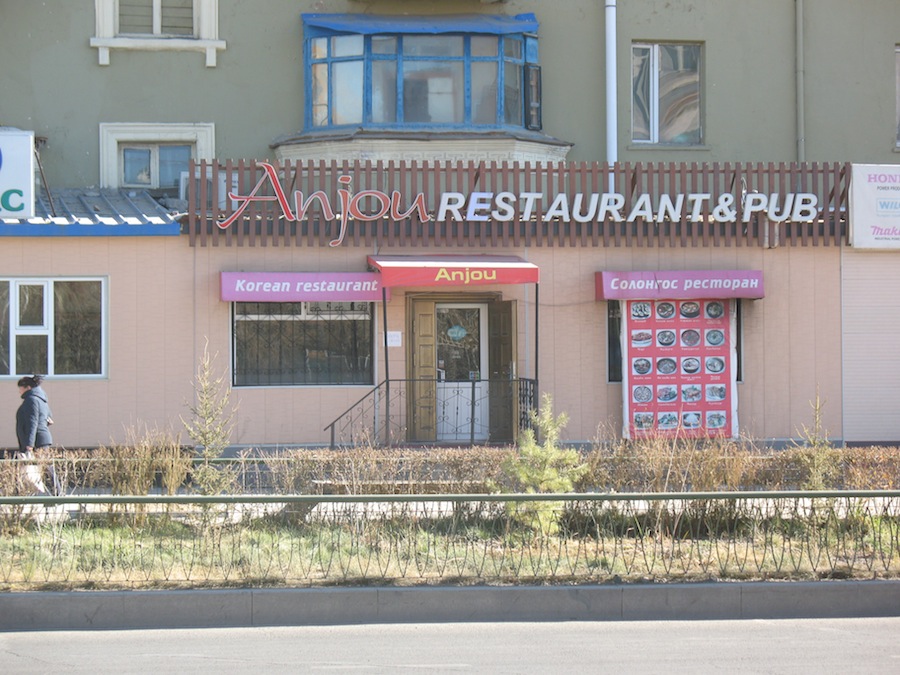
Anjou Restaurant & Pub, Inner Ring Road

Solongo Restoran

Solongo Restoran

IMG_2232

Seoul kalbi.3, Inner Ring Road

IMG_2239

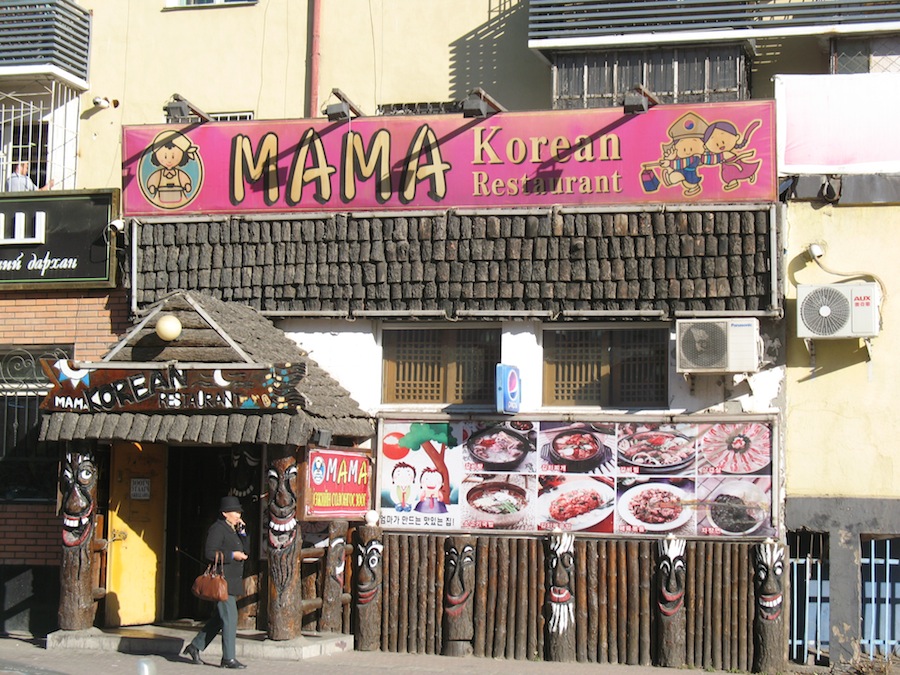
Mama Korean Restaurant near State Department Store

IMG_2259

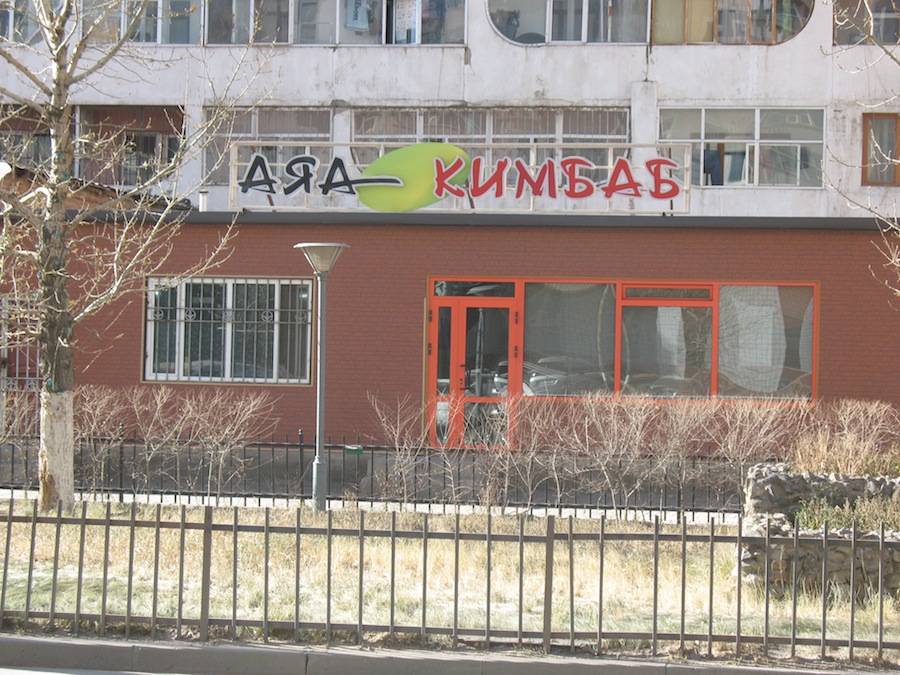
Ayaa Kimbab, near UB train station

IMG_2241

Chejudo (Cheju Island) Dinner House. Near State Department Store

Caffe Bene, a Korean coffee shop chain, also has a presence in Ulaanbaatar, on the ground floor of the State Department Store.

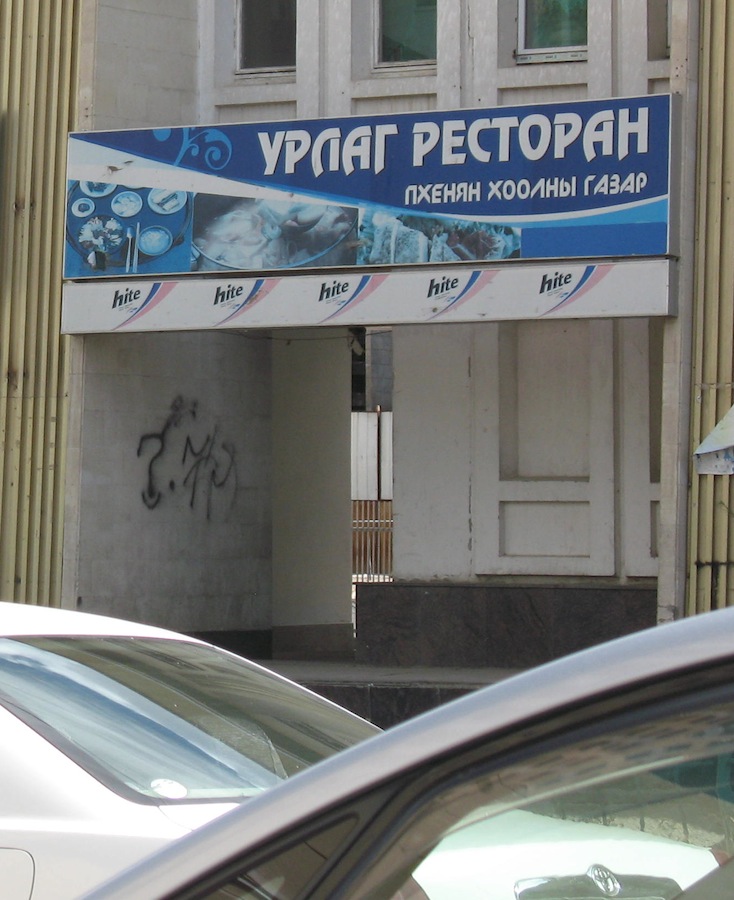
Another observation: “Solongos” refers to both South and North Korea.  There is a North Korean embassy in Ulaanbaatar, as well as North Korean restaurants such as Pyongyang and Urlag Restoran.

Outside the North Korean embassy

Outside the North Korean embassy

Urlag Restoran

Urlag Restoran, Pyongyang Dinner House, with [South Korean] Hite beer signs underneath

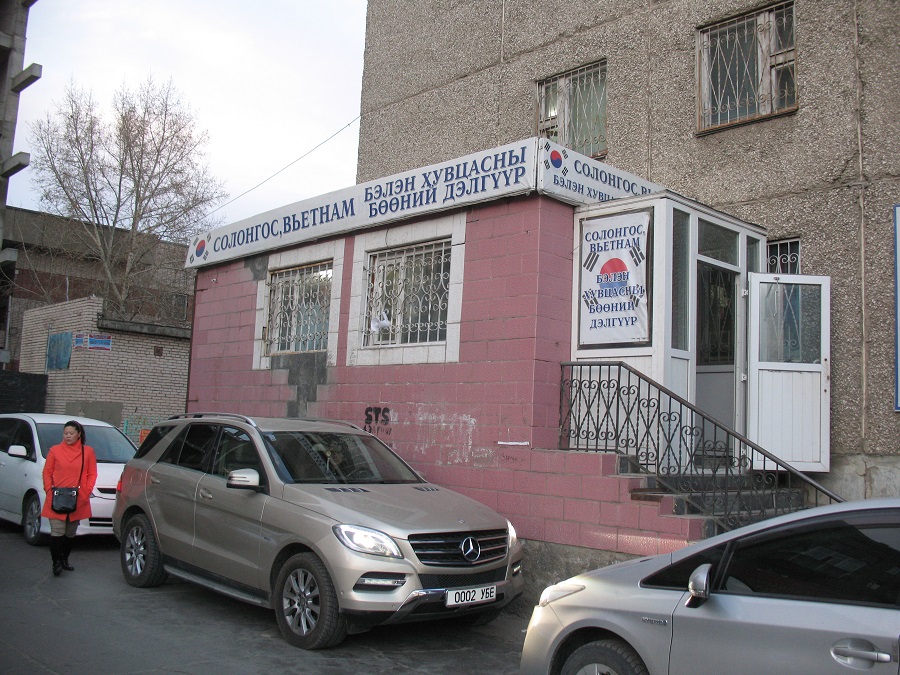
Here is another interesting find throughout the City: Korean and Vietnamese (?) Fashion outlets:

IMG_2176

Korean, Vietnamese Fashion Outlet. Near Mercury Market.

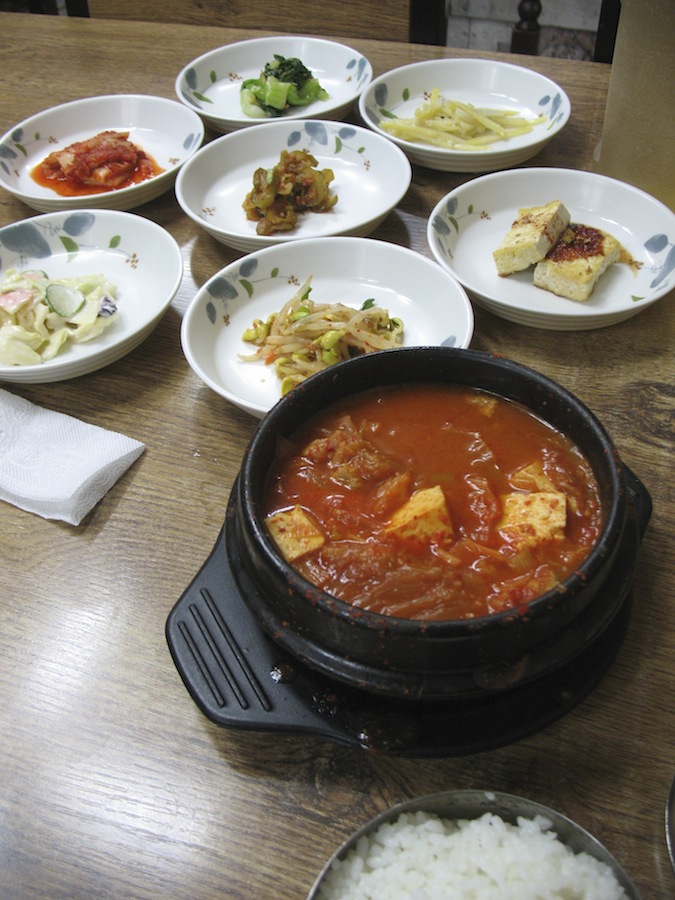
Weather in November in UB is getting cold.  It is very nice to have options such as kimchi jjigae 김치찌개 along with a table full of banchan 반찬.  This photo is from a small upstairs place off of Seoul Street:

IMG_2124

The above was a cheap, hot, and fulfilling meal.  The tofu was a little tough, the meat in the soup was gamey, and the cucumber kimchi (center banchan) tasted a bit like yak butter.  Good though.

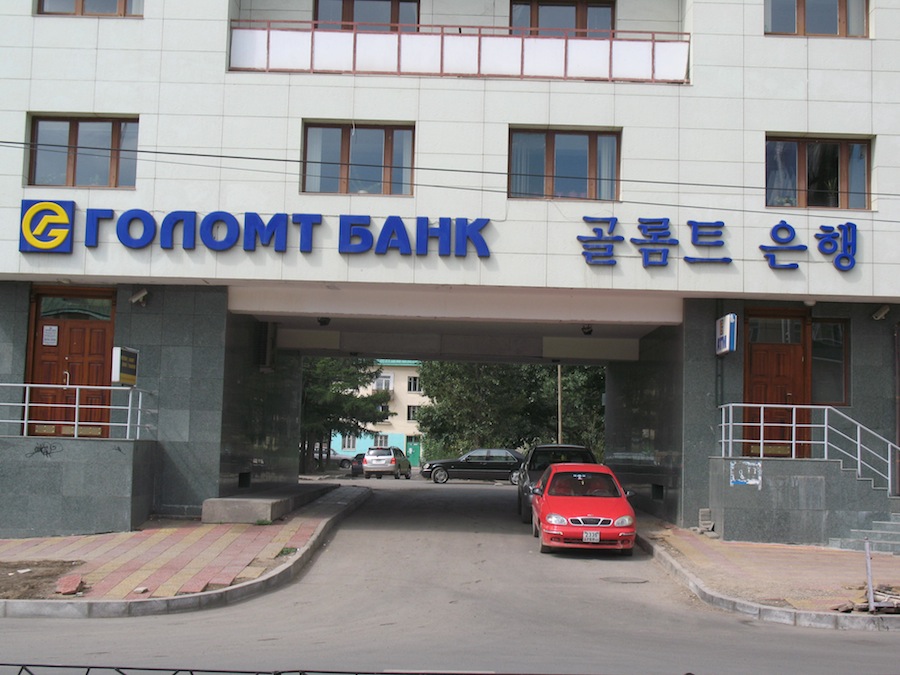
Here are some more images of other Korean (or Korean-friendly) establishments.  Most “Korean shop” or “Korean Mart” places generally sell household appliances.

Korea-friendly Golomt Bank

Korea-friendly Golomt Bank

IMG_2270

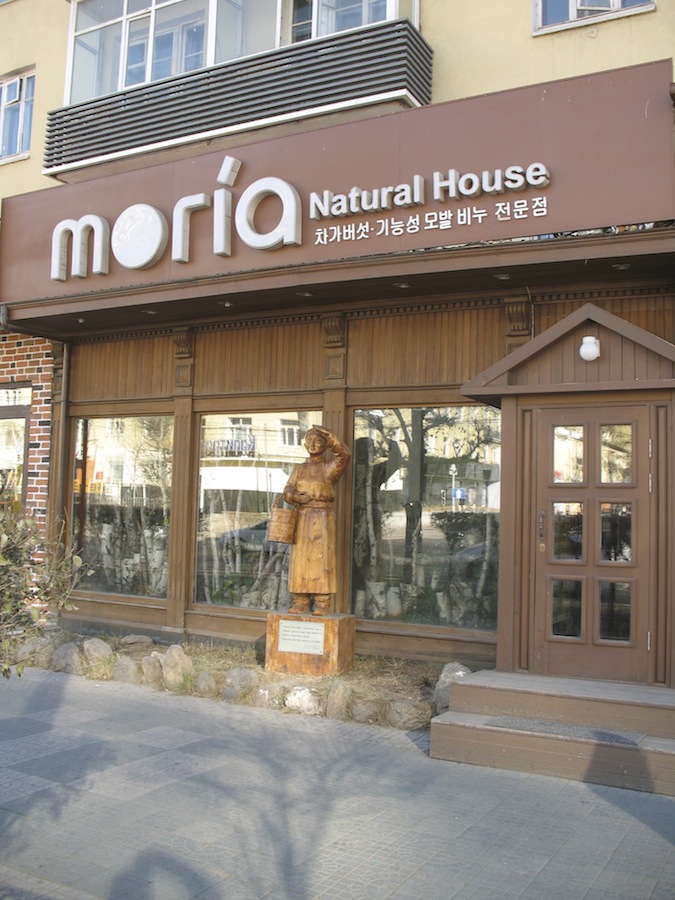
Maria Natural House, Peace Ave

IMG_2264

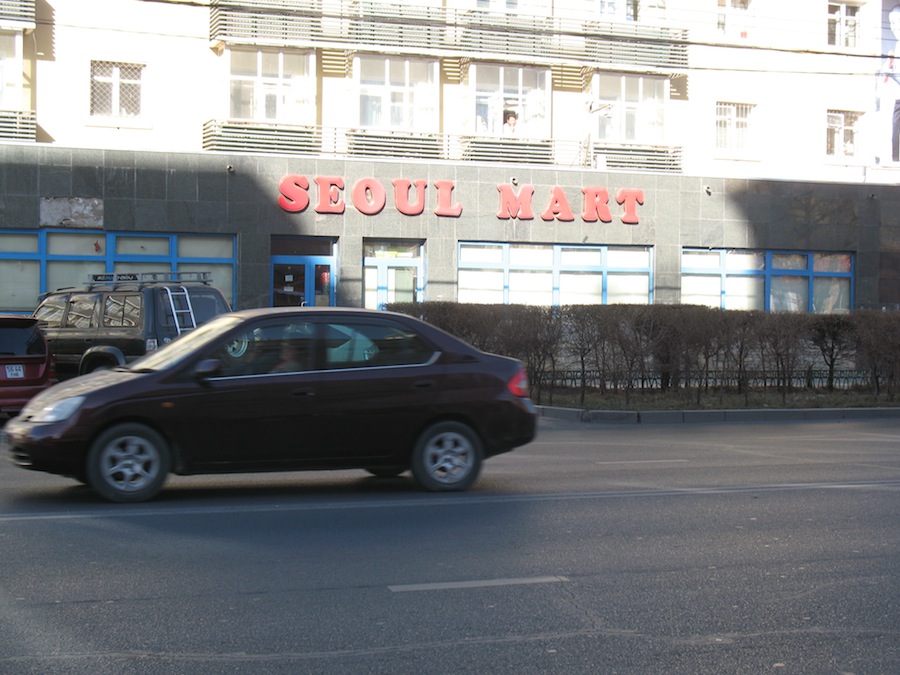
Seoul Mart, Peace Ave

IMG_2212

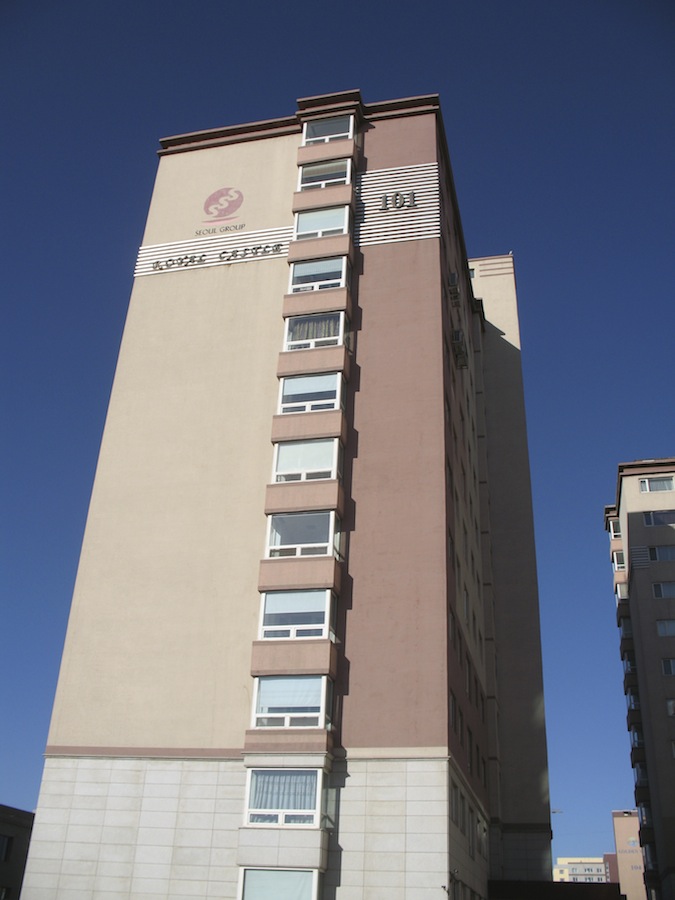
Seoul Group Royal Castle, Beijing St.

IMG_2211

Seoul Business Center, Beijing St

IMG_2135

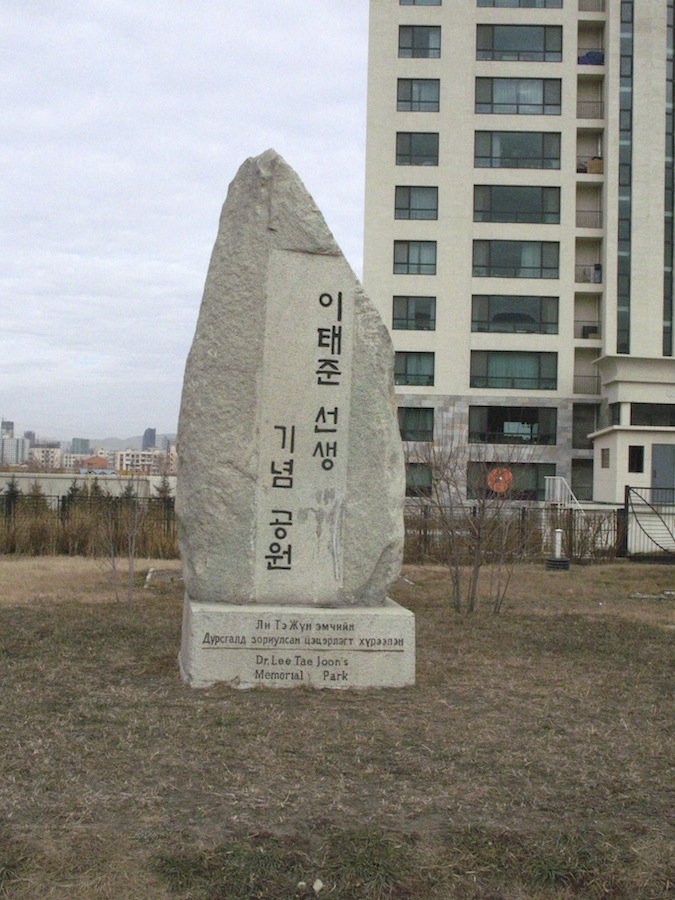
Monument to Dr. Lee Tae Joon, near Mount Zaisen

CAM00139

Hangug Mart, near wrestling palace

Posted in - Featured Food Discoveries, - Guides, Korean food, Mongolian food | Tagged , , , , , , , , , , , , , | 2 Comments

Asian Markets of Ulaanbaatar

Greetings from the land of the great blue sky! Over the next few weeks I’ll have a series of posts from here in Mongolia’s capital city of Ulaanbaatar, and its environs. Food shopping here is very interesting, and in recent years markets have drastically expanded offerings, to the point where most basic needs are covered for diverse tastes. Restaurant offerings are also growing in variety.  To put it bluntly, there is a lot of great food to be had.

At home in Philly I get a thrill out of locating obscure Asian food items.  That thrill is taken to a new level in a place like Mongolia, where even fresh vegetables can be scarce.  The title of this post may seem a bit odd to some, as Mongolia is indeed in Asia. After you read the post below, you’ll see why that is not such a crazy theme for the post. I’ll be highlighting some relatively recent imports to Mongolia from China, Japan, Korea, and beyond.

Mercury Market (Меркури худалдааны төв)

The single most fascinating place for food items (that I’ve found so far anyway) is Mercury Market, not far from the circus building.  This is a bazaar of sorts, with kiosks and shops tucked away in the building’s rooms.  The location of this market is within a mash-up of buildings, together with a decent-sized Miniy Market chain grocery store as well as the Passage Market collection of clothing shops.

The fascinating Mercury Market

The fascinating Mercury Market

IMG_2173

Mountains of non-perishables, preserves, European-style cheeses, and sausages

The first half of the building consists of cheese, bread, fruit, canned goods sellers.  Canned goods are largely coming from Russia and adjacent countries.  European-style cheeses and sausages are also in abundance.  There is also flat bread that resembles Uzbek non.  Among the notable fruits, I found long Hami melons.  We’ve been eating the cheeses with breakfasts in the morning and they are quite good.

As you wander through this bazaar, three rooms can be found off to the left that have many specialty items from China, Japan, Korea, and Thailand.  Items such as Thai fish sauce, Sriracha sauce, Korean gochujang, and a wide variety of seasoning/soy sauces from these countries can be found in these shops:

IMG_2169

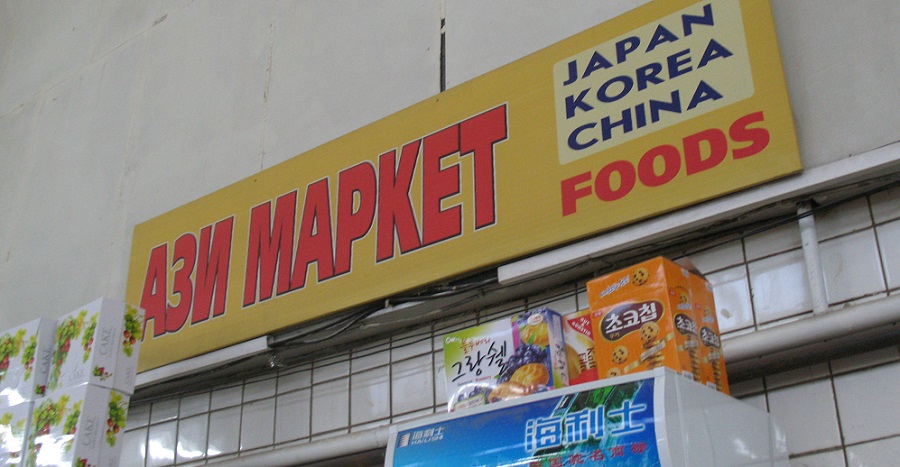
“Asia Market”, one of the several small rooms inside Mercury Market that have specialty items mostly from Korea and Japan.

Note the use of the term above “Asia Market”.  See, I wasn’t so far off here.  Does this imply that Mongolian food items are “normal”, and Asian food is something else?

IMG_2170

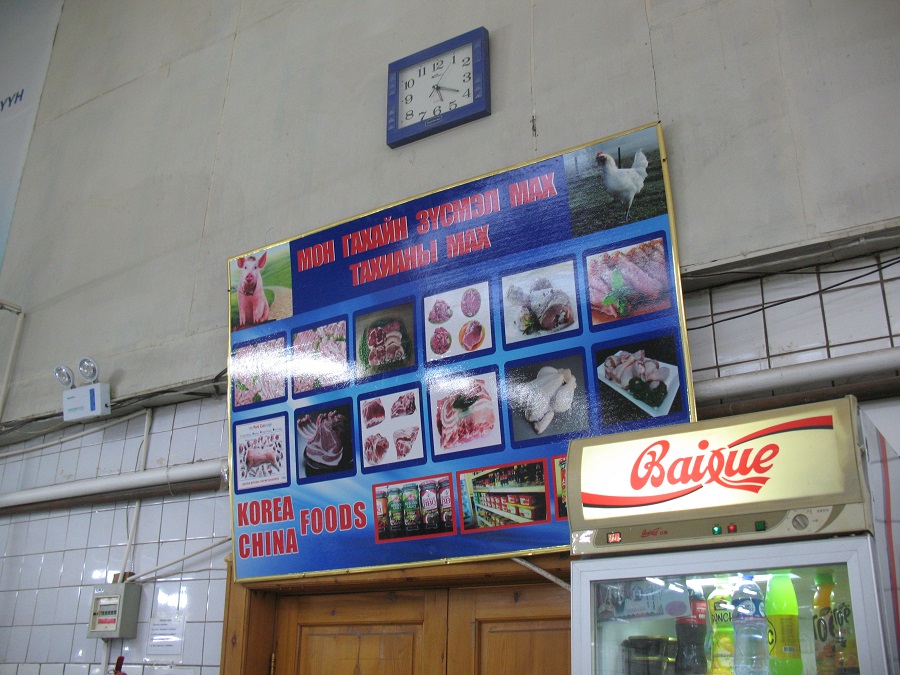
Another room in the market, “Korea China Foods”

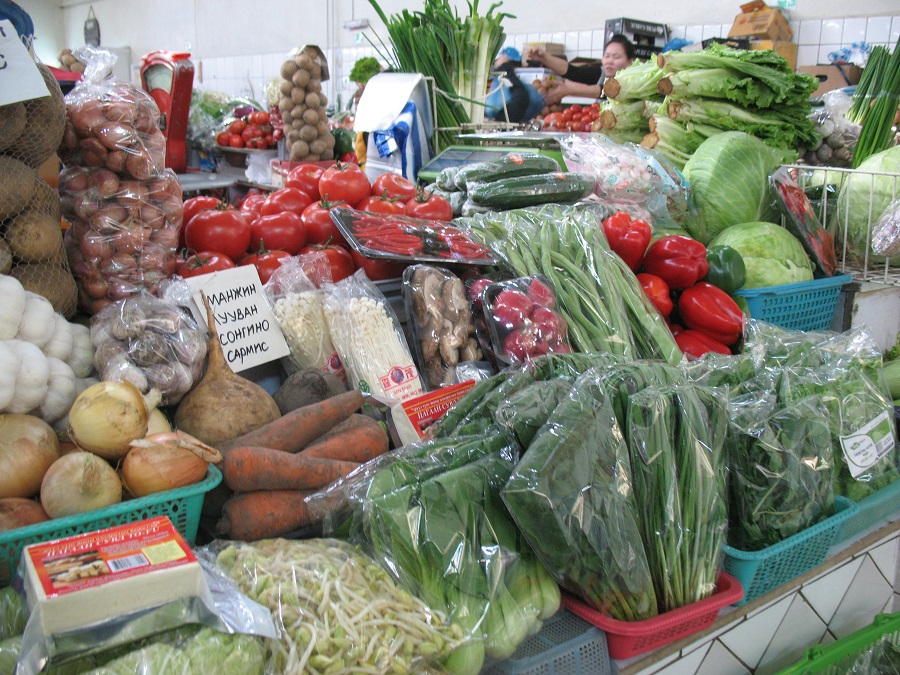
If you go through one of the corner doors, you end up in the fresh produce and meat section.  I was quite surprised with the produce available.  Of note: cilantro, shanghai choi, mint, basil, dill, garlic chives, leeks, cabbages, lettuces, chile peppers, spinach, soybean sprouts, long beans, tofu.

Some of the many vegetables available at Mercury Market

Some of the many vegetables available at Mercury Market

Through to the fresh veg and meat section... much bigger green vegetable selection since my last visit

Through to the fresh veg and meat section… much bigger green vegetable selection since my last visit

On the left of the picture above, you can see a kimchi counter where a variety of kimchi are for sale in bulk.  On the other side of the produce market there is another couple of Asian Market shops, selling mostly non-perishables and dried noodles.

IMG_2171

Mercury Market’s meat section and the “Chinese food warehouse” inside Mercury Market. Korean and Chinese items.

Out in the parking lot of Mercury Market, there is a Kyrgyz fruit seller.  Kyrgyzstan seems to be one of the well-known fruit exporters for Mongolia, as I’ve started to notice kiosks selling “Russian” and “Kyrgyz” fruit around UB:

IMG_2175

Zhong guo shi pin dian (Хятад хүнсний дэлгүүр)

Just in between Mercury Market and the huge circus building you can find the “Chinese food store”.  This is the best selection that I’ve seen so far for Chinese products.  All spices for stews and meat braising can be found here, along with Sichuan chiles and huajiao.  I also found Xinjiang dried figs here.

Zhong guo shi pin dian -

Zhong guo shi pin dian – “Chinese food store”

Many basic Korean food items are also available at large grocery stores throughout UB.  For example, kimchi and gochujang can be found at Miniy Market, or the Nomyn grocery store chain (i.e. on the ground floor of the State Department Store).  Korean food is among the food staples of Ulaanbaatar.  That will likely be the subject of a future post.

Posted in - Featured Food Discoveries, - Featured Markets, - Guides, Central Asia/Uyghur food, Chinese food, Mongolian food | Tagged , , , , , , , , , , , | 3 Comments

Urad dal and dal makhani

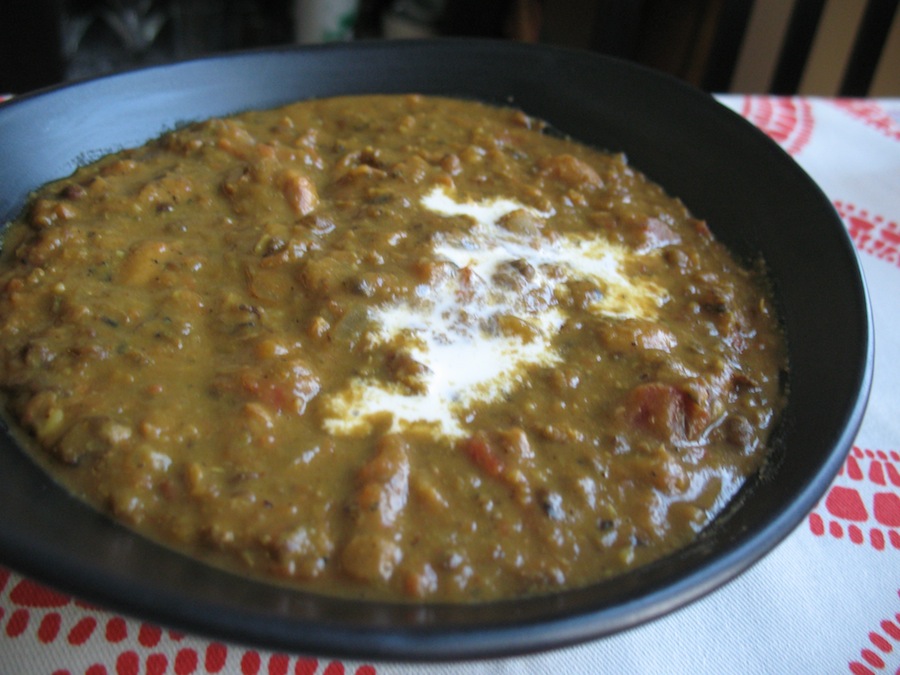
IMG_2095Dal can refer to the types of pulses from all over South Asia, and it can also refer to a soup made from those beans and lentils.  Soups with lentils or beans are economical and protein-rich, are popular all over the world.  A relatively thick style of dal from the north of India and Pakistan, is perfect over rice for a satisfying lunch.  This is dal makhani.  This is an easy dish to adapt for vegan and vegetarian tastes, but it is often made with heavy cream, and I like to make mine with cream, ghee, and if I have it, chicken stock.  It is delicious without these too, and I’ve made this enough times with various substitutes, that I find its adaptations are infinite.

This is one of those dishes that you can make mostly from things in the pantry, if you have to.  It is best with delicious fresh tomatoes, ginger, garlic and onions, but it good too with canned tomatoes and ginger powder.

If you have a pressure cooker, this is also pretty convenient to do altogether in one pot.

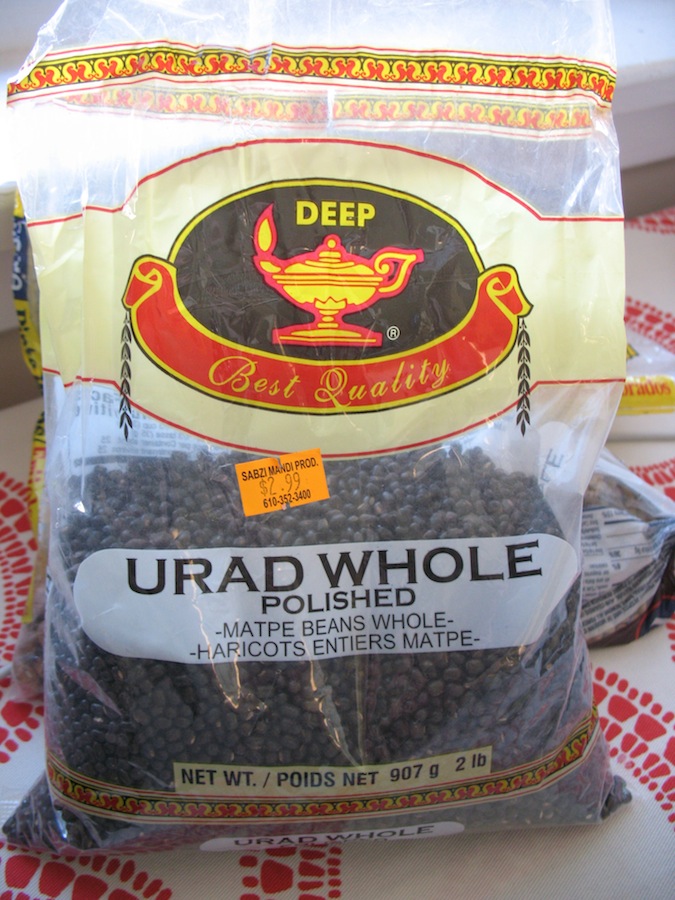
The star ingredient here is urad dal.  Chances are good that you’ll find this at your local South Asian grocer.  I got this bag from Sabzi Mandi, far west Philly near Upper Darby.  The end texture of the soup/stew will be almost like a (sorry vegan readers) ground beef protein chew.  If you are vegan but miss that kind of density, this might be a perfect substitute for you to use in place of ground beef in things like chili.

IMG_2047

IMG_2038

The two key ingredients to dal makhani: kidney beans and urad dal

This is a creamy, protein-packed stew of beans and urad dal.  It is great with bread (naan traditionally) or rice.  Here is a recipe for my pressure cooker method:

Recipe: Dal makhani

  • 3-4 Tblsp oil (or ghee, or oil+ghee)
  • 2 tsp cumin seeds
  • 1 medium onion, finely chopped
  • 1+ tsp shredded ginger
  • 1 tsp minced garlic
  • 2 medium tomatoes, chopped
  • 1 1/4 cups red kidney beans or other (pinto beans are nice too), soaked overnight
  • 2/3 cups whole black urad dal, soaked overnight
  • 1 tsp each: tumeric, ground cayenne, ground coriander, garam masala
  • large pinch asafoetida
  • salt to taste
  • large pinch of sugar
  • stock or water to comfortably cover all ingredients
  • heavy cream
  • 2 Tbls chopped cilantro (optional)

Method:

1. Soak beans and dal overnight.  I just soak them together in one bowl.  Drain.

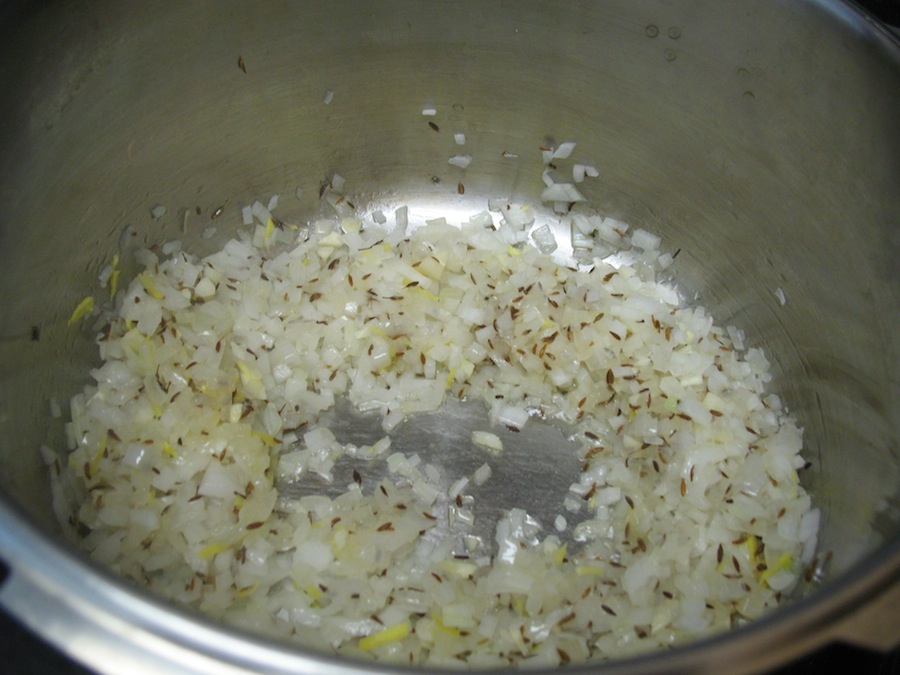
2. finely chop an onion.  Put the oil and or ghee in your pot, get it medium hot and start frying cumin seeds.  Before they burn, put onions in and mix.  Have tomatoes and/or water/stock on hand in case this mix is in danger of burning.  When onions are translucent, you can add all items except the heavy cream and cilantro.

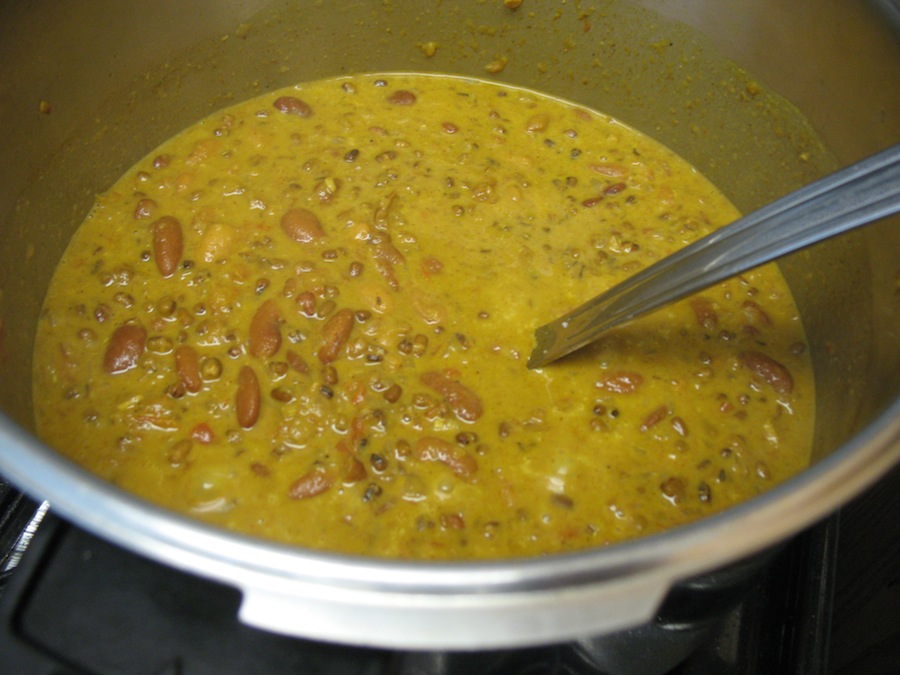
3. Cover tightly and bring to pressure (if using pressure cooker–if not, simmer covered until beans and dal are cooked).  Reduce heat and simmer for 25-30 minutes.

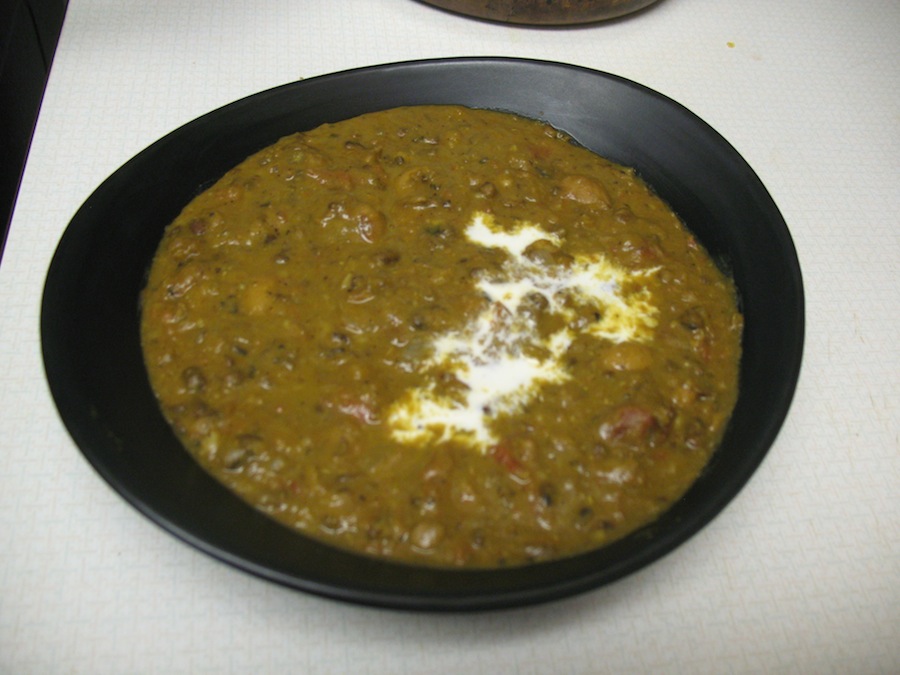
4.  Remove from heat to depressurize the cooker and open.  Beans and dal should be cooked and tender.  Mash some of them to produce a thicker sauce.  Taste for salt, and salt if necessary.  Add in 2-3 Tblsp heavy cream and stir.  Serve.  Top with shredded ginger and/or chopped cilantro and another spoon of heavy cream.

NOTE: this just tastes better later on.  Great for weekday lunches later in the week.

IMG_2051

Onions, oil and ghee, and cumin seeds

IMG_2052

mash some of the beans and lentils to thicken the sauce. You can also use an immersion blender if you like.

IMG_2102

satisfying enough to be a meal.

Posted in - Featured Food Discoveries, - Featured Markets, - Recipes, Indian food | Tagged , , , , , , , , | 1 Comment

Fresh mangosteens and rambutans

IMG_2063

One of my favorite fruits in Thailand, mangkut มังคุด, or mangosteen

For those out there who have been to Southeast Asia, fruit is something you likely miss dearly if you are now elsewhere.  For me, Guangzhou was a perfect introduction to many fruits, at a time when food in China was very cheap while imports were plenty from Southeast Asia and Hainan Island.  China is where I first experienced papayas, rambutans, bayberries, durian, among others.  Later in life I moved to Thailand, and I experienced many, many new fruits, several that don’t make it to export.  For a long time my favorite fruit, the mangosteen (mangkut มังคุด in Thai), was in that category.  Finally in 2006, imports began to the US, and now they are a fairly regular find in Asian markets (according to season in Southeast Asia anyway).

Yesterday we were in New York, and La picked up mangosteens and rambutans from Manhattan’s Chinatown.  Both of these fruit are also occasional offerings in Philadelphia.  Chinatown’s markets as well as Washington Ave’s large markets regularly carry Southeast Asian fruits.
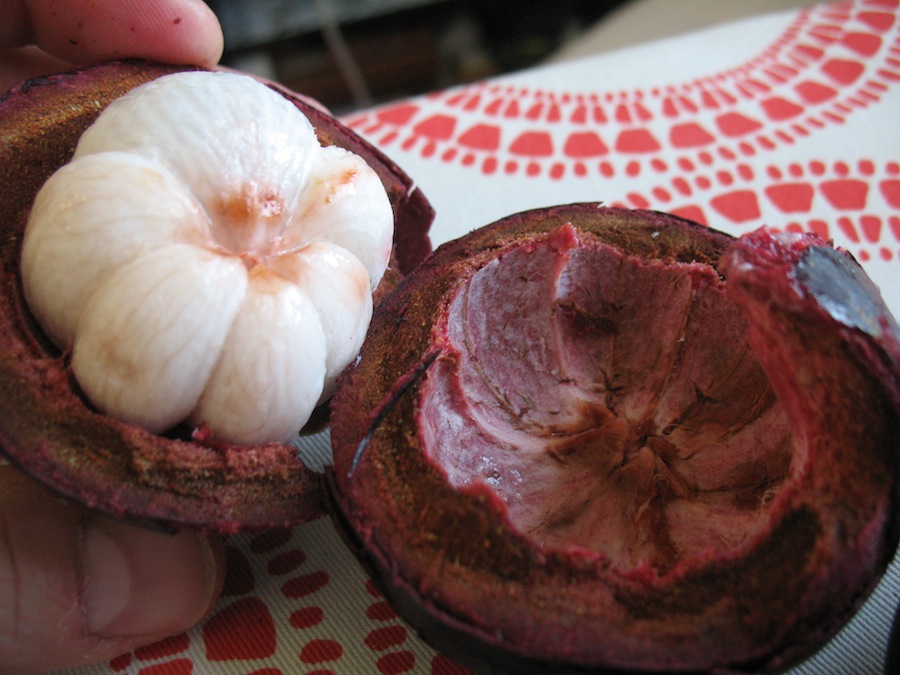
For those of you who have not experienced mangosteen, they are quite unique.  The shell is almost woody, and you have to score the outside with a very sharp knife, taking care not to dig too deep or go all the way through.  You can then pry it open to reveal the luscious white flesh inside:

IMG_2070

Mangosteen cracked open to show it’s sweet juicy white segments.

The segments inside are about the size of a mandarin orange, but the flavor is sweet, perfumed, and creamy, and the texture is like a fibrous watery peach.  There is a large dark seed, usually just one, and I usually just eat the segments out of the shell and spit out the seed.  If the flesh looks grey and deflated, you got a dud.  Look for purple firm fruit rather than brown and soft.

IMG_2065

Rambutan.
Another popular fruit in Thailand that is not so common in the States is the rambutan.  In Thai this is known as ngo เงาะ.  In both fruit, the names into English came through Indonesian/Malaysian.
Rambutans have a very unusual appearance, a creepy, alien, hairy fruit.  They can be opened in much the same way as mangosteens (with much less pressure), by scoring the circumference of the fruit and popping it open.

IMG_2078

Rambutan, sliced open.

The consistency of this fruit is like a tough grape, with a large seed inside.  The flavor has a faint flowery perfume.  This fruit is also commonly available in canned form, seedless and usually packed in syrup.  This can be used to eat as a dessert with coconut milk or shaved ice.

Posted in - Featured Food Discoveries, Malay/Indonesian food, Thai/Lao food | Tagged , , , , , , | 2 Comments