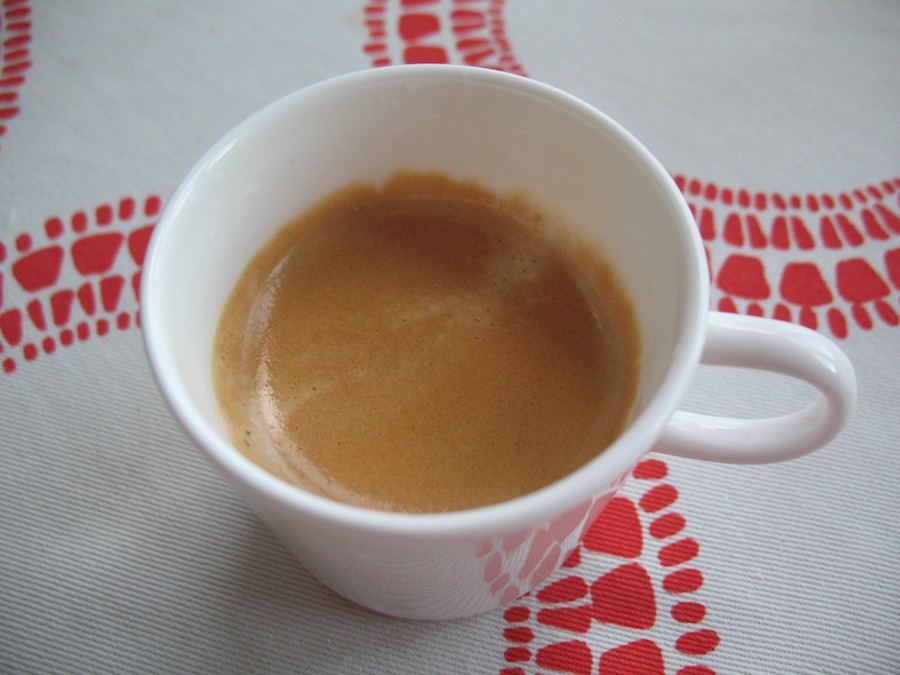
Making a better espresso with a home machine

coffee5

Getting there… a better espresso!

You may be like me, where you’ve gotten a start of the line home espresso machine, and you can’t seem to use it to make an espresso (at all) similar to what you might get at a reputable shop.
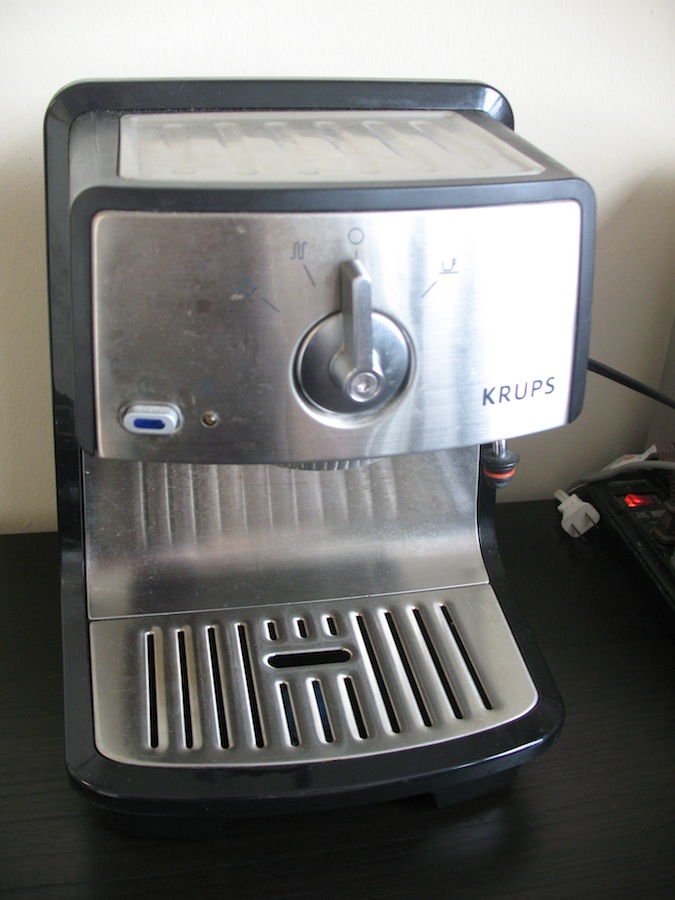
My machine, a Krupps from about 5 years ago

My machine, a 15-bar capable Krups from about 5 years ago, still going strong.

Well, I’ve learned a few ways to make a more delicious espresso from a home machine by pushing the machine’s limits.  This comes after some years of experimenting, and after discussions with friends (thanks, Kray) who are as obsessive as I am about these issues.

The problem I faced was dull flavor, no matter the quality of coffee bean.  The drink itself was not altogether bad, in fact it wasn’t bad at all.  But it wasn’t like a real espresso, like what you’d get from your local coffee shop (assuming they know how to do espresso).  Instead, it was more like a slightly watered filter coffee.  The plus side is the usual result doesn’t have any bad flavors of a mediocre filter coffee, it’s just not as strong as I’d expect in an espresso.  It’s not even as strong as a french press with the same beans.

If I buy a pre-ground coffee ground professionally for espresso, Illy brand, for example, the espresso is much better.  It can still be so-so though.  And, crazy as I am, I don’t want to be dependent on 3rd party services.  I want to be able to make a great coffee with the beans I choose.

Ultimately the tricks I’ve learned are all about knowing your machine’s limitations and the limitations of your grinder.

If you share some of my problems, below are some things to think about:

1. You need a consistent grind of beans, and that grind needs to be as fine as your machine can tolerate.  This is tricky to get exactly right, especially with a hand grinder like what I use (see below), without any sort of guide or dial.  Blade grinders will NOT work for this, and their resulting grinds will be too inconsistent.  Grocery store grinders I’ve found also to be all over the place.  Putting those grinds through the espresso machine will either pass through too easily, or the blade cut beans will produce enough dust to easily clog the espresso machine.

I upgraded to a hand grinder, and I’m amazed at how much of a difference [more] consistent grinding makes.  An expensive machine burr grinder would do even better than my hand grinder, but even with a grinder like mine you’ll notice the crema on top of the coffee to be a darker golden brown, and the flavor will be stronger.
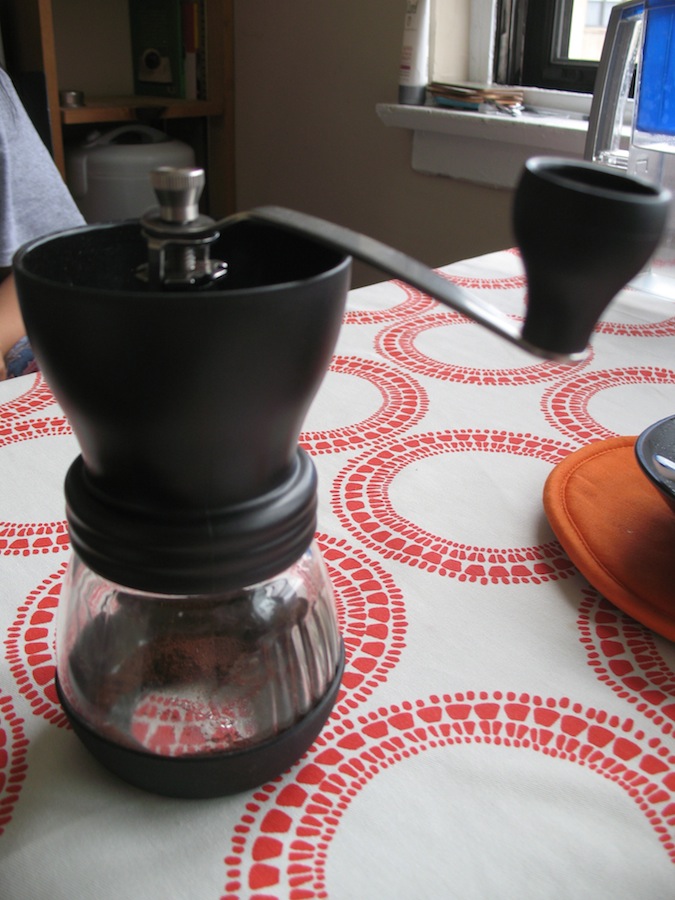
my hand grinder.  Kyocera.

my hand grinder. Kyocera.  Also marketed under the brand Hario

The hand grinder that I use I got for $30+.  I’m still not ready to invest in a several hundred-dollar burr grinder, and I am satisfied with this grinder’s results.  It’s fairly consistent.  It isn’t perfect though, and I’ve found the grind settings to be just a little smaller or larger than a store-bought pre-ground espresso.  That means that again, water will run through it too easily, or your machine will clog too easily.  For now I am erring on the side of the fine grind, even though I occasionally do clog the machine to the point where no coffee comes out.  That said, the tamping and the type of roast also affects this outcome, so there are ways to compensate (see following points).

One last point about having your own home grinder… you can grind fresh per cup.  For me, I grind just before making a cup, that’s one tablespoon of beans and very little time turning. I also love low-tech human energy.  So many things go wrong with little motors and parts… (I also bike a 15 mile commute every day)

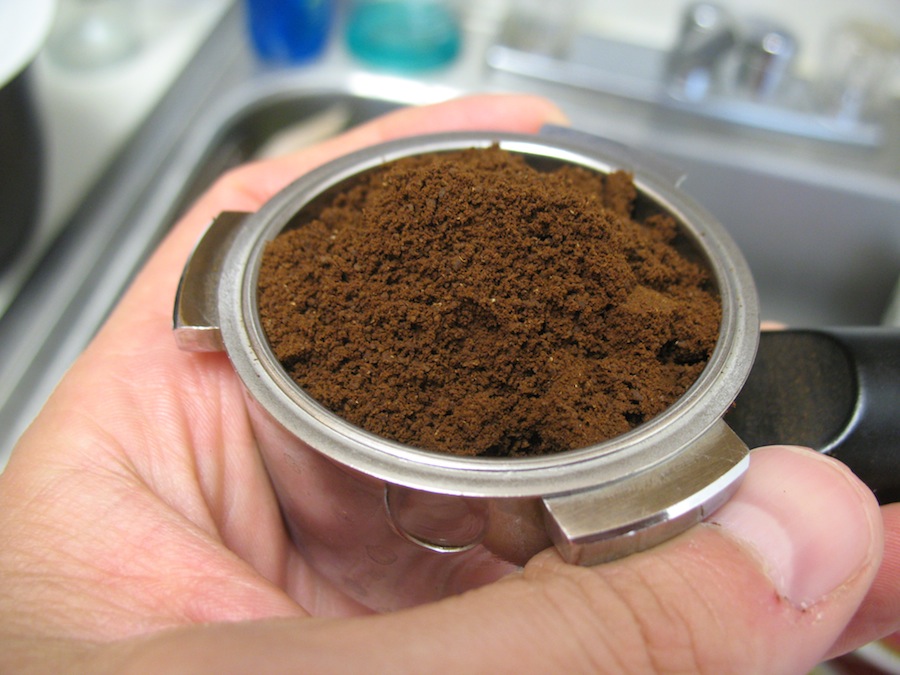
2. You need to have enough coffee in your filter cup.  You need to have a tamped “cake” of coffee that will give enough resistance to build necessary pressure.  If you tamp your coffee without enough in the cup, you could risk grounds floating around with water (which can also lead to clogs).  Put enough coffee in.  I usually mound my cup like the image below.  This amount will tamp nicely.  If you find you are clogging too easy with a fine grind and you are not overfilling the cup, tamp lighter.  If water runs through too easy on the grind that your machine works with, tamp harder.coffee3The key is to find the balance of where your machine can get the water through, even though it needs to work harder with appropriate pressure.  Watch the speed and color of the coffee coming through during the “press”.  If it is too light and fast, try a slightly finer grind and/or harder tamp.
3.  Different roasts yield different grinds.  What I mean is that if you take a dark roast and grind it fine like above, you’ll find it easy to grind and water will also pass through it easier.  A light roast will be tougher to grind, and it will clog easier (too bad for me as those are my favorite roasts).  If you use darker roasts, you probably will be tamping harder than your light roasts.

Finally, you need to rinse and clean the machine after use.  Sometimes if the machine really needs to work to force water through the beans, a few grounds might get pushed up around the gasket.  Sometimes they get forced underneath the rubber seal.  For the next use, there will be a greater chance of the basket not sealing properly and allowing for water to leak out the side–thus ruining the coffee due to not being at adequate pressure.  You don’t want that.  Cleaning the grounds out of that area can be very tedious.  And it can be difficult if the machine is hot.  Run the machine without the filter cup in place to help eject any stuck-on coffee before trying to wipe that area, it will reduce the chance of you accidentally wiping any stray grounds into the rubber seal.
Posted in - Featured Food Discoveries | Tagged , , , , , , , , , , , | 2 Comments

More Indonesian delights from Cafe Pendawa Lima

Cafe Pendawa Lima is not super convenient for me to visit, but the sheer variety always includes new, interesting, and delicious finds.  And the prices are right.  If I spend an additional 45 minutes to go out of my way to bike down there after work, it will be worth it.  Since my last post on Philly’s Indonesian neighborhood I’ve been back several times already.  Below are some images of foods found there recently.  I’d happily buy any of these dishes again, they were all very special.  Again, these dishes are prepared at the Indonesia Restaurant on Snyder Ave, just boxed up and sold here.

IMG_1931

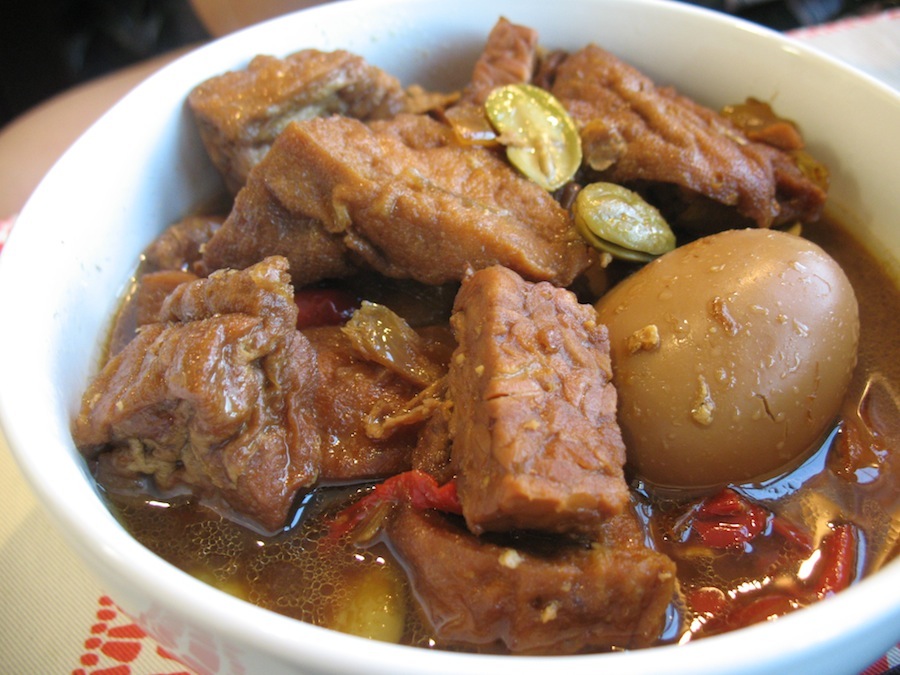
“TAHU TEMPE PETE TELUR”. $5. Basically a sweet five spice stew with eggs and Tahu tempe. Also notice those huge stink beans (pete in Indonesian, satau สะตอ in Thai)

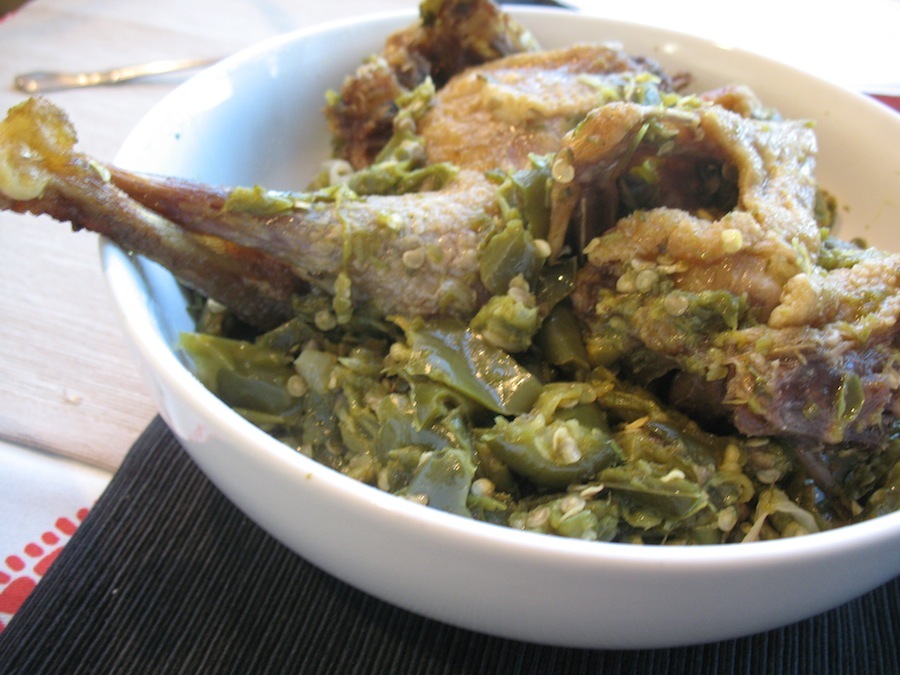
"AYAM SAMBAL PETE IJO". $8.  This was a very lean chicken, roasted maybe, and then mixed with a delicious spicy sambal of green chiles.  Fiery and delicious.  Remnicient of Northern Thai jaew, perfect for eating with sticky rice.

“AYAM SAMBAL PETE IJO”. $8. This was a very lean chicken, deep fried or roasted maybe, and then mixed with a delicious spicy sambal of green chiles. Fiery and delicious. Reminiscent of Northern Thai jaew, perfect for eating with sticky rice.  This dish also used that pete bean

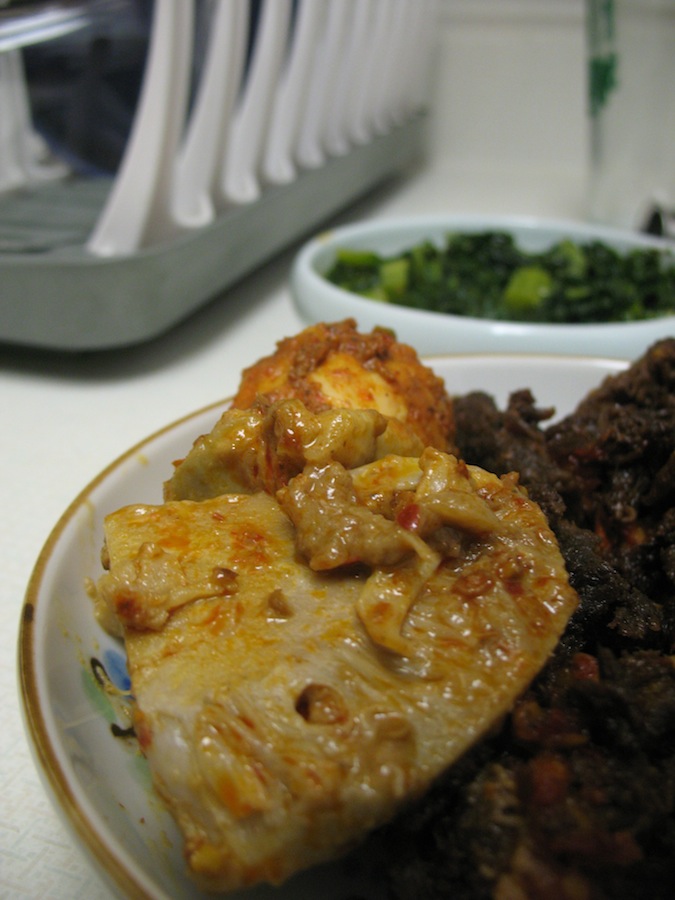
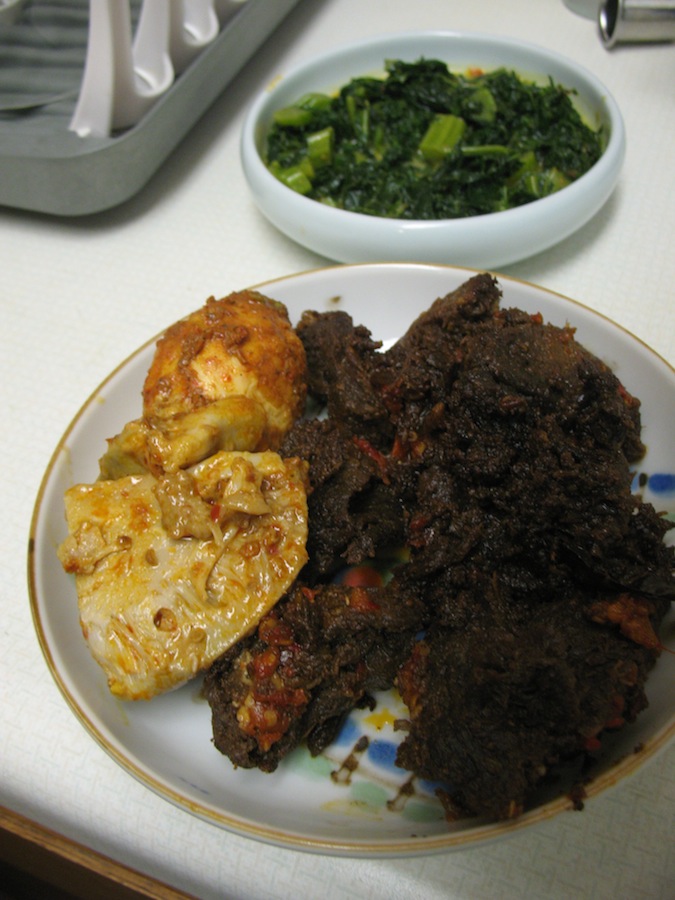
In the foreground, a dry stewed beef, incredibly rich and salty.  Almost like beef rendang that has been boiled dry.  On the left of this plate is a jackfruit curry.

On the right (barely visible here, see next) a dry stewed beef, incredibly rich and salty. Almost like beef rendang that has been boiled dry. On the left of this plate is a jackfruit curry.

In the foreground, a dry stewed beef, incredibly rich and salty.  Almost like beef rendang that has been boiled dry.  On the left of this plate is a jackfruit curry.

That same image from above.  Beef looks dark but is in my shadow.

IMG_2012

Indonesian sweet jasmine tea in drink boxes

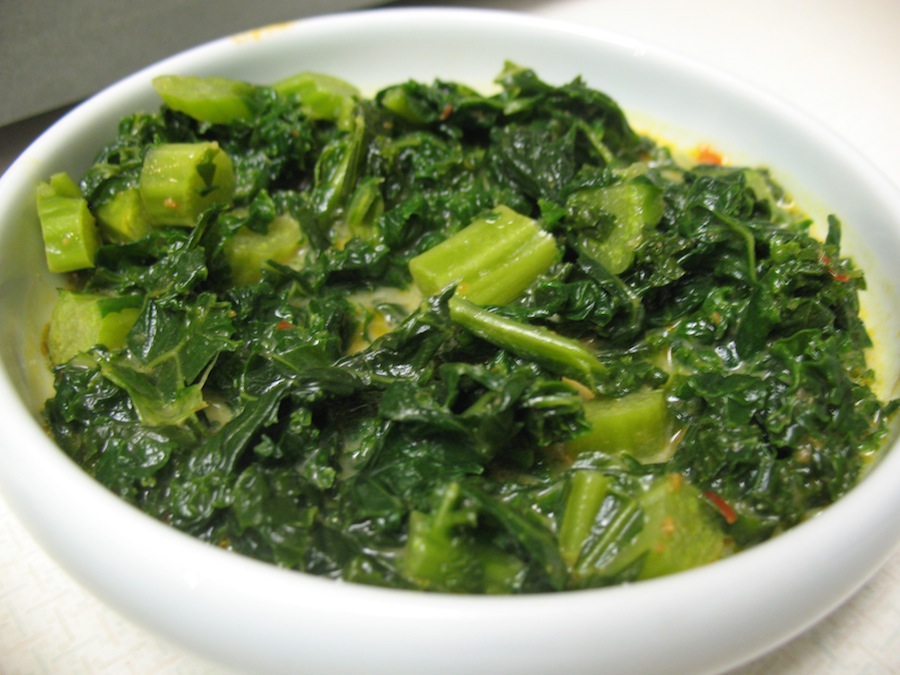
I don't know what the vegetable is here, might be yu choi.  Reminded me of collard greens but in a coconut curry sauce.  Very nice.  I should note this was only 1/3 of one of the variety packs on rice for $6

Collard greens in a coconut curry sauce. Very nice. I should note this was only 1/4 of one $6 “NASI PADANG” pack

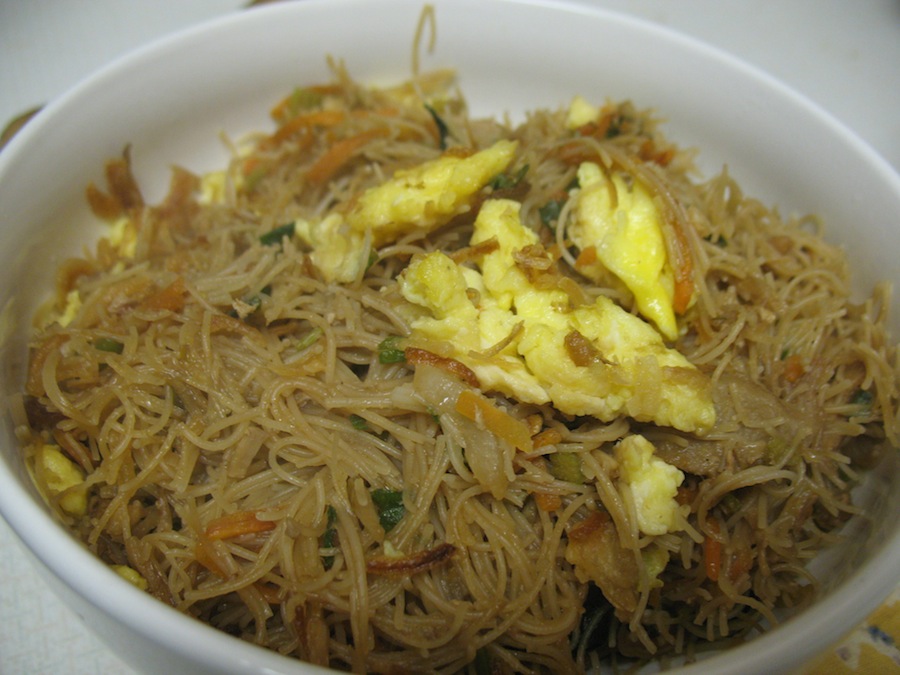
"BIHUN GORENG" $4.  Definitely worth $4.

“BIHUN GORENG” $4. Definitely worth $4.

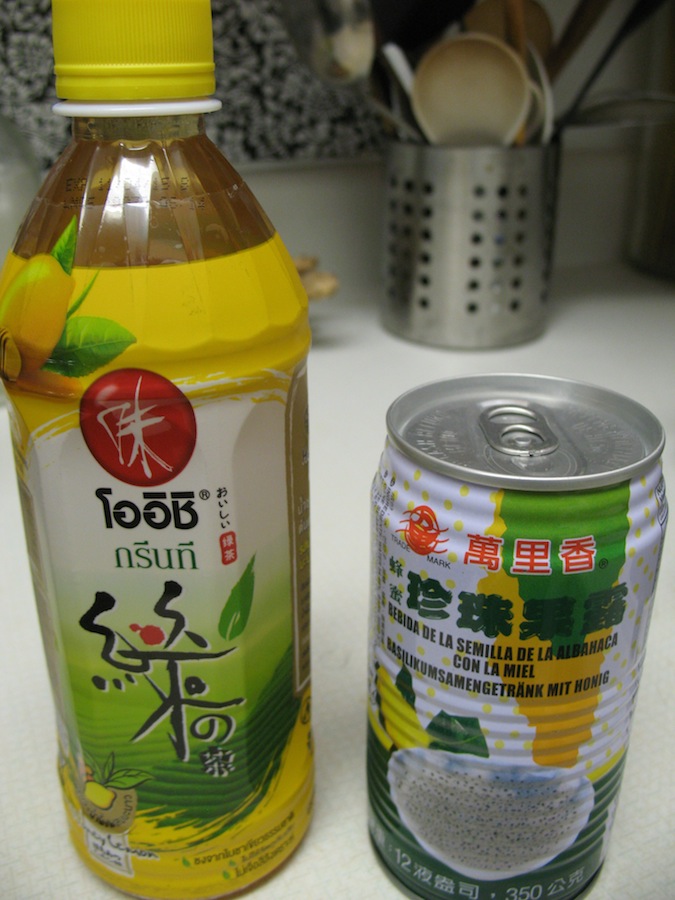
Oishi brand tea and basil seed drink (see below)

Oishi brand tea and basil seed drink (see below)

IMG_2033

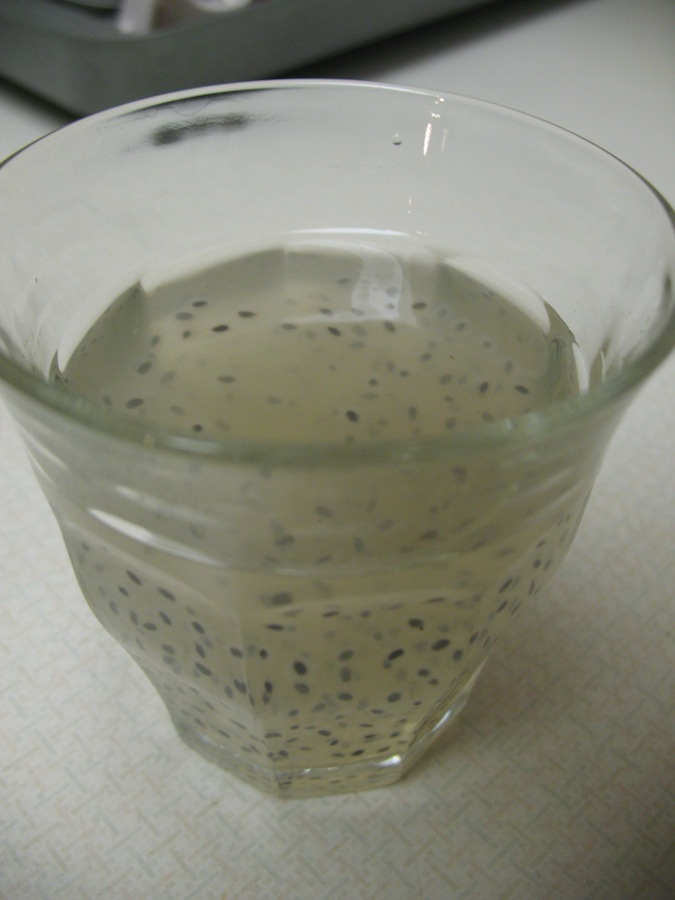
basil seed drink. This is made from the seeds of lemon basil, the little seeds become little slimy tadpoles. Quite nice.

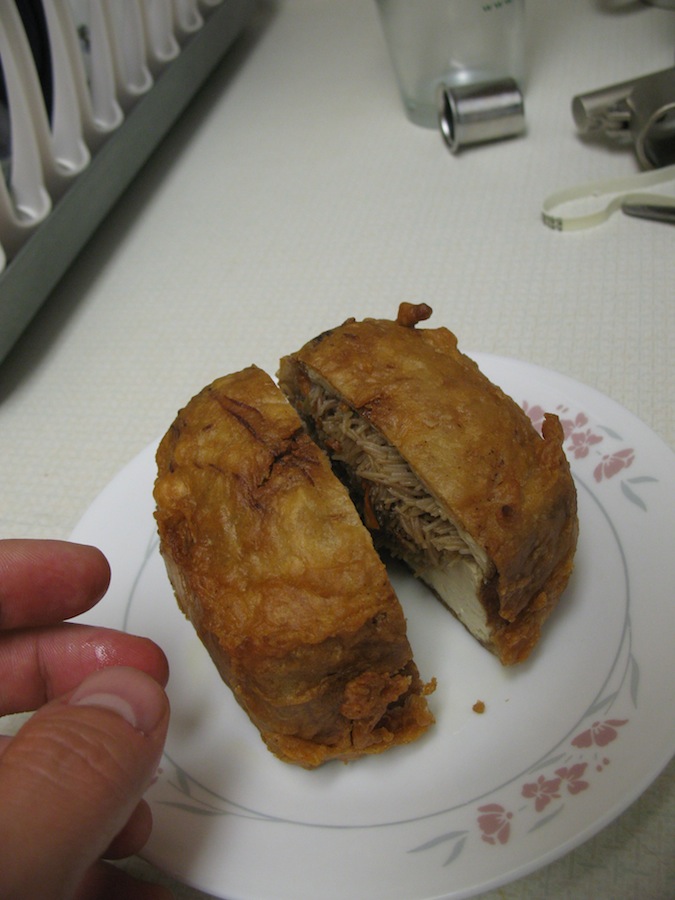
More deep-fried things.  There is such a variety.  Here I selected a HUGE stuffed tofu.  I cut it in half.

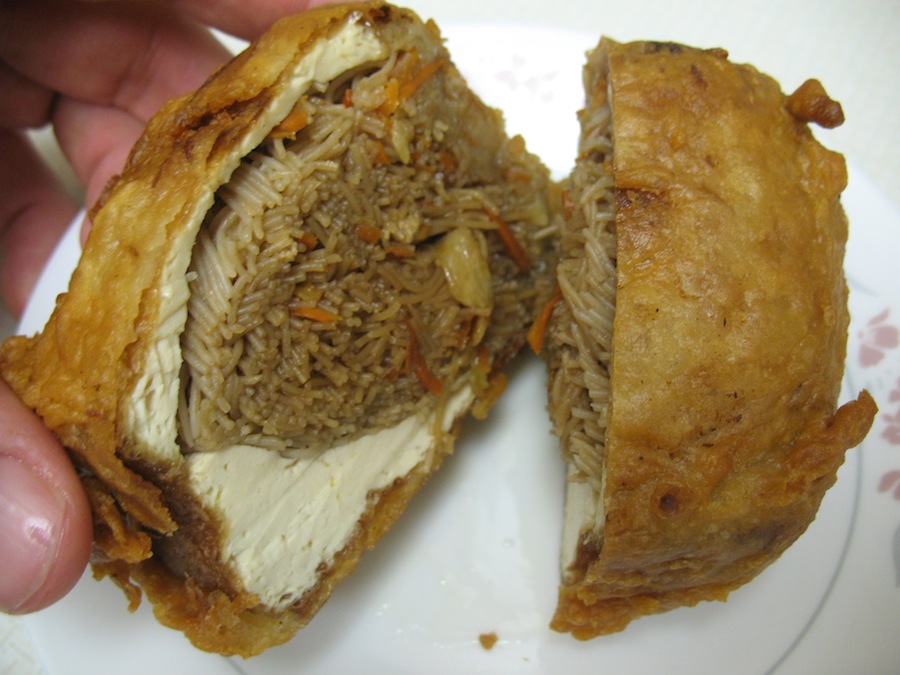
More deep-fried things. There is such a variety. Here I selected a HUGE stuffed tofu. I cut it in half.  What’s inside?

Oh, an order of noodles.

Oh, it’s another order of noodles.

Posted in - Featured Food Discoveries, Malay/Indonesian food | Tagged , , , , , , , , , , , , , , | Leave a comment

Uyghur style rice pilaf with beef and yellow carrots

polo6Happy Eid!  Over the weekend friends will be feasting around the world, and in Xinjiang no doubt people will be eating the dish I’ll describe below.  Half a world away in Philadelphia, the weather is changing from hot to quite cool, and the season is getting perfect for eating things that are just a little bit heavier and a little bit richer.

Many cultures of Eurasia lay claim to a form of rice pilaf as a “national dish”.  Uyghur polo (پولو) is no exception.  While other Uyghur dishes like laghman and nan remain popular and are important staples in Xinjiang, polo still occupies a higher position among other foods.  For many countries in Central Asia, the same is true with each national version of rice pilaf.  If you cross the border into Kazakhstan, and beyond to Kyrgyzstan, Uzbekistan, Persia, Turkey, you can see the name slowly change to something recognizable in English: polo (Uyghur), palau (Kazak), palov (Uzbek), plov (Russian), pilav (Turkish).  These words can be traced to a Persian root, and each version has a slightly different iteration.

To the uninitiated, the Uyghur polo is pretty oily.  It is generally considered a celebratory food, however, not something you eat every day.  Most recipes you can find will use at least 1/4 cup of oil (usually more), and some of tastiest recipes will use rendered fat from the fat-tailed sheep, a popular domesticated animal in Central Asia.  Unfortunately, I don’t have any of that today.

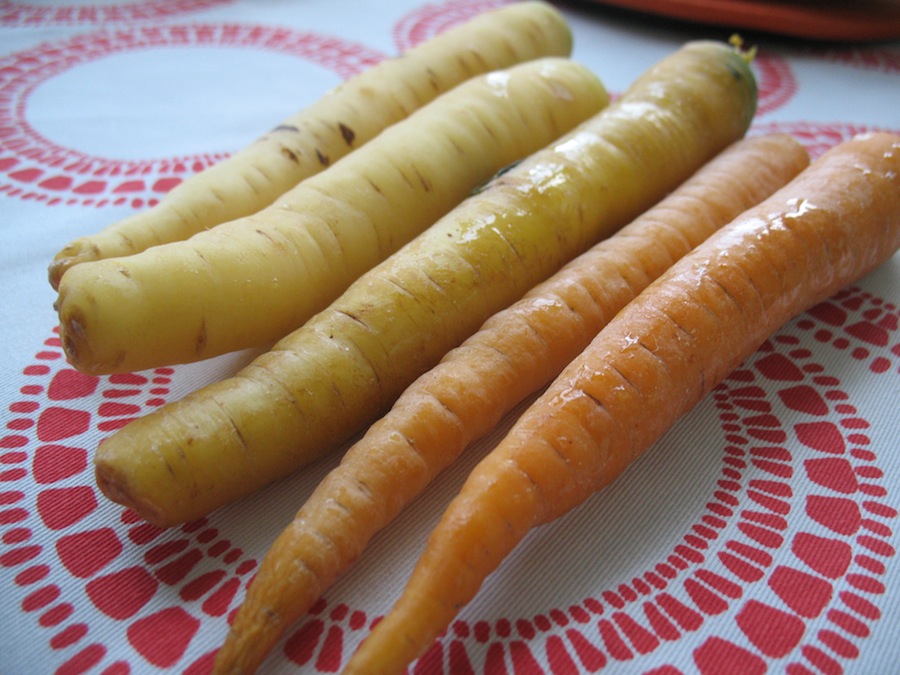
Something else that may seem out of the ordinary with this dish in Xinjiang is the use of yellow carrots.  Nowadays we are finding more “heirloom” varieties of carrots at places like Whole Foods, including yellow and purple carrots, but for the past 300 years or so they have been primarily orange in Western Europe and the Americas.  In Central Asia there are more varieties of carrot.

polo13This dish uses a lot of carrots.  It might seem like too much, but they really bring an interesting sweet and savory to the dish.  I am using a variety of light-colored carrots that we bought from a market in Montreal.  Some of them are yellow, some appear white inside.
polo9

Five shredded light-colored carrots

There is, of course, nothing wrong with using orange carrots in this recipe.  They’ll be just as delicious.

Recipe: Uyghur beef polo

  • 1/3 cup oil
  • 1 lb beef with fat, cut into chunks 1″ or larger.  Meat with bones is fine too.
  • 5 good-sized carrots, shredded or julienned
  • 1 large onion, chopped fine
  • 2 cups soaked short grain (i.e. sushi) rice
  • ground cumin
  • salt, black pepper (optional)
  • boiling water to cover

The general idea here is to brown meat in a lot of oil, stew that meat (especially if it is a tough cut) with onions, add a layer of carrots and rice and cook until the rice is done.  This can be a little tricky, because you don’t want the bottom to burn, and you don’t want your rice undercooked when the water has evaporated.

Cooks in Xinjiang (see here for an instructional video in Uyghur) will use a vessel that resembles a heavy wok with higher sides.  The bottom is tapered in a way that will help keep the bottom hydrated (i.e. not burnt) while the rice cooks on top.  I’ve found that a pressure cooker can also be used to make a decent polo.  Nearing the end of the cooking process you can put the lid on and add pressure.  That will help ensure that the rice will cook through.

I use my pressure cooker for the whole process.  Here we go:

  1. Shred carrots.  I use a grater.  Set aside.  Cut up meat and chop onions.
  2. Heat oil to nearly smoking.  Put in the meat and brown well.  Do this in batches as not to crowd the pan and steam the meat.  The bottom of your pan might be darkened with lots of fond from the beef.  This is good.  Take out your meat and set aside.  With the meat out, there is a threat of burning in the pan.  Put in your chopped onions.  Stir and bring up all the fond off the bottom of the pan/pot.
    meat, nicely browned

    meat, nicely browned

    use onions to deglaze the pan

    use onions to deglaze the pan

  3. If your meat is a tough cut, you might want to stew the meat and onions for some time before beginning the rice.  To do this, add some water to barely cover the meat and onions and cover the pot.  Boil for as long as it takes, up to an hour or more.  This time I boiled my beef for about 45 minutes and it was getting tender.  Also at this stage, add salt to the meat and onions.  The mix should be a bit salty, as carrots, water, and rice will bring that saltiness down.
  4. Boil some water in a kettle to prepare to pour over the rice in a few steps.
  5. Sprinkle ground cumin and ground pepper into the beef and onion mixture. I used a scant teaspoon of cumin.
  6. Layer the shredded carrots on top.
  7. Layer the pre-soaked short-grained rice on top of the carrots.
    rice layered on top of carrots and beef and onions

    rice layered on top of carrots and beef and onions

    polo7

    poking holes to check the water level

  8. Pour boiling water into the pot without disturbing the layers.  Since my pot has very straight sides, I poured the water over a spoon to make the water go to down the sides of the pot.  Put enough water in to cover the rice.
  9. Boil uncovered until the water goes below the rice (you can make holes in the mixture with a chopstick to see this progress).
  10. Cover tightly and turn heat to low.  Simmer for 30 minutes.  If you hear sounds of the bottom drying out and burning early, you might add a little water.  Otherwise, you should be good to go.  Here is how mine came out, stewed beef from the bottom on top of the rice:polo4

As mentioned above, this is a rich and heavy dish.  It is balanced well with cool crunchy vegetables and/or yogurt.  Perfect for a cool fall night!

Posted in - Featured Food Discoveries, - Recipes, - Unique food traditions, Central Asia/Uyghur food | Tagged , , , , , , , , , , , , , , , , , , , , , | 5 Comments

Northern Lao ingredients and cooking blog

Last night I came across a very interesting blog and cookbook.  I hope the cookbook will be as good as the blog is, we will have to see.  The blog/site is called Food from Northern Laos: The Boat Landing Cookbook, and it is the work of Dorothy Culloty and Kees Sprengers. Unfortunately, it doesn’t look like the blog is updated so much anymore.  Still, you can find posts about very unique ingredients, like this one on “Chilli wood” or mai sakaan ໄມ້ສະຄານ.

You can also find some interesting rural cooking (i.e. over open fire) step-by-step recipes, for example Khao soi noodle making Tai Neua style.  Do take a look if you are interested in Lao food.

Posted in - Unique food traditions, Thai/Lao food | Tagged | 2 Comments

A brief visit to South Philly’s Indonesian neighborhood

In South Philly there is an area west of Broad St in between Tasker St and Snyder Ave, where you can find many culinary staples and treats that are unique to Indonesia.  Today I took a long overdue trip there to sample a few of the shops, and to bring home an impressive lunch.

IMG_1891

Santos Groceries.

I started at Santos Groceries at 1443 Tasker [Update: Santos was sadly closed as of January 2017]. The style and set-up of this market is very similar to the other Indonesian markets in the neighborhood.  Usually a corner store, which fills the role of the local deli or convenience store (perhaps these were old corner deli/hoagie joints previously).  Signage is minimal, and there is little to imply that there are Indonesian specialties inside.  Other shops in the neighborhood have even less signage.  See below.

I came with a shopping list with a few staple items for cooking Indonesian food such as candlenuts (kerimi), salam leaves (aka “Indonesian bay leaves”–though quite unlike bay leaves of Eurasia), and crunchy crackers made of a kind of nut, called emping.  I quickly found all of those items, along with several other things, at this first store.  The store was pretty well stocked for non-perishables, and the shopkeeper Santo was very welcoming.

Afterwards I walked the neighborhood in an “S” shaped pattern, following the one-way streets south.  There are several markets in the neighborhood, and I’ve added the ones I saw today to my map.

IMG_1893

Cafe Pendawa Lima

The second place I visited really blew me away.  The place is called Cafe Pendawa Lima, and it is at 1529 Morris Street. Again, a fairly nondescript building, a tiny sign on the door and no other indications that this place is filled with unique, freshly made, delicious meals and snacks.  It is also an Indonesian supermarket to boot, with several non-perishables in the back.  There are so many delicious options here, very reasonably priced (most meals at $4-$7) ready to go, it was is really hard to make a decision.

The meals are actually prepared at Indonesia Restaurant, over on Snyder Avenue. Check out the store’s Yelp images to see how the place looks, with the wire racks running down the center of the place, with all of the prepared food.  Here are some images of what I ended up bringing home:

IMG_1910

Nasi Campur Menado (Ikan Saos), on a bed of rice, $6

IMG_1908

Nasi Campur $5

IMG_1906

Mie Medan Special $5

All of the above dishes were as tasty as they looked, I’ll definitely be back there for more when I am in the neighborhood.  I also got these two delicious filled treats:

IMG_1902IMG_1914

The above were breaded, and presumably deep-fried.  Imagine a cross between a deep-fried apple pie and chicken pot pie.  Sweet and savory.  Still unsure if the balls were made from mashed potatoes, but the consistency was like that.  The dipping sauce had a tamarind base.

I biked down to this area today, and my bags were already full with groceries and all of of this food.  I kept walking, however, just to get a sense for where other notable shops and restaurants were.  I look forward to returning!  Can’t wait to check out these places:

IMG_1894

Friendly Market

IMG_1897

Borobudur Mini Market

IMG_1899

Indonesia Restaurant

IMG_1900

Fan’s Cafe

IMG_1895

Morris Market

Hardena Waroeng Surabaya

Hardena Waroeng Surabaya

Posted in - Featured Food Discoveries, Malay/Indonesian food | Tagged , , , , , , , , , , | 3 Comments

Recent book finds

This week I was in New York, and I came across a bookstore that specializes in out-of-print cookbooks.  You can find this place, Bonnie Slotnick Cookboooks, at [Updated] 163 W 10th St in Greenwich 28 E Second St in the East Village.  I left there with two unique books, Everyday Siamese Dishes by Sibpan Sonakul, 4th edition, 1966, and Chinese Medicinal Herbs compiled by Li Shizhen in 1578, “translated and researched” by Porter Smith and G. A. Stuart, MDs, 1977.

cookbooks

two interesting recent book finds

I had no idea who Sibpan Sonakul was when I bought this, but it turns out she was a princess among (one of) the royal family lineages.  In Thai she is known as หม่อมเจ้าสิบพันพารเสนอ โสณกุล.  She was daughter of Prince Sonabandhit, son of Rama IV (aka Mongkut, i.e. the king in The King and I).  She died in 1985.  I found an obituary for her online claiming that she was the favorite sister and teacher of Prince Dhani Nivat, who wrote much in English in the 50s on Siam’s history and its place in the world.  She was also a teacher at the Rajini School for Girls in Bangkok.

The reason I was attracted to this book was because it contains several recipes that I haven’t seen before in English.  To boot, it was written confidently, and for a different era.  The recipes are geared towards a western audience, but they are not adapted.  The recipes and introductory matter are written unapologetically, as if to say, “if you try it, you will like it.”  When there wasn’t an appropriate translation for a food item, they would just use the Thai word.  In addition, they keep annotation with the Thai script so we can be sure of what they are talking about.  There is also a fairly detailed index and Thai-English glossary, and photo plates were taken by the king himself.  For someone who would have been truly interested in Thai food back then, I’d imagine this to be a very illuminating book.  For today, the recipes are just as usable as they would have been in the 60s.

Here is a sampling of some of the book’s unique recipes:  Pigeon in sweet and pungent mixture (นกพิราบเปรี้ยวหวาน) page 22, Yam of roses (ยำดอกกุหลาบ) p. 29, Pratad lŏm (ประทัดลม) p. 15, Overturned eggs (ไข่คว่ำ) p. 22.  There are a few hundred recipes that attempt to indicate the general idea, along with many suggested variations.  This book is a pleasure to browse, and I’m sure I’ll be using a few of these recipes.

The second book that I bought was not a cookbook at all.  Instead it is an analysis and explanation of Chinese herbs listed in Li Shizhen‘s 1578 work, 本草綱目, or Bencao gangmu, aka “encyclopedia of roots and herbs”.

The original was an encyclopedia of medicinal edibles, including many foods.  The book is organized by the original Chinese entry, translated into scientific name, with common English name in the colophon.  Then, the definition expands with when and where this item was previously referenced in Chinese literature, variations on the name, and what each item is good for.

This book was marketed as a “translation”, but it is really an analysis of the the original Bencao and later studies of the text, with explanations.  The purpose of the book was to understand Chinese herbal medicine, not to try for exact translations of the original.  For that, it is kind of misleading.  It is still a fascinating book.  I find it a pleasure to look up edible items to see when and where they were discussed in ancient China, and how ancient scholars thought about their medicinal properties.  Later imports to China (i.e. tomatoes and chiles) are also included, with information as to when they are first discussed in Chinese literature and how they are used.  Fun!

Posted in - Featured Food Discoveries, Chinese food, Thai/Lao food | Tagged , , , | Leave a comment

Tiny eggplants and prahok pork dip

makheuapuong

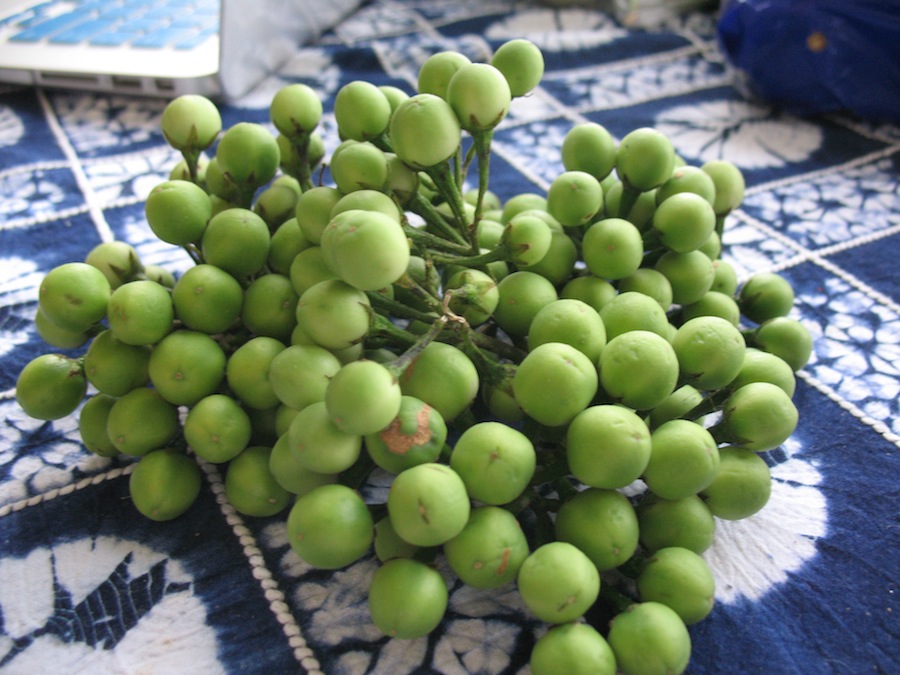
tiny eggplants (makeua phuong มะเขือพวง) found!

I found tiny pea-sized eggplants at my local Cambodian market in North Philly.  This fruit (Solanum torvum, aka turkey berry) is commonly used in Thailand, and is known there as “cluster eggplant”, or makheua phuong มะเขือพวง.  In Thai food, perhaps the most recognizable dishes with this ingredient are curries, like penang curries (image at bottom of page with La’s recent effort), or green curry.

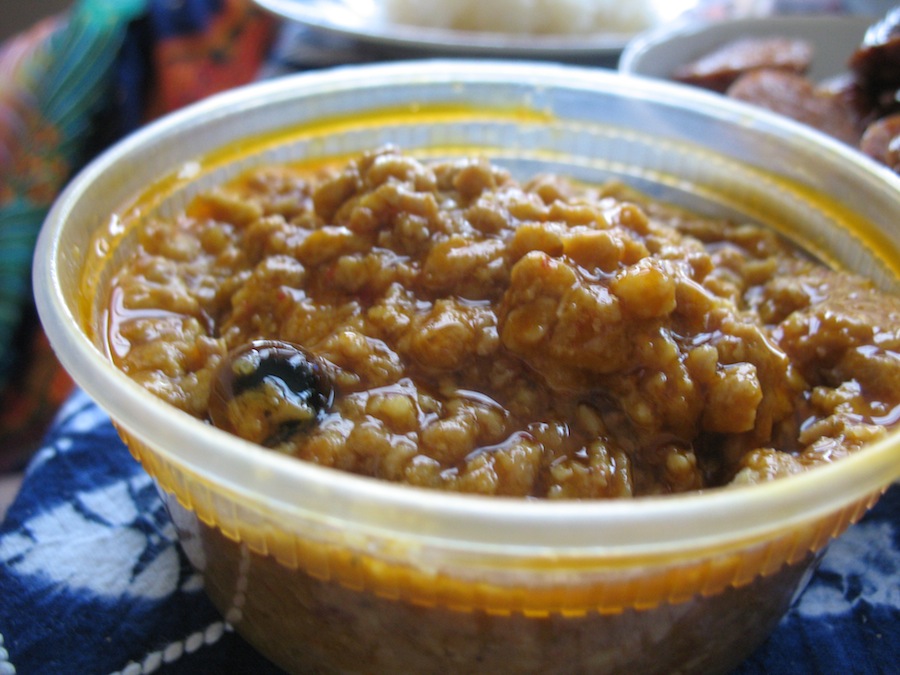
A delicious Cambodian dish that uses this ingredient is prahok ti ប្រហុក​ខ្ទិះ, which I found, ready-made in a stack of plastic containers on the counter.  [Update 17 Jan 15: it seems the proper pronunciation of this dish is “prahok katii”.] When the shopkeeper seemed challenged to explain what it was, I figured I should buy some and check it out.  I’m happy I did, it was incredibly rich and delicious.  At first I thought it was going to be something similar to a Northern Thai favorite, nam prik aung น้ำพริกอ่อง, but it was quite different.  It was with ground pork, and the important flavors that stand out are prahok (hence the name), as well as kroeung (see here for a post regarding these two important Cambodian ingredients).  Other important flavors present were coconut cream and palm sugar.  It was kind of sweet and oily.

prahokgroundpork

prahok ti [prahok katii] from the market, with ground pork and darkened pea-sized eggplants

This dish is meant to be eaten with veggies as a dip, and it’s also good for dipping sticky rice in too.  La said there is a Thai equivalent for this, called lon หลน. Coincidentally, I found a 1966 cookbook the other day Everyday Siamese Dishes where I found recipes for lon, that indeed sounded quite similar to prahok (ka)ti.  My next post will highlight my recent cookbook finds.

I found a really nice video explaining prahok (ka)ti, from Australian TV network SBS.  Check it out to get a sense of how it is put together, and you can find a decent recipe there too.  There are also several recipes (here’s one for example) out there online, but they are in Khmer.

For the above prahok (ka)ti that I got locally, it looks like they dry-fried the tiny eggplants in a pan first to darken them before adding them in.

Another day this week, La used those tiny eggplants to make a chicken penang curry.  With this preparation, she simply added the eggplants (detached from their bunch) into the coconut cream and curry mixture and boiled them.  The eggplants have a hint of bitterness to them, and a nice slightly grassy crunch.  A perfect match to the sweet/savory of the coconut curry or the coconut-prahok combination.

panaenggai

La’s finished chicken penang curry with tiny eggplants

Posted in - Featured Food Discoveries, - Featured Markets, Cambodian food, Thai/Lao food | Tagged , , , , , , , , , , , , , | 5 Comments

Three essential Cambodian flavors and sour beef soup

senghong

Seng Hong Oriental Market on Old York Road

Lately I’ve been exploring prepared food containers of the refrigerator section at a my favorite Asian markets as well as expanding my understanding of Cambodian food.

The nearest Asian market to my house is Seng Hong Oriental Market, over on Old York Road.  It is one of my favorite markets in Philly.  I am always finding new things there, often things I haven’t seen since living in Isaan.  Over this past summer I’ve seen items such as fresh tamarind leaves, and even a frozen “sour fish” (plaa som ปลาส้ม).  I’ve already written a few posts on other finds here this summer, holy basil and long pepper.  Certainly many more posts will be coming with items found here.

kreung2

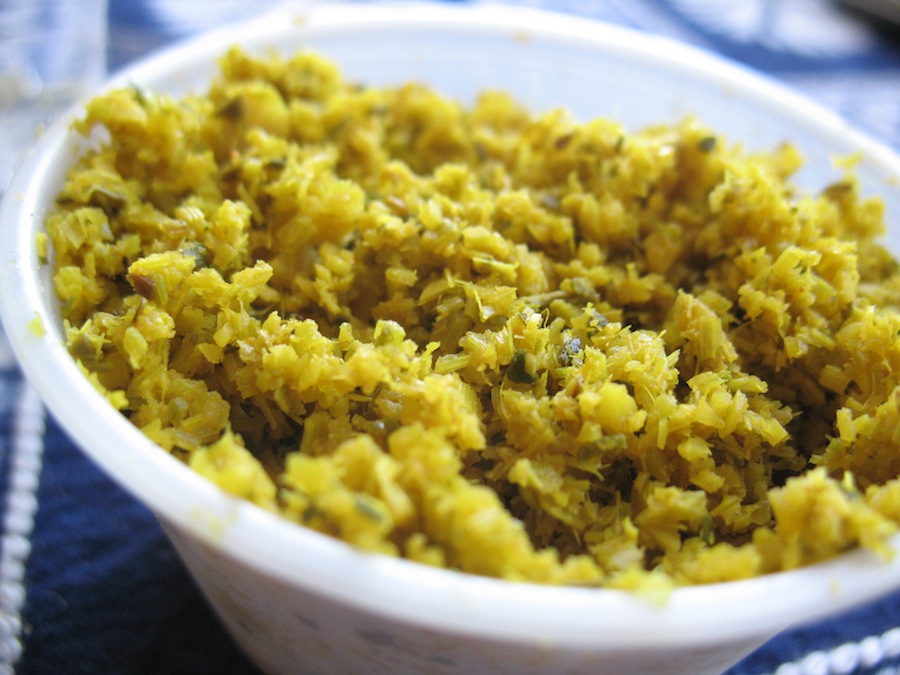
kroeung from Seng Hong Market

In the fridge section they sell little plastic cups with a yellowish-green chopped and ground paste for making Cambodian soups and/or dips.  It is called kroeung គ្រឿង.  See Wikipedia entry on this variety of pastes here.  It is a base of flavors for several Cambodian dishes, and the version Seng Hong sells consists of chopped lemon grass, galangal root, kaffir lime leaves, garlic, tumeric and salt.  At first I thought it must be meant for marinating meat before grilling.  When I asked what to do with this they suggested I make a sour beef soup with it, and to top it off with holy basil.  Seemed to me like a haphazard mix of things, but after reading up on the soup and this spice mix, I was inspired.  I bought a few cups and spent some more time researching “Cambodian beef soup” recipes.  After I got a sense as to what the key parts were, I felt ready to experiment.  The key parts as I understand them are: the above basic kroeung paste, sauce from a funky fermented fish (prahok), and sauce from the flesh of tamarind fruit, followed by beef and selected vegetables of choice.  My first try was with round green Thai eggplants, and Chinese celery.  I also ended up using a lean beef cut that I boiled in my Guilin master stock for a few hours.  The results were really wonderful, and La and I were instantly reminded of a stew in Isaan called aum อ่อม.  It was perfect to eat with sticky rice.  I was thrilled with the result, and La thought it was pretty good too.  The use of holy basil, combined with the umami of the fermented fish and the sour of the tamarind really was a beautiful combination.
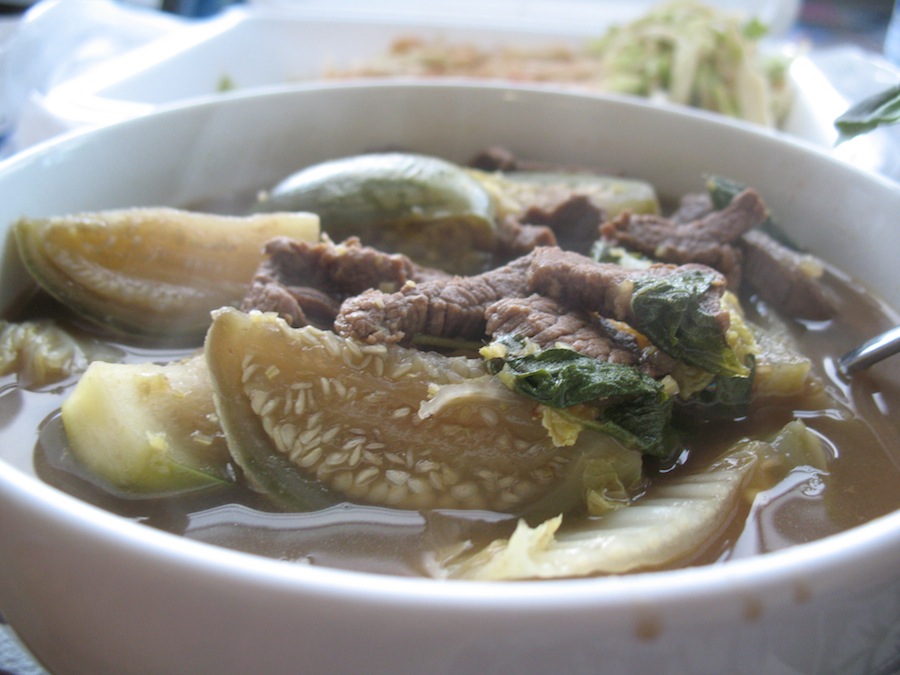
At the bottom of this page there is a recipe that mimics my second try at this dish, equally as pleasant, but this time using quick-cooking beef slices, eggplants, and napa cabbage.

prahok1

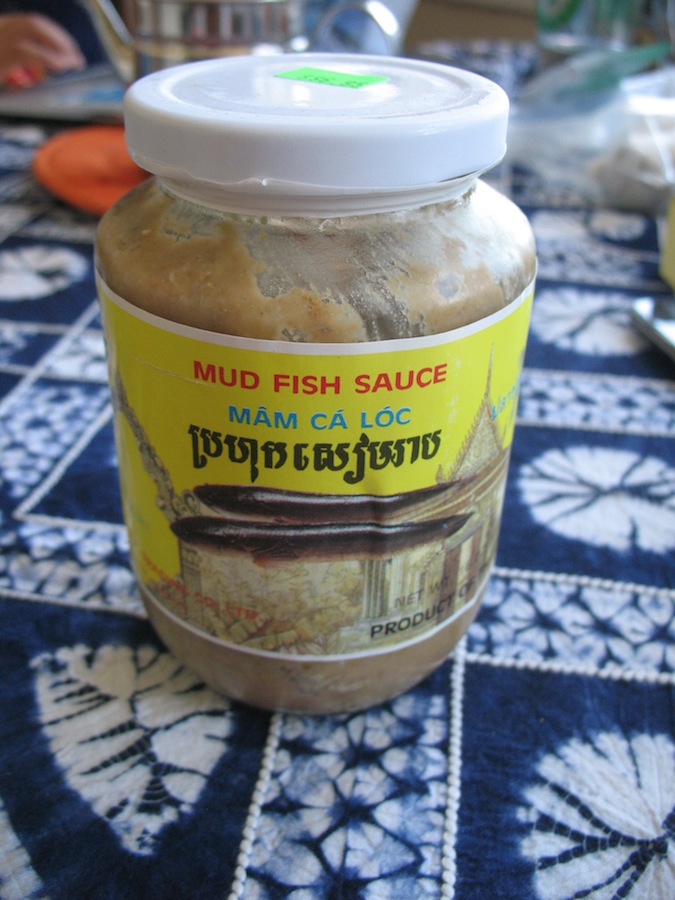
“Mud fish sauce”, label in Khmer: “Prahok Siam Reap”

Prahok ប្រហុក is a second key ingredient in many Cambodian dishes-here is a link to the Wiki entry).  It’s one of those things that smells very wrong when you open the jar, but if you left it out of a dish, there really would be something important missing that would be hard to explain.  Flavors come together with this ingredient, and that may be hard to believe if you’ve only smelled it out of the jar.  This is, of course, a style of fermented fish.  In Isaan cooking, the fermented fish plaraa ปลาร้า (aka badaek ปาแดก) is used in a similar way, in salads, dips, and soups.  In the US, these two things are often marketed as the same product.  According to Cambodians though, the “proper” version (the ones touted by food bloggers anyway) is the “Siam Reap-style” kind, the kind made without adding rice bran (i.e. the way it is made in Thailand).  After some research I found an acceptable prahok, also from Seng Hong Market.  From the Khmer on the label, ប្រហុកសៀមរាប, this product is “Prahok Siam Reap” (i.e. Siam Reap-style prahok).  Unfortunately this message is nowhere in English or phonetic Latin characters.  If you are looking for this but can’t read Khmer, ask your Cambodian shopkeeper.  No rice is listed among the three ingredients: mud fish, water, salt.  There are two kinds of this prahok, fish pieces in a jar, like the one I have above, and “creamy style” (i.e. boneless and pureed).  I like the one with fish chunks, skin, bones and all, but if you use this, you have to boil a chunk in little water and mash it with a fork, much like the method for making a sauce from tamarind (explained below).  A chunk of fish should yield 2-3 tablespoons of funky sauce, that should be strained before use in recipes.

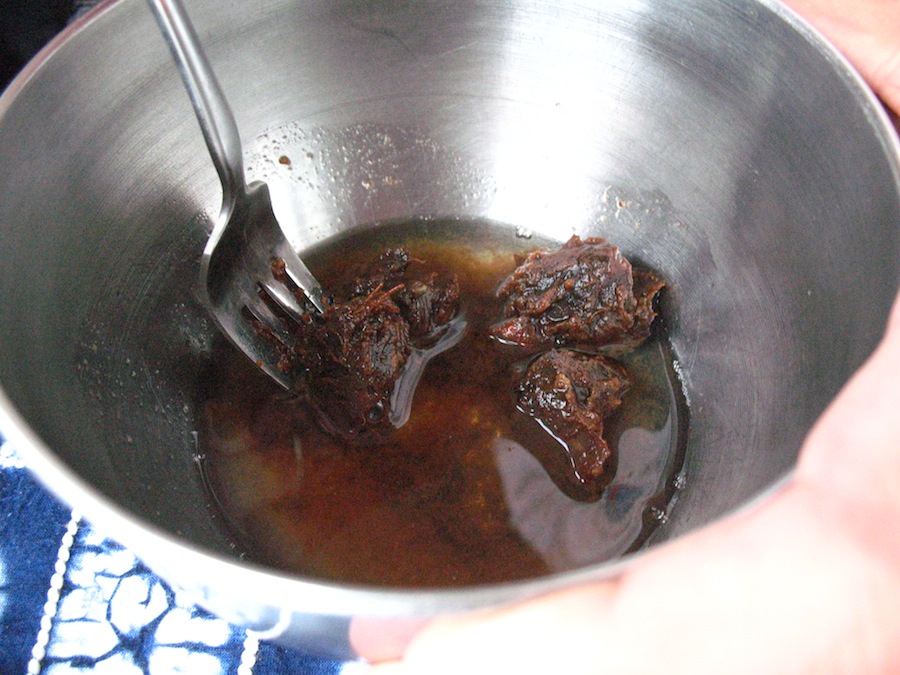
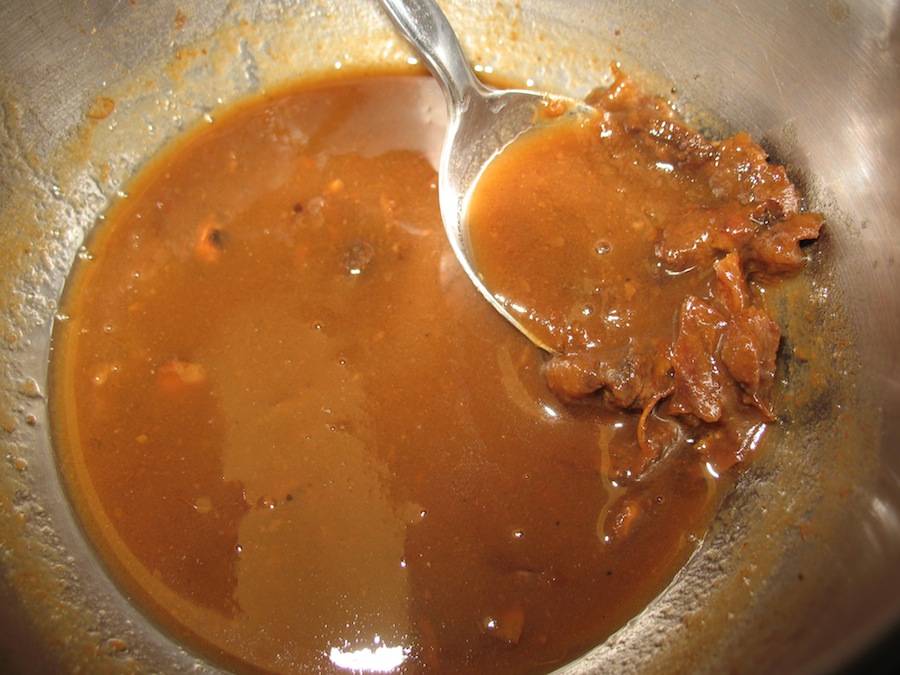
A final key ingredient that I’ll discuss today is a juice made from sticky tamarind fruit.  This is a very common ingredient in many dishes between Thailand and Cambodia, and it adds an interesting sourness to dishes.  Many of the recipes online use a powdered, instant version of this, marketed by Knorr.  I prefer the old school method, by ripping off a chunk of tamarind from the pulp block that it comes in (you can find this at most any Asian market), and covering that with some boiling water, letting it sit for about 10-20 minutes, occasionally mashing and poking it with a fork to make the flesh dissolve into the water.  After that time the liquid will thicken noticeably.  Spoon out the liquid into what you are cooking, whether it be papaya salad, or soup.  See below for a step-by-step for this process:

tamarind1 tamarind2 tamarind3


Recipe: Sour beef soup with kroeung – samlor machou kroeung sach ko សម្លម្ជូរគ្រឿងសាច់គោ

Most recipes that I found during my research were in Cambodian or Cambodian-American blogs and instructional videos.  It seems that the round, golf-ball-sized Thai eggplants were a pretty standard ingredient, either that or chopped water spinach (aka morning glory).  See the bottom of the page for links to some of these blogs and videos.

The key flavors to this recipe are alluded to above: Kroeung, prahok, and tamarind. I give approximate amounts below, adjust according to taste.

  • About 1/2 to 3/4 lb lean beef, to be slow cooked in large chunks in a spiced master stock (see next ingredient), or thinly sliced for quicker cooking.  If using slow cooked chunks, cool and shred the fibers.  This time I used slices for quick cooking
  • 3 tablespoons spiced master stock, beef, or chicken stock (many Khmer-American bloggers instead suggest powdered chicken stock to boost flavor)
  • 2-3 Tablespoons kroeung
  • 1-2 Tablespoon strained prahok sauce OR “creamy style” prahok
  • 1-2 Tablespoon tamarind sauce, or instant tamarind soup mix powder
  • additional water or stock, to cover ingredients (likely around 4 cups+)
  • about 7 Thai eggplants, quartered
  • about 1 1/2 cups roughly chopped napa cabbage
  • about 1/2 cup holy basil leaves for topping
  • salt to taste
  • palm sugar to taste (my master stock was a little sweet so I omitted this)
samlor2

My finished sour beef soup

1.  Prepare meat.  Slow cook, cool, and shred if going that route, otherwise start frying the meat slices in a little oil.  Add kroeung.  Fry until fragrant.

2.  Add eggplants and any other tougher vegetables you are using.  Add stock if using, and some water to nearly cover.

3.  Add prahok sauce and tamarind sauce.  Add palm sugar if using (start with 1/2 Tablespoon or so)

4.  cook for 10 minutes or so until eggplants and any other tougher vegetables are cooked through.  Taste for seasonings.  It might need salt, depending on your kroeung, stock, and prahok.  Add salt if necessary.  Add in lighter veggies that don’t require much time to cook.  This time we used napa cabbage, which was nice.  Cook until all vegetables are done.

5.  Finally, stir in the holy basil leaves and take off heat.  Enjoy with rice, jasmine or sticky rice.

My selected sources, please check them out for a comparison:

Posted in - Featured Food Discoveries, - Featured Markets, - Recipes, Cambodian food, Thai/Lao food | Tagged , , , , , , , , , , , , , , | 19 Comments

Kaffir lime leaves and kaffir limes

makrut1Our kaffir lime (มะกรูด makrut in Thai) tree is starting to produce fruit!

makrut5

The tree in our apartment

The leaves and fruit of the kaffir lime tree (citrus hystrix) are intensely fragrant.  The leaves provide a key flavor in Thai curries, soups, and stir-frys.  You have probably tasted it in dishes such as penang curry, or tom yam.  Often the leaves are chopped (chiffonade) finely in long strips and then go into the dish late in the cooking process.  For soups the leaves can go in whole, and earlier in the cooking process.  Recently La and I cooked with green peppercorns, and we tore the leaves into that stir-fry.  I also used these leaves in an earlier recipe for tom yum plaa.

Less commonly used whole in cooking are the knobby kaffir limes themselves.  One dish stands out in my memory with the fruit as a primary ingredient.  The scrumptious gaeng tepo แกงเทโพ “tepo” curry, usually made with fatty pork, coconut-based red curry, and large-sized morning glory or water spinach (here is a link to a Thai language video on how to make this dish, and here is a link to a nice example image). 

The rind of the fruit is, however, used to make Thai curry pastes which are used for a wide variety of purposes in Thai cooking.  These are used to make coconut-based curries, like red, green, penang flavors, and these pastes are also used in stir-fry cooking (here is a recent example of one that we made), and they might be used to marinate meats before they are deep fried (fish cakes for example).  Most people, even in Thailand, simply buy the paste pre-made from the market.  In the US, of course our pastes are sold in handy pre-sized cans. 

makrut2

figure 1.

Nowadays kaffir lime leaves are readily available in well-stocked Cambodian, Vietnamese, Lao, Thai markets.  The shape of these leaves are very unique.  You know them by the double-leaf shape (see figures 1 and 2).  In our Philly markets, we can get them fresh in little baggies (sometimes in the fridge section), and you can also find them frozen and dried.  There was a time, however, about 4 years ago, when they could not be found in our region.  We were living in Wisconsin then, and our area was apparently affected by a USDA restriction on the movement of these leaves to slow/stop the spread of a citrus greening disease. 

makrut3

figure 2. Baby makrut!

During that time we found that we could buy young kaffir lime trees online.  That’s what we did.  So now, we no longer have to go to the market for these, we just cut some off when needed.  For those interested, I’ve seen small kaffir trees also for sale occasionally at my North Philly Cambodian market, and also at the Big 8 supermarket on Washington Ave.  Again, you can find these places via my maintained map of Philly Asian markets.

Kaffir limes are not found at markets (I have yet to see them anyway).  That said, the majority of recipes use the leaves only–only occasionally the fruit or rind of the fruit is called for.  I have seen dried kaffir lime peel at Southeast Asian markets.  That can also be used as a substitute in dishes like the aforementioned “tepo” curry.  If you are looking for this, South Philly’s 7th street would be the best bet.

Posted in - Featured Food Discoveries, Thai/Lao food | Tagged , , , , , , , , | 12 Comments

Xinjiang(?) Hami melons in Chinatown

IMG_1731With the bulk of my food experiences in China being more than ten years ago already, and with the continually changing norms of food import/export and larger Chinese consumer markets in the US, I constantly come across things that were once hard or impossible to find here in the States.  These items tend to be the subjects of most of my posts on this blog, and today is no different.  Today’s theme is the delicious hami* melon or hamigua (哈密瓜).

Since about 2011 I began seeing “hami” melons occasionally sold in US Asian markets, with my first sighting at the Niles, Illinois H-Mart.  I excitedly bought one to take back to Wisconsin, only to later find it unripe, dry, and not so sweet.  Granted, the bar was set pretty high.  The melons in my memory (with the most delicious in my experience coming from Turpan, Xinjiang, nearby the city of Qumul–known as Hami in Chinese) were the juiciest, sweetest, longest (longer than a foot), and cheapest melons I’d ever had the pleasure to eat.

In Uyghur these melons are known as qoghun (قوغۇن) and they rank among grapes, dates, and tomatoes as big food exports to “China proper” and beyond.

The melons were so cheap and juicy, when a friend in Xinjiang asks you, “hey, are you thirsty?” you stop by a melon stand and quickly suck down the juicy flesh of a long wedge of hamigua rather than look for a bottled water vendor.

Xinjiang-hamigua-Chinatown

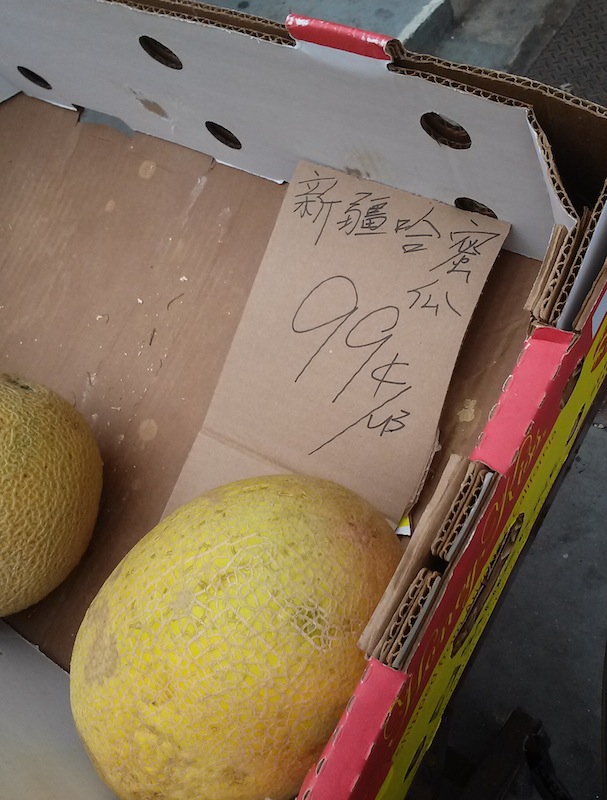
“Xinjaing hamigua 99¢/lb”, in front of Four Seasons Seafood in Chinatown

Today I took a long walk and ended up in Chinatown.  I was thirsty, and I found one of several shops that carry such melons.  The shop was better known for fish and seafood, but the melons looked pretty good too.  The sign said in Chinese “Xinjiang hamigua 99¢/lb”.  I bought one.

IMG_1733Upon closer inspection, the fruit is obviously not from Xinjiang.  In Philadelphia and in the USA, we only rarely enjoy imports from the distant land of Xinjiang.  Most commonly, if we are eating Xinjiang produce at all, we are eating ketchup that is made with Xinjiang tomatoes.  In other cases, we can find imported dried foodstuffs that are marketed as common “Chinese” products, without any mention of Xinjiang as the home province of origin.  Finally, we can occasionally find other food items that make their way after being processed and packaged.

Other kinds of melon, cantaloupe for example, have in the past been described in Chinese as “hamigua”.  This is likely the reason why we may see “Xinjiang” on signs at markets, letting us know these are the Xinjiang Hami, not the other ones.

Of course this melon did not come from Xinjiang.  It is a product of a US company that manages farms in the US and Chile, called Sandstone Melons.  You can learn about Sandstone and their hami melons (marketed in English as “Honey Kiss Melons”) via their website here.  This is one of the many new foods that is now grown in North and South America for US consumption.

IMG_1734This melon was sweet, as was guaranteed by its label, but it paled in comparison to Xinjiang’s melons.  It was hard and crunchy as opposed to lush and juicy.  Perhaps it is off season, or perhaps it could have been riper.  Despite its not exactly living up to my memory, it certainly was a contender compared to mediocre cantaloupe and musk melons from the standard grocery store chains.  The flavor profile is similar to that of a cantaloupe melon, but these tend to be sweeter.  And the shape is different.

Give it a try if you find your local market selling them.  Better yet, travel to Northeastern Xinjiang to get the original version.

*I’m choosing not to capitalize since it is now a variety of melon in English, known not by the city name of Hami, as it is in Chinese.

Posted in - Featured Food Discoveries, Central Asia/Uyghur food, Chinese food | Tagged , , , , , , , , , | 4 Comments