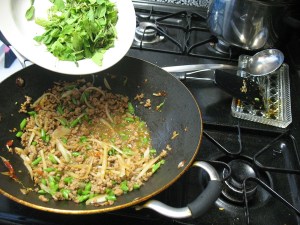
Lamian (pulled noodles) in University City

mian3

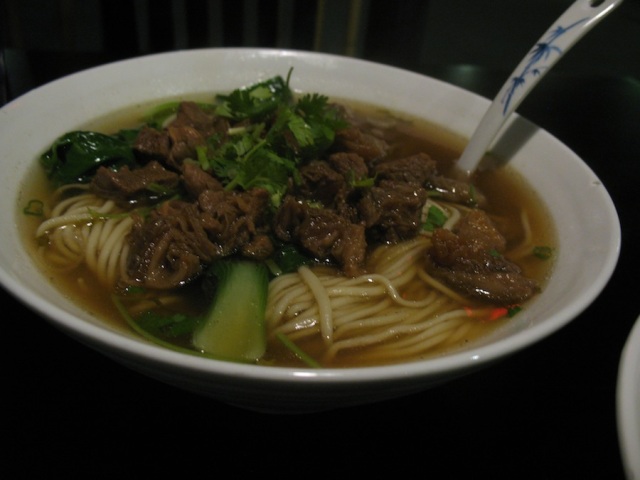
Chattime’s hand-pulled beef brisket noodles

Life is starting to get easy.  A new place opened up next to the Wawa on 36th and Chestnut in University City that does a decent pulled noodle (lamian 拉面–see here for my more detailed entry about this noodle dish).  Lamian isn’t the theme of the restaurant at all–most of the menu is an odd mix of sushi, Japanese noodles, and bubble tea.  You might expect this kind of menu outlier to be made with dried noodles or frozen noodles, but when you order a bowl, a noodle-puller will come out to his station, next to the sushi chef, and pull to order.

The restaurant is called Chattime Hand Drawn Noodle & Japanese Cuisine (a shameless corruption of the Taiwanese brand franchise Chatimeas in “tea” time, down to the same use of fonts).  [UPDATE: Since the end of 2015, this restaurant was renamed Ochatto, perhaps in connection to the Chatime franchise extension to Philadelphia in 2016]  Anyway, the noodles are decent, if not a little pricey, and they also do “shaved noodles”, another Chinese specialty where a chunk of dough is shaved with a razor, directly into boiling water.  I found the consistency of this type of noodle less enjoyable than the bite of their lamian.

Can’t complain too much when lamian is an option, and so close to work.

Posted in - Featured Food Discoveries, Chinese food | Tagged , , | 4 Comments

Turkish hot pepper paste and cracked wheat salad

Today I’ll share a recipe for one of my favorite Turkish dishes.  It is a fine cracked wheat (a.k.a bulgur or burghul) salad.  In Turkish the salad is called kısır.  This is a very nice thing to eat on hot days, along with a nice lettuce, cucumber, and yogurt sauce.

One item commonly used in this salad that is not readily available in most US markets, is red pepper paste.  This is similar to tomato paste, but made from peppers, of a variety akin to Hungarian paprika.  The Turkish name is biber salçası “pepper paste”.  Here is the brand that I am using, found at one of the comprehensive Turkish markets in Delran, NJ (if you are serious about cooking Turkish food, you need to visit the communities near Delran).  This one is a acı “hot” version of the paste, I don’t find it particularly spicy, but the regular kind would be less spicy.

kisir2

Turkish (hot) Pepper paste, “Gaziantep home style”

So far I’ve only found one market that has Turkish pepper paste in Philly.  That is the Queen Village market on 2nd street (see map section), which carries many desired Turkish food items.  The bag of bulgur below was also purchased there.

kisir1

Basic ingredients (minus vinegar and olive oil) for making the salad. Notice my bag of bulgur–written on the label is “köftelik-kısırlık”–meaning for kofte (spiced patty–usually meat but sometimes lentil) and kısır (the recipe below)

The recipe is very simple.  One of the most important points is to not overcook or over saturate the cracked wheat with liquid.  My recipe is kind of generic, and it will depend on how juicy your tomato or herb ingredients are.  Here we go:

Ingredients:

  • 1 cup bulgur (cracked wheat, also known in Arabic as burghul).  For this recipe it is best to use fine or medium fine sized bulgur.  Most markets sell a variety of sizes.  Some brands are numbered 1-3, fine to coarse.  My bag says “fine” on it.  One cup goes a long way.  This recipe will feed 2 or 3 easy.
  • 1 bunch flat leaf parley, coarsely chopped
  • 4 medium sized green onions
  • 1 medium tomato, chopped
  • about 12 leaves mint, fresh or dried
  • 1/4 cups each olive oil and clear white vinegar
    (many recipes use lemon juice in place of vinegar–I prefer vinegar)
  • 3 Tbsp red pepper paste (biber salçası)
  • 2 tsp salt

Method:

1. Boil water in a kettle.  Put the bulgur in a bowl (with room to grow–i.e. with high sides).  Pour the boiling water over the bulgur, just covering it.  Cover the bowl tightly with a plastic wrap, lid, or some mechanism.  Let sit until bulgur swells, about 10 minutes. Do other steps meanwhile.

kisir3

bulgur swelling.

2. Put the oil, vinegar, pepper paste, and salt in a bowl and whisk it to a thick sauce.  Pre-mixing in this way makes it easier to distribute the flavors among the bulgur.  I suggest not using all of this mix, but mixing with the bulgur salad to taste.

kisir5

pepper paste, vinegar, oil, salt

kisir6

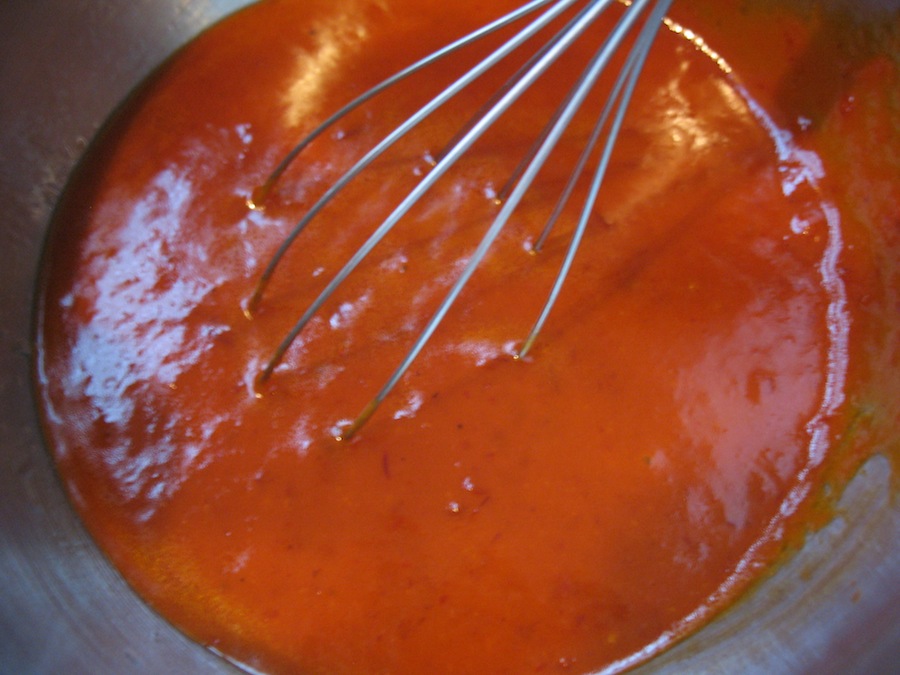
pepper paste emulsion

3. chop the herbs, green onion, and tomato.  If the tomato is really watery you might want to drain or squeeze out some excess water with paper towels as bulgur might get too saturated.

4.  Use a big bowl to mix all ingredients, it’s a lot easier.  You can plate it on a smaller plate or bowl after mixing.  If bulgur is still very hot (temperature-wise), herbs will wilt a bit and give up a little water, FYI.  Use only as much of the paste mixture of step 2 as you need, maybe as little as 2/3 the mixture.*

*This is a standard recipe (i.e. derived from other recipes) that I’ve used and enjoyed many times.  Today it seemed a bit too much vinegar and pepper paste.  So, maybe less is needed.  Best to taste as you go.

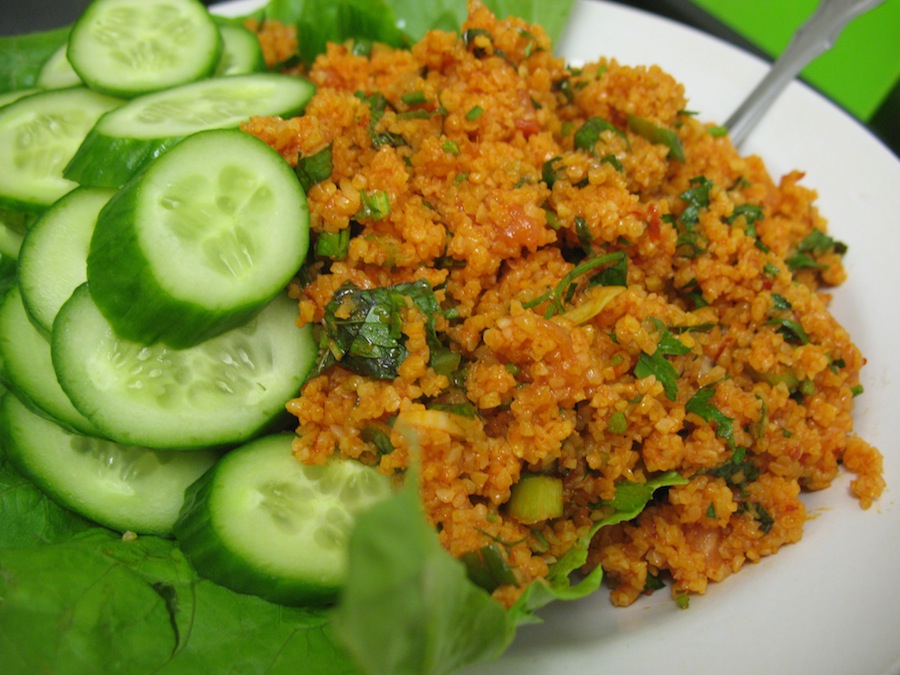
kısır with some cucumbers and lettuce, yogurt off camera (but necessary accompaniment!)

today’s kısır with some cucumbers and lettuce, yogurt off camera (but necessary accompaniment!)

Posted in - Featured Food Discoveries, - Recipes, Turkish food | Tagged , , , , , | 2 Comments

7th Street’s Friendly Market

A few days ago I gave a rough breakdown on the many markets on 7th Street.  I didn’t mean to leave out an important highlight on South 7th: the Friendly Market, a market with truly unusual food products.  The sign has hints as to why this market’s food finds are so unusual.  Friendly MarketSpecializing in products primarily from Nepal, and Burma, surely this market has things you haven’t seen before.  In terms of Burmese products, you can find an assortment of ingredients to make your own pickled tea (lahpet thohksee here for a post with a recipe) and pickled ginger salads.  You can find the various nuts that are common to Burma and South Asia.  You can find instant mixes for making the national dish mohinga, a noodle and fish soup.

The Burmese offerings are considerable, and there is a surprising selection of offerings from Nepal as well.  There are a number of unique spices I found here that I have never seen before in the states:

Jimbu, a dried grass-like allium used in Nepali pickles and chutneys:

jimbu

Jimbu, a very rare spice in the US

Timur, a cousin of the Sichuan pepper (huajiao), aka Himalayan pepper.  Check out interesting introduction to this spice via experiencing Masterchef India.  This has a stronger aroma than Sichuan pepper.  More on this spice in a later post.  For now, here is from me:

a close up of the elusive timur spice

a close up of the elusive timur spice.  Whoa that is strong smelling stuff

In addition to this variety of rare items, there are many South Asian products and foods from Thailand.  The market is very clean and neat, and it’s the kind of place you can return to, and still find something new.  Friendly Market can be found at 2135 S 7th St.

Posted in - Featured Food Discoveries, - Featured Markets, Cambodian food, Myanmar/Burmese food, Nepali food, Thai/Lao food | Tagged , , , , , , | 8 Comments

Guilin rice noodles, part two

Now that the hard part is done with the preparation of the master stock, or lushui 卤水 (described yesterday), putting together a delicious bowl of Guilin rice noodles, or Guilin mifen 桂林米粉, is relatively straightforward.  If you want to make this dish, but do not have the time or interest in making your own master stock, you can buy a bottled liquid version at your local Asian market, usually called “Chinese Marinade” or “Chicken Marinade”.  If you go this route, bring this to simmer as if it is your stock in a small pot.

Choose and prepare meat topping.  I chose a beautiful filet mignon (beef) from our local co-op, Weaver’s Way in Mt. Airy.  I sprinkled salt on it, let it sit for a little bit, dried it with a paper towel and browned it in a lot of hot oil on medium-high heat.  I seared it almost to the point of charring on all sides, for about 10 minutes.  After it was crispy and well browned, I took it out of the oil to rest on a plate for 15 minutes.  Since this was a thick cut, there was a nice and crispy surface on the outside, and it had nice color and texture on the inside.  A roasted, braised, or even boiled meat: beef, duck, chicken, pork would also be great.  Could be leftovers, doesn’t have to be extravagant.

browning beef

Boil the rice sticks/rice vermicelli.  The names for this item can vary.  In Chinese they are often referred to as Guilin rice noodles (guilin mifen 桂林米粉), or sometimes laifen 瀨粉.  In Vietnamese they are known as bún, or bánh (like the bag below).  As long as the ingredients are rice and water, and if they are similar size to spaghetti, they will be perfect.  Below is an image of the kind that I got, and they were too big–I prefer (in hindsight) a little thinner.  Beware: sometimes instructions on the bags are way under on cooking times.  For this giant noodle that I cooked today, the bag said 15 minutes in boiling water, but mine took nearly 30 minutes.  They take longer than pasta or other types of noodles.  They should have a little bite to them, but not too tough of course.  Once al dente, drain and rinse under cold water to stop the cooking.  Just keep an eye on them, stirring from time to time.  Don’t let them overcook.

mifen

XL rice sticks. They really were! Too big.

Chop the vegetable toppings.  Finely chop green onion and cilantro.  Choose a good pickled vegetable to accompany the noodles.  The standard at my Guangzhou restaurant, and my favorite to date is pickled long beans.  You can often find them in the “pickled things” section of the Asian market.  I found mine at the basement market in Chinatown. Rinse the vegetable if need be.  The long beans tend to be kind of briny.  A rinse does them good.  I’ve also had this with chopped pickled mustard greens, those are good too.

pickled_beans

Prepare crunchy nuts for the topping.  Some recipes call for roasted or fried peanuts, but my Guangzhou restaurant always used fried soy nuts.  I find that the soy nuts available at co-ops, Whole Foods, etc. groceries are a very suitable match.  No special preparation is necessary.  The ones I used here I got from Weaver’s Way co-op in Mt. Airy.

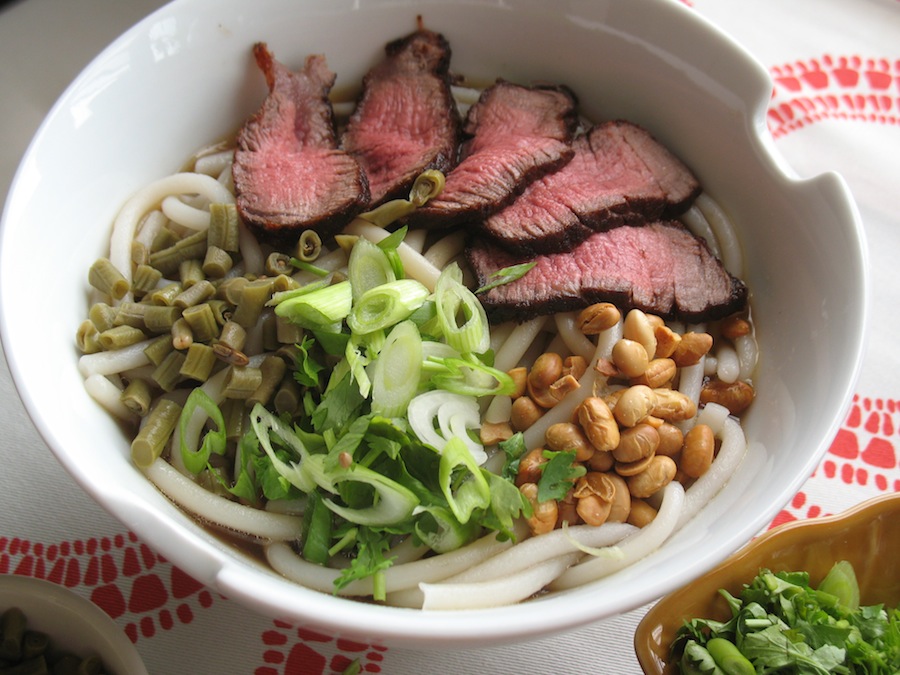
Finally, assemble it all in a bowl.  Noodles first.  Very hot master stock second, 1-2 ladles worth.  Stock should be fairly concentrated.  If it is too concentrated to enjoy as a soup base, top off with boiling water or the water you boiled your noodles in to make it more palatable.  Sliced meat on top, with chopped pickled veg, cilantro and green onion, and soy nuts.

My finished product. Quite like how I remember in Guangzhou.

Posted in - Featured Food Discoveries, - Recipes, Chinese food | Tagged , , , , , , | 5 Comments

Master stock for Guilin rice noodles

Guilin rice noodles, or guilin mifen 桂林米粉, is a delicious lunch or anytime snack that is popular not only in Guilin, but in large cities all around China.  There used to be a place right near my old school in Guangzhou that I went to often.  I’ve never actually been to Guilin, so I have no idea how the noodles in my memory from Guangzhou and Beijing stack up to Guilin.  The noodles I know are delicious though, and that is enough for me to want to make them at home.  Unfortunately, I know of no such noodle shops in the Philadelphia region.

guilin mifen2

my recent effort at home at making a bowl of Guilin rice roodles 桂林米粉

The basic layout of the noodles is very simple: a master meat stock base (lushui 卤水), rice sticks about thickness of spaghetti, pickled vegetables, crunchy nuts, green onions and cilantro, topped-off with a sliced roasted or braised meat.  The next post will provide a lot more detail for the staging of the noodles. Today I’ll focus on the master stock.

There are several recipes online (in Chinese) for making Guilin-style master stock. I based my most recent effort on a good recipe on a Chinese blog xiachufang.  I took an afternoon and rounded up as many Chinese dried spices and herbal ingredients as I could find.  I didn’t find everything, but I got most of it. By the way, if you are not ready to commit to buying all of these items individually, Asian markets tend to have mixed bags of spices, ready to go.

It should be noted that this stock has counterparts in lands across Southeast Asia.  The beloved Thai dish kai palo ไข่พะโล้ is basically this same master stock, cooked with pork belly and shelled hard boiled eggs. Here is a picture of the dry spices I included in my seasoning:

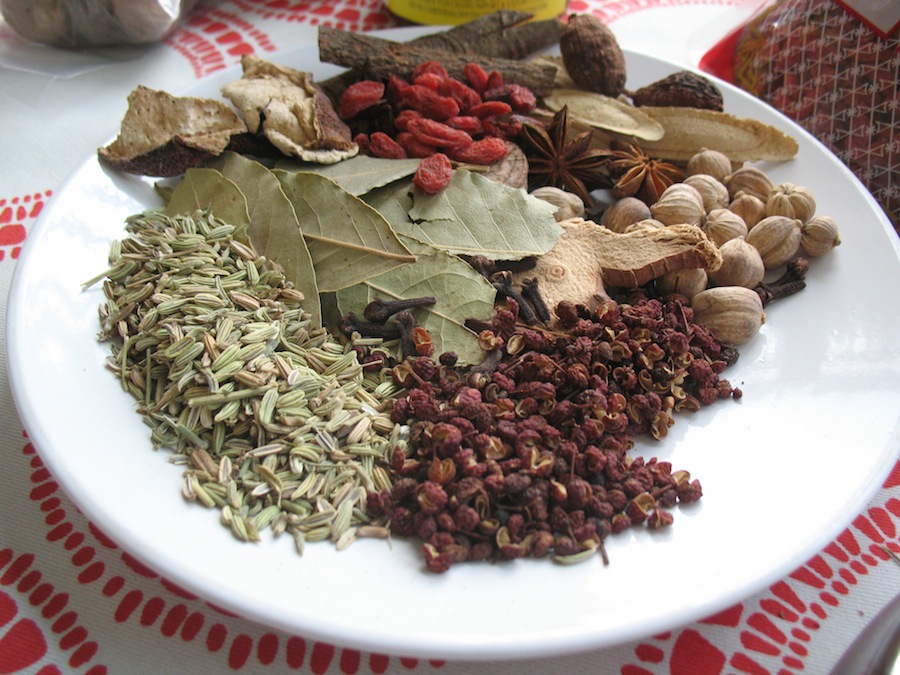
Spices used for my Guilin master stock

Dried spices used for my Guilin master stock, starting from purple spice bottom going clockwise: Sichuan peppercorn (huajiao), fennel seed and clove, bay leaves, dried orange peel, goji berries and nutmeg, cassia bark, caoguo pods, liquorice root, star anise, white cardamom, and galangal root

In addition to these dried spices, I also included chunks of ginger, green onions, bashed-up lemon grass.  The process of making the stock is incredibly simple.  It just takes time to simmer (4 hours).  The result was marvelous.

Ingredients, dry spices for step 2 below: about 5 grams each of the following: cassia bark, liquorice root, caoguo pods, white cardamom pods, star anise, galangal root, nutmeg, bay leaves, and Sichuan pepper (huajiao). About 8-10 cloves, a couple dried tangerine peels, 4-5 thick slices of ginger, 2-3 green onions.

More ingredients for step 3 below: About a tablespoon of fermented black beans, 4 cubes of fermented tofu (豆腐乳, 南乳), 3-4 dried chiles, about 1 tsp-1 Tbsp salt, 1 cup of dark soy sauce.

Method:

1. Select about 1 lb of bony meat to use.  I used pork hocks, with fat, skin, and bone.  Parboil meat for 5 minutes in a different pot if you are using pork or beef bones.  This will help keep the master stock clear.

2. Boil 4 or 5 liters of water.  Put in the meats of choice, along with all of the spices.

3. After 2 hours, toss in the salt, dark soy sauce, fermented tofu, chile peppers, fermented black beans, rock sugar, and simmer for an additional 2 hours.

4.  Strain the stock and it is ready to use.  Use the 1st meat for other dishes, or for your noodles. This stock is meant for boiling meats in the future.  It will produce amazing results if you maintain it.  It can be repeatedly frozen and thawed between uses.  Taste the stock in later renditions.  If it needs additional sauces or spices, add more.

After straining, these are the trowaway bits. Of note: the fermented tofu blocks really imparted a beautiful addition to the stock

After straining, these are the throw-away bits. Of note: the fermented tofu blocks really imparted a beautiful addition to the stock

Pork hocks, 4 hours in the master sauce.

Pork hocks, 4 hours in the master sauce. Sublime.

making lushui

Finished strained master stock, fat globules a-floating. Ready for use in Guilin rice noodles

Next post: assembling the noodles.

Posted in - Recipes, Chinese food | Tagged , , , , , , , | 15 Comments

Tom yum plaa, Thai hot and sour fish soup

Coming home with a nice looking bunch of sawtooth coriander and Thai basil bai horapa ใบโหระพา (not to be confused with holy basil), I decided to cook a pot of tom yum plaa.  Tom yum is pretty common on Thai menus in the US, usually with shrimp, tom yum koong.  I love the fish version, that is less commonly found in restaurants.  This version has an addition of savory herbs, Thai basil, kaffir lime leaf, cilantro, sawtooth coriander, green onion.

IMG_1415

many of the green ingredients that are going into the soup, from bottom: Thai basil (horapa), above that lemon grass, sawtooth coriander, cilantro, field mushrooms, green onions, limes.

List of ingredients:

  • 4 cups water or stock–or to the amount you need–stock should cover fish by about an inch
  • 2-3 stalks fresh lemon grass, tough green tops cut off, (mostly white part) cut into 3″ lengths and banged up
  • Thick slice galangal, banged up (or 2-3 slices of dried galangal)
  • 5 cloves garlic, peeled and slapped with a blunt object to split them open
  • 2 tsp of sea salt
  • About 1 lb or less whitefish or catfish (I used 6 fillets of frozen whiting), cut into large bite-sized hunks
  • 4-5 pieces fresh kaffir lime leaf (i.e. 2 pairs of leaves)
  • 4+ fresh Thai chilies, split in half, as few/many as you like
  • Fresh tomato, sliced into wedges. If using small tomatoes use a few
  • small pack field mushrooms, cut lengthwise into quarters or sixths if large
  • Handfuls of the following, roughly chopped: sawtooth coriander, cilantro, green onions, Thai basil leaves (horapa)
  • fish sauce.  Probably about a tablespoon or more, to taste.
  • 1-2 limes, depending on size of limes

This soup is very simple.  Bring the water to boil.  Throw in the lemon grass, galangal, garlic, salt.  Boil for 5 minutes.  Add in the fish, chiles, tomatoes, kaffir lime leaf, mushrooms.  Cook until mushrooms and fish are just cooked (might be another 5 minutes).  Add in the handfuls of leafy herbs and taste for seasoning.  If it doesn’t seem salty enough, keep adding fish sauce.  This will really help to bring the soup together.  When the seasoning is right, and the leaves are nicely wilted, turn heat off.  I like to add lime juice directly to the bowl before adding soup.  If you have a large bowl, start with 1/2 a lime’s juice.  Lime can also be added to the pot directly.  The soup should be kind of sour and complex with the flavors of galangal, lemon grass, and leafy herbs.

IMG_1426

My finished product. Not super photogenic, but full of flavor

This dish is a nice accompaniment to Thai or Chinese stir fry dishes–and jasmine rice of course.

Posted in - Featured Food Discoveries, - Recipes, Thai/Lao food | Tagged , , | 3 Comments

Markets of South Philly’s 7th Street

Among Philadelphia’s many hidden charms are its neighborhoods.  Some of those neighborhoods can transport you to other lands, complete with markets, restaurants, religious temples, and even street food–from sources that are commonplace in other countries.  Though long gone for France, the colonial land of Indochina lives on in South Philly.  Cambodian, Vietnamese, and Lao immigrants have formed little slices of home on 7th Street, largely in between Snyder and Oregon avenues.

For someone like me, looking for unique food items of Southeast Asia, this is a kind of heaven.  There are no less than eight food markets on 7th Street, and there several Cambodian/Vietnamese restaurants, and even several Southeast Asian coffee shops.  There is a lot to experience!

Let’s go for a walk.  I’ll point out some of the main markets and sights.  Walking south from Snyder, this is the first market on your right.  It is kind of dark, but it has a basic selection of fresh and refrigerated items, with the standard non-perishables for Vietnamese and Cambodian cooking.  Much from Thailand, as is true for every place in Philly.  Thailand is the primary exporter for mainland Southeast Asia.  There is no Thai market in Philly, though (to my knowledge). IMG_1403 The next market is on the left side, the Rising Star Grocery. IMG_1401This one is interesting, it is a lot brighter, and there is a nice selection of obscure leaves and herbs.  The 3 large markets on Washington Ave will have most of these items, but not all.  Lemon basil and holy basil noted among an increasing selection of Burmese items.  Today I picked up a pickled tea leaf salad kit.  They have other Burmese items too.

Across Winton Street there is Phnoum Penh Tmay Market.  This market is not bad, again, standard items for Cambodia/Laos tastes.  I overheard Lao spoken here, could be Lao run. IMG_1402There are also many other shops in this neighborhood.  In the above picture you can see “Angkor Pharmacy”.  There are medicine shops, laundromats, hair salons, video stores (yes, still), traditional Khmer clothing stores, etc.

UPDATE 24 July: I didn’t mean to leave out the impressive Friendly Market! That market is in between these two, and it is so specialized with products from Nepal and Burma, that it deserves its own post.

IMG_1404Next up is Chai Hong Market.  This market is well stocked, and there are some relatively obscure fresh vegetables and items from Thailand.  The shop owner has a savory fruit dip tray set up near the cash register, like they do at Whole Foods for tasting new products.  There are usually Cambodian karaoke videos playing.  Today I bought some nice sawtooth coriander for a fish soup that I’m planning tonight:

IMG_1419

sawtooth coriander

I also found a few items here that I didn’t find at the larger Washington Ave markets, while preparing to make a master stock for a Chinese rice noodle dish (see Guilin noodle post). Moving on.

One more market that might be Lao (there were guys eating grilled meat outside speaking Lao anyway).  This one is Koh Kong Market at the corner of Moyamensing Ave.  Again, a decently stocked market in terms of basic necessities for Cambodian and Lao cuisines. Nice basic selection of herbs and veggies.  I felt bad because I already had everything I was prepared to buy for the day.  “Just looking,” I have to say. IMG_1405I should mention that all of the signage we have seen today is in Cambodian (Khmer), often translated in Vietnamese, and occasionally in Chinese too.  More rarely can Lao be seen.  I’ve already mentioned that I’ve been hearing Lao spoken at shops.  Either some shopkeepers are bilingual, or the signs don’t represent the nationalities of the owners.

For me, Lao is a kind of “home”.  I am barely conversational in Lao, but still, I feel very comfortable among Lao people.  Beyond language, I can say that I am comforted by the flavors of this “home”: grilled meats, eaten together with sticky rice, papaya salad (mashed together with the super umami of fermented fish), and a funky spicy paste known as jaewbong.  It is so good.

Much to my pleasure, I encounter some Lao folks on 7th street.  Just south of Wolf Street, there is an enclave of sorts.  It’s my lucky day, and they are grilling out, with all of the standard accoutrements.  Grilled meats on skewers: beef, chiken wings, or Lao sausages (if you haven’t had Lao-style sausage, you should try, it is delicious–sour pork mixed with rice and spices and crammed into a tube).  Too much to go on about here, about how good Lao food is.  More coming later.

There is an unmarked Lao market on 7th, in between Wolf and Ritner, across from the Lao video store.  It is a small selection, but I was able to find an obscure spice there, the Thai version of the Sichuan peppercorn, makhwaen มะแขว่น.

Around the corner towards the Delaware River you can find the Cambodian Buddhist temple and school.  Its unique architecture and sculptures will also transport you to another place.  It is an amazing complex, you should see it for yourself.

IMG_1409

Cambodian temple over on 6th and Ritner St, Preah Buddha Rangsey Temple

IMG_1408

IMG_1407

Traditional Cambodian sculptures on W Ritner Street

I hope you pay a visit to 7th Street.  It is kind of like taking a trip to mainland Southeast Asia.  If you have a particular need for a Southeast Asian food ingredient, you are sure to find it here!

Posted in - Featured Food Discoveries, - Featured Markets, Cambodian food, Myanmar/Burmese food, Nepali food, Thai/Lao food | Tagged , , , , | 5 Comments

Uyghur flatbreads, meat pies, and the tonur oven

I love looking at recipes and cookbooks–especially the kind that explain the unusual elements you are trying to replicate.  There are some gems out there for US cookbooks nowadays, with authors that do go through great lengths to explain culture and unique ingredients.  What I hate is, “if you don’t have ‘x’ then just use more salt”–recipes pre-adapted for typical American tastes or kitchens.  Adapting is totally fine, I just hate it when the reader is not given a proper context of understanding of how their ingredients might differ from those of whatever native region.  For that reason, I love shopping for cookbooks in the places where I encounter my food obsessions.  I always look for instruction in that region’s native language–with the understanding, of course that the whole idea of cookbooks and DIY is very American. Underrepresented regions of the world, like Xinjiang for example, are publishing interesting cookbooks, and they are much fun to come across.

One of these regional cookbooks that I’d like to share today is in Uyghur, a Central Asian Turkic language, written in the Arabic script.  The book was published by the Xinjiang People’s Publishing house in 2007, and it is part of a series on Uyghur culinary culture, by Yunus Hemdulle.  It is titled, Nan samsa komechler (flatbreads, meat pies, and buns).

Nan1

A favorite cookbook from my collection: “Flatbreads, meat pies, and buns” by Yunus Hemdulle (Xinjiang people’s publishing house, 2007)

First of all, notice the language of the title.  Nan is of course the same “nan” or “naan” that is pretty much universal for flatbread, as you might recognize from your favorite Indian restaurant.  Samsa comes from the same root that “samosa” does.  Komech is an outlier here meaning “bun”.  Many words in Uyghur have connections to Central Asia, India, and beyond. Why is this?  The Turks (whose descendents include the Uyghur, Kazak, Uzbek, Kyrgyz, Turkmen, Tatar, Azeri, Turkish) were powerful armies, and they had at several times throughout history dominated vast lands: from Mongolia to India, from China to Africa.  I’m not saying that the root of all things is Turkic, but that interaction of peoples paved the way for many, many linguistic and cultural loans and borrows across Eurasia.

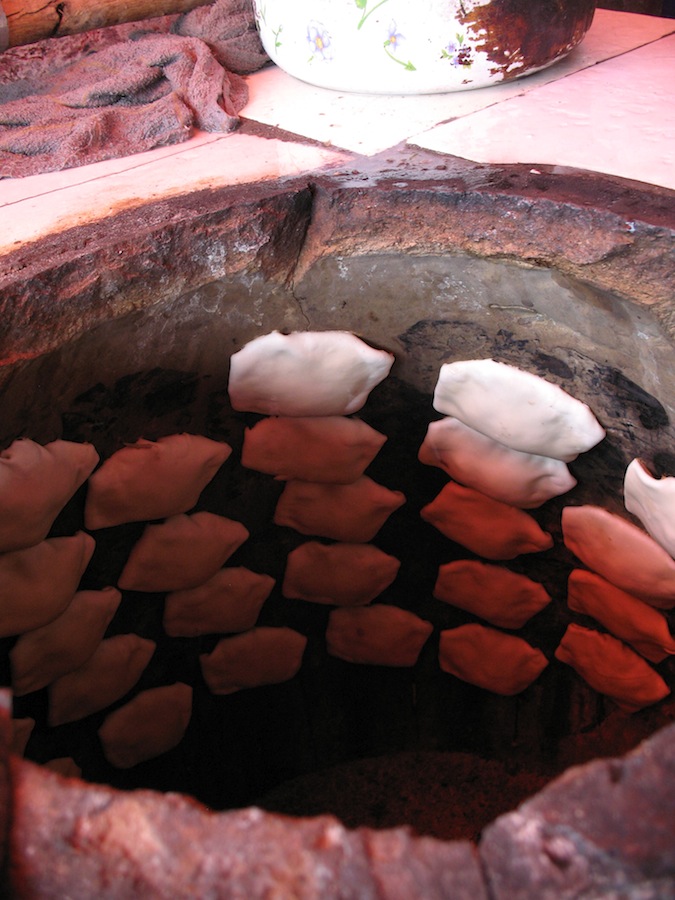
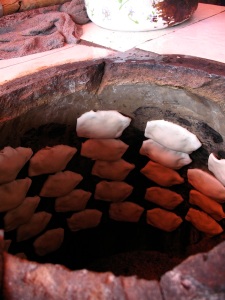
The recipes in this cookbook are meant to be cooked in an Uyghur tonur, or as they say in India, “tandoor”.  A tonur is a wood-fire oven that is shaped like a big jar.  They can be made out of a variety of materials, from ceramics to iron.  A wood fire is stoked on the floor of the oven, and there is usually a box built around the oven to allow for the baker to easier angle themselves to put breads onto the oven’s inside walls.  See a video so you can get an idea of this process here, a nan baker from a tourist video in Turpan.
samsa

Cooking Uyghur meat pies (samsa) in a tonur in Ghulja (Yining) Xinjiang, 2010

Uyghur breads are made from simple wheat doughs.  Yeast, a little salt, a little oil.  Occasional other ingredients might be egg, butter or fat, seeds or onions as toppings.

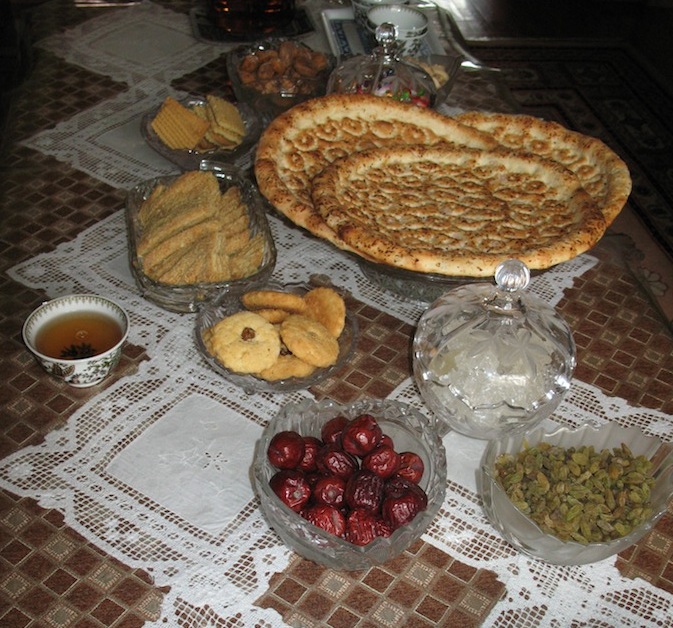
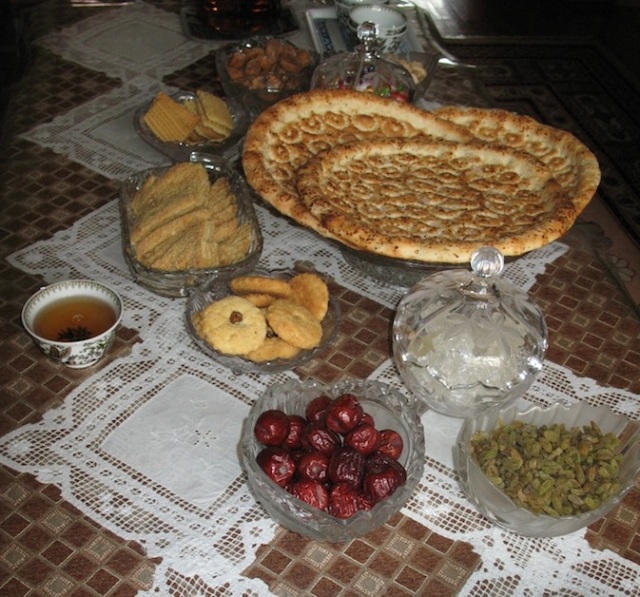
Many traditional Uyghur nan are very thin in the middle, punctured by a device to inhibit the bread from rising while baking.  What this amounts to is a ring of puffed bread, and a crater, similar in texture to nearly that of a saltine cracker.  This traditional shape is usually marked with a concentric design, and the bread itself can act as serving tray for roasted meats or other dishes, or as a compliment to eat alongside breakfast or lunch tea or with a soup or stew.
guest foods

Tea time at an Uyghur household: a selection of dried fruits with some beautiful Uyghur nan, with punctured designs

Back when I lived in Guangzhou in the ’90s, typical baked goods were primarily sweet breads and deserts.  They were a novelty in a region where most things were cooked on top of a fire or stove (steamed, boiled, or fried).  Foreigners, missing salty or savory breads, used to flock to the city’s Muslim quarter (Sanyuanli三元里) to find cheap and delicious wood fire baked breads.  Some would buy Uyghur nan flatbreads, in order to decorate them with tomato sauce and cheese to emulate “real” pizza that they remembered from home (as opposed to what was called “pizza” at Guangzhou’s pizza restaurants).

This cookbook begins with an concise history of bread, complete with images of ancient funerary statues of bread bakers.  Also in the introduction is, “how to build your own tonur oven,” with a step-by-step photo description on how to do this. I love this.  American cookbooks would tell you what things you can buy, and if you can afford it, then you should buy the top-of-the-line version.  This book explains how to make what you need, from the most basic ingredients: earth, concrete, a metal ring, and some wood.

Why does tonur/tandoor produce such delicious breads?  It’s the same idea as your local neighborhood (if you are lucky) wood fire pizza place.  Get a strong wood fire going, keep feeding oxygen to that fire to get it quite hot.  Stick some bread dough on the stone walls of the oven.  They’ll bake and brown really fast, browning beautifully on the outside while staying moist on the inside. They also retain that wood fire aroma. The bread is peeled off the wall with a big tongs.  Classic and delicious.

Unfortunately there isn’t a go-to Uyghur restaurant that I can suggest for you to try this delicious cuisine.  It is still largely unknown in the states, and restaurants are rare.

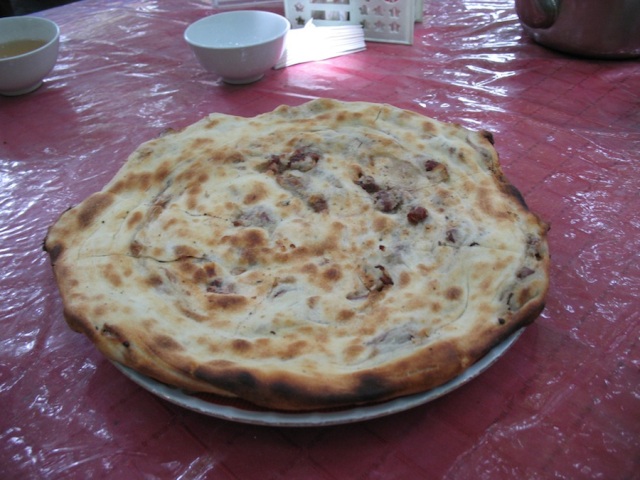
Nan breads, meat pies (samsa) and buns are possible to duplicate in standard US ovens.  You won’t have the intense heat of the wood fire, or the smoke, but you can do pretty well baking at high heat on a pizza stone, emulating the shock the dough would get when getting stuck to a tonur wall.  Stay tuned for a recipe to make one of the special breads in this cookbook, goshnan, or “meat bread”.  Update 22 Feb 2015: I finally posted that recipe. Here is an image of a delicious example that I captured in Urumchi a few years ago:
goshnan1

Uyghur goshnan, or “meat bread”
Posted in - Unique food traditions, Central Asia/Uyghur food | Tagged , , , , , , , , , | 9 Comments

Tofu threads, a nice cold side dish

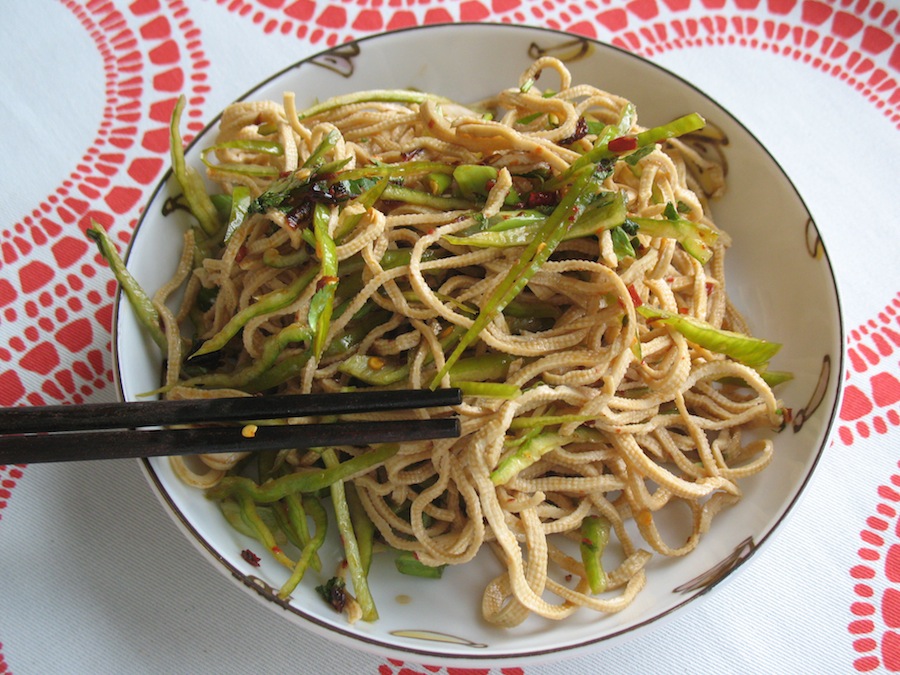
tofusilk3Back in 2010 I enjoyed a northeastern-style buckwheat noodle restaurant in Huhhot, Inner Mongolia.  On the table were several cold plate dishes to eat together with the noodles, among them was a small dish of tofu threads or tofu “silk”.  It was really nice, and new for me (most of my eating experiences in China had been other region’s foods).  I really like the idea of having several cold dishes to eat along with one or two main dishes, like banchan at the Korean table.  In addition to the cool nature of the dishes, especially during Philadelphia’s hot summers, the overall meals just seem healthier.

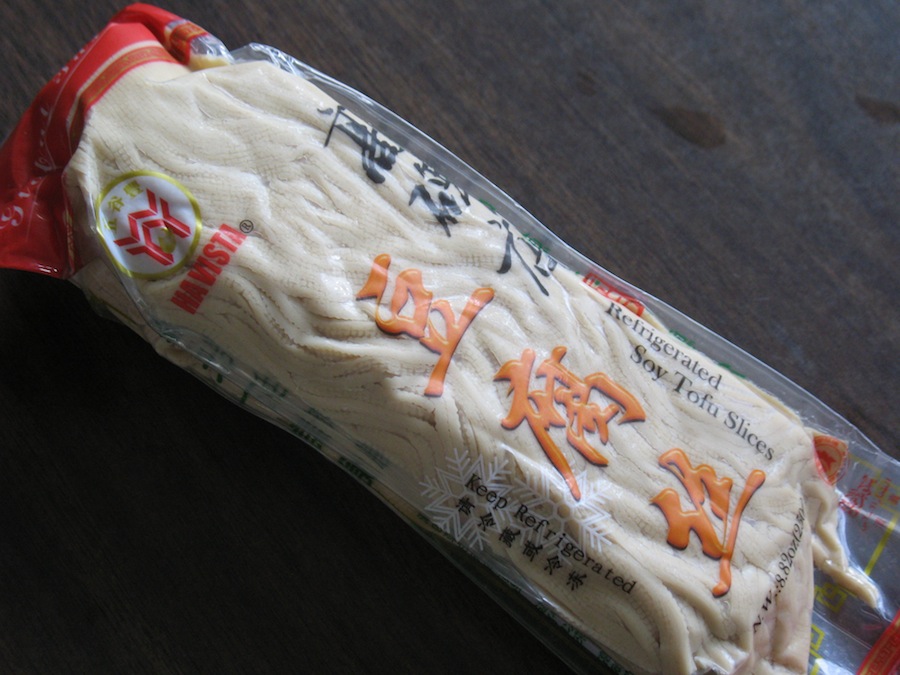
I found tofu threads in the refrigerated section of Spring Garden market.  There was a variety of sizes.  I bought this smaller bag for around $2. There are different kinds, some are infused with flavors.  I accidentally bought this kind.  This is the “5 spice” version.  The spices are very mild, though, and it didn’t affect my recipe.

Tofu "silk" found at Spring Garden market

Tofu threads found at Spring Garden market

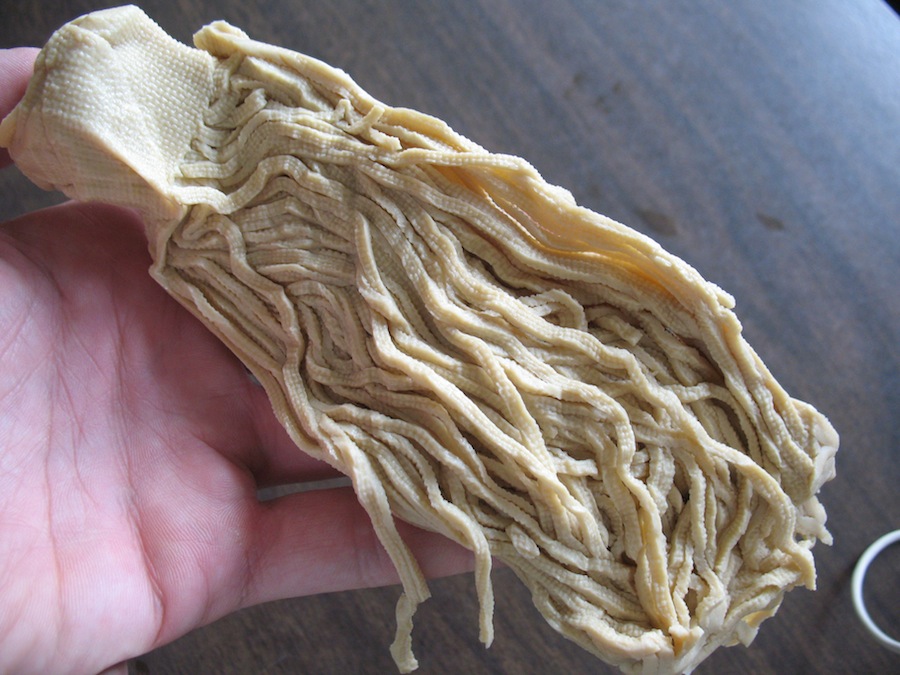
The small pack has two bunches of tofu threads.  This is what a bunch looks like:

tofusilk2It is actually a long sheet with tassels, rolled up.  You can just cut the tassels off and use those, and you can make the head into matchsticks too if you don’t want to waste it.

tofusilk3

I made a very simple cold dish.  I cut some chile pepper matchsticks, and mixed a simple sauce with a little black (Chinkiang) rice vinegar, some Sichuan pepper (huajiao 花椒) oil, a touch of salt, some green onions.

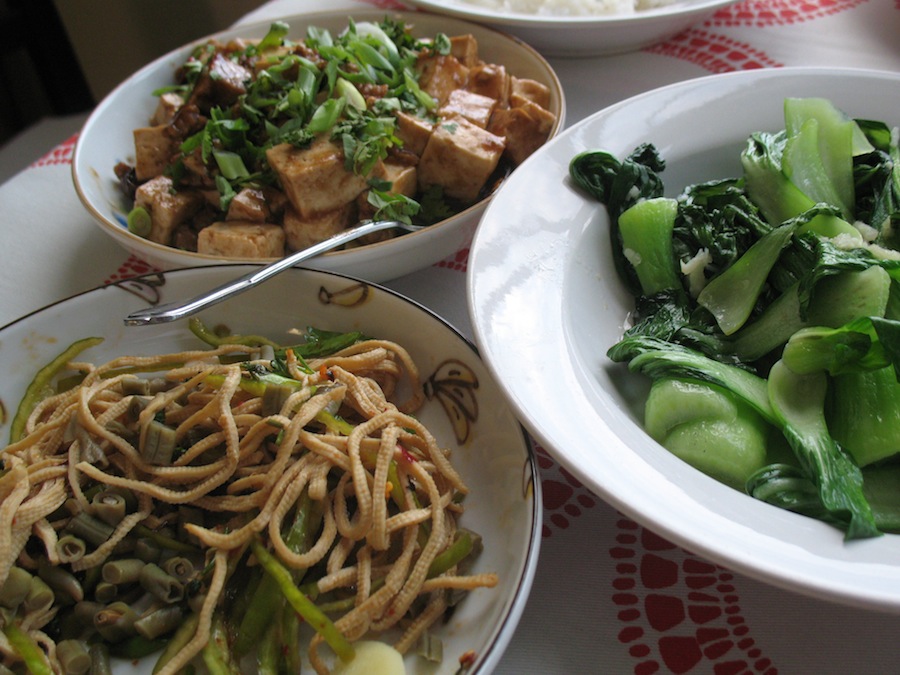
tofusilk4Later I found I had some leftover chopped pickled beans from lunch, I added them too. Turned out nice (can’t really go wrong I think). Other dishes on the table are mapo tofu, and fried baby bok choy.

Posted in - Featured Food Discoveries, - Recipes, Chinese food | Tagged , , , , | 1 Comment

Holy basil, my long lost love

Finding holy basil in the states is often pretty hit-or-miss.  In Wisconsin we could occasionally find this herb in local Vietnamese, Hmong, or Thai markets in the summertime.  These days in Philadelphia, I am seeing it around at Cambodian markets in North Philly (it will take some time to see if this will be a regular offering). Often it’s not as fresh as you’d like it to be, and sometimes you excitedly buy it, but then realize that you bought an even more obscure Southeast Asian herb that is NOT holy basil.

Today I found a beautiful fresh bag of holy basil at a local shop (New Mee Wah Market) over on Old York Road.  It was a buck.  After finding it, I decided to cook it tonight with some long beans and other standard ingredients that I already had at home.

gapao_01

The elusive bai kaphrao, or holy basil

Thai restaurants are ubiquitous in the US, but I have yet to find one that serves this dish with this herb. This is striking because in Thailand it is about the most common thing you could possibly find. I’ve eaten it for breakfast, lunch and dinner, for bar food, street food, and even on the delightful Nakhornchai Air bus service that connects Bangkok to Isaan (this bus service is more like an international flight, complete with a stewardess, reclining massage chairs, video games, and food service). Because holy basil is so common there but so rare here, every time I eat it I am instantly transported back to Isaan.

gapao_18

my version of heaven with a crispy egg on top

I will show you how to make a simple holy basil stir fry. As I said, this is about the most common thing you could ask for in Thailand. There the dish is known simply by the name of the herb. Holy basil in Thai is kaphrao (pronounced, “ga-pow”).  When you order it, you can say pad before it (like “pad Thai”–  “Pad” means “fried”). Beware that many US restaurants actually DO have pad kaphrao on their menus, but in my experience they generally use a different herb in its place. They tend to use the more commonly available “Thai Basil“, or horapa.  That is delicious too, but it is NOT the same.
Pad kaphrao is most commonly fried with Thai chiles, garlic, onion, long beans, and a ground or sliced meat.  A memorable variation is diced crispy-skin roasted pork belly, re-fried as instructed below–for when you can’t indulge enough. Tonight I will make this with ground pork, as that’s what I have on hand.  Here we go…

gapao_02

Ingredients for this dish, minus the ground pork off camera

gapao_03

Mash the Thai chiles with garlic in a mortar and pestle. It is amazing how much of a difference this step makes in the flavor of the dish. Slice the garlic and pepper and it will NOT BE THE SAME.

gapao_04

my nostrils are telling me, “yes this is the smell.”
gapao_05

pick the holy basil leaves and flowers off the stem. if the stem is young and limp, that is fine to add in too.

gapao_06

chop up 3 or 4 long beans. green beans can also be used as a substitute, but they have a slightly different flavor

gapao_07

(optional) fry up a crispy egg. I like to splash hot oil over the top until the edges are very crispy but the center is still runny.

gapao_08

take out some of that oil and fry the garlic and chile paste. (caution this will make you cough and sneeze)

gapao_09

add the meat and stir frequently to incorporate flavors and get rid of big lumps [cough, sneeze…] yep, that smells right

gapao_10

add beans and onions

gapao_12

add fish sauce (this is the salt in the recipe. if it needs salt, add more fish sauce), black sweet soy sauce (this blue bottle), and little sugar

gapao_13

when the meat is just cooked, taste for seasoning. Should be pretty full flavored. If it isn’t, adjust with more salty or more sweet.  As you end the frying process, dump the basil leaves in and stir to wilt the leaves. Turn off the heat.

gapao_16

Hopefully you remembered to cook your jasmine rice to form a nice placeholder for your stir fry. Oh, and top with your crispy egg if you like (see top).

If you go looking for holy basil in Philly, it might be best to ask someone at the shop if it is what you think it is.  It is often not labeled at all.  In Cambodian the name is somewhat similar to the Thai name “ga-pow”. Update: the Khmer for this herb is “mreah prow”, ម្រះព្រៅ

Recipe: I realized I didn’t give you measurements for things.  I used 4 garlic cloves, 4 fresh Thai chiles (adjust if you can’t do spicy), 1/4 a big white onion, about 1 Tblsp fish sauce, 1 tsp sugar, 2 tsp black sweet soy sauce (Thai brand), about 3/4 lb of ground pork, and that plateful of holy basil (approx. 1/3 cup packed). 4 long beans and one egg.  Again, just taste for seasonings before dumping the leaves in, and it will be great.

Posted in - Featured Food Discoveries, - Recipes, Thai/Lao food | Tagged , , , | 11 Comments