A brief visit to Montreal and Thai green peppercorn

This past week La and I journeyed to Montreal for a long weekend.  It was rainy all weekend, but we thoroughly enjoyed ourselves, eating and drinking our way around the city.  Everyone knows the European influence on Montreal is strong, and we situated ourselves right in the middle of the “French Ghetto” (at least this is how it was explained to us by our host).  We tended to focus on African and Asian foods, however, almost completely circumventing this omnipresent European influence.  We visited the famed Marché Jean-Talon, which was really wonderful–but ended up walking away with several items from nearby groceries that we haven’t seen before in North America: a dried and preserved Algerian beef (thanks for the introduction, pseudoerasmus), fresh Thai green peppercorn (prik thai aun พริกไทยอ่อน), and a flower used in spicy dips and soups in Thailand, dok salid ดอกสลิด or dok kajon ดอกขจร. More on the beef and flowers later.  Today we are back in Philly, cooking with fresh green peppercorn, a first time for us in North America.

IMG_1668

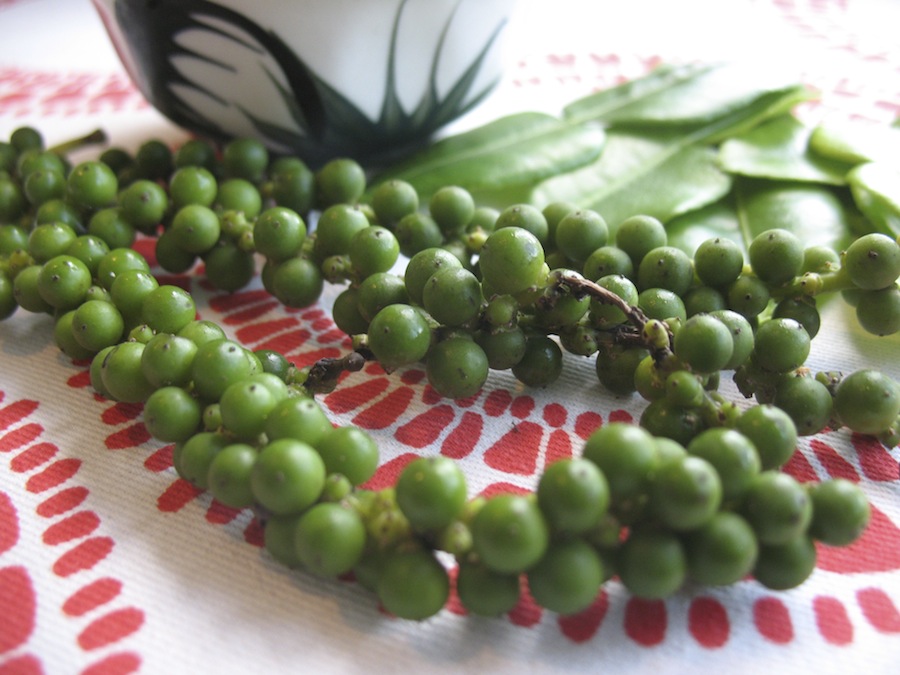
Green peppercorn.

These were labeled as “legume” from the Marché Orientale St-Denis (just around the corner from the St-Denis exit of the Jean-Talon metro stop).

grn pepper

“legume”.

In Thailand, green peppercorn is most commonly used in stir-fries and curries.  When used, it is used in the format above, no chopping or shucking is necessary.  The flavor is like grassy-fresh version of black pepper.  I should mention that most Southeast Asian-focused markets have a canned version of this in brine.  We haven’t had satisfactory results with that in stir-fry cooking.  Consistency is too soft.

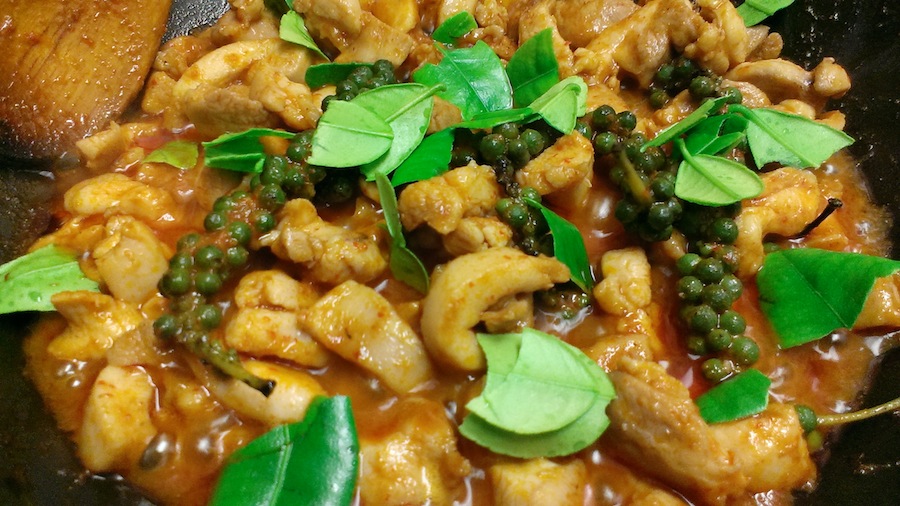
Tonight we are trying a typical Thai dish, pad prik gaeng gai ผัดพริกแกงไก่ “fried curry paste chicken” or perhaps better known as pad pet gai ผัดเผ็ดไก่ “spicy fried chicken”.  We used these green peppercorn, 1-2 tablespoons of red curry paste, about 3/4 lb of chicken cut bit-sized, 2 long green chiles, some fish sauce, some sugar, some torn kaffir lime leaves (see image below).

grnpeppr4Finally, we used some frozen krachai rhizome, cut into near matchsticks.  This was a key ingredient, worthy of its own post, and detail will come later.  For now, here is the label of the bag we used:

IMG_1687

“Krachai whole”, Ingredients: Krachai.  Chef Brand.

IMG_1681

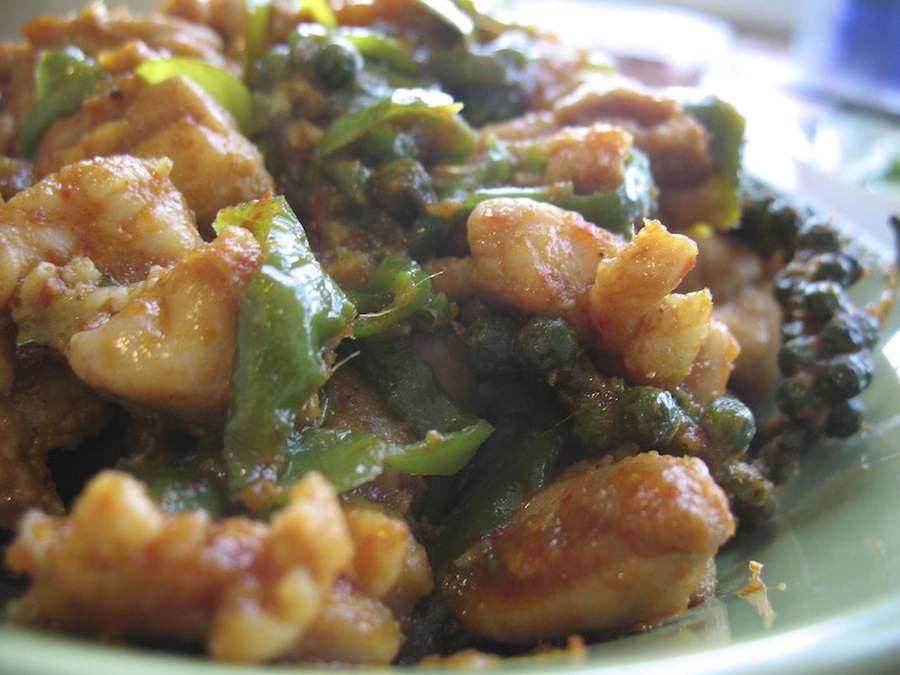
Pad ped gai – ผัดเผ็ดไก่

Posted in - Featured Food Discoveries, Thai/Lao food | Tagged , , , , , , , , , | 10 Comments

“Sichuan pepper” and some of its relatives

IMG_1640

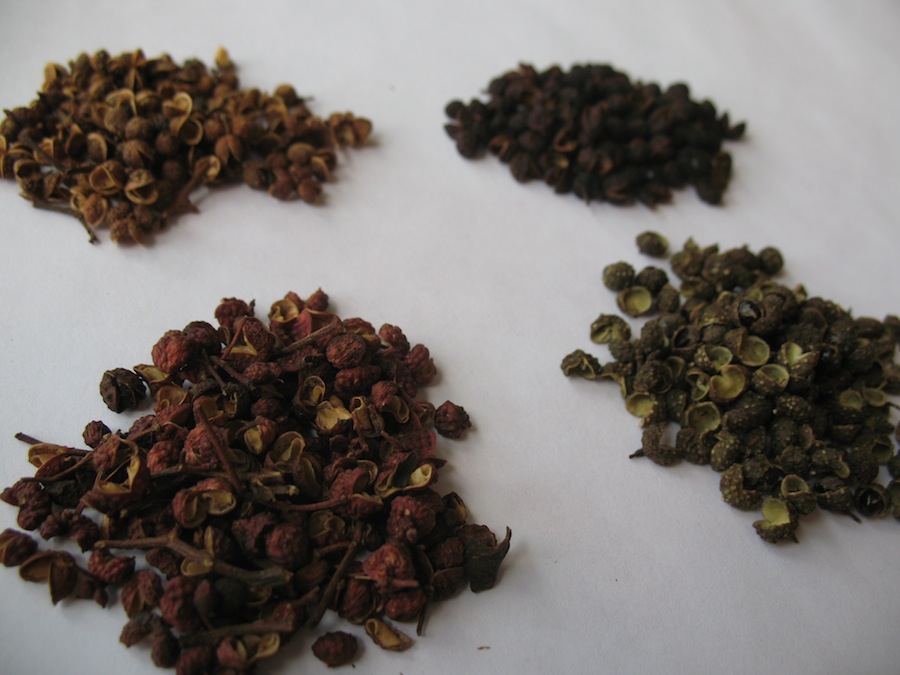
Huajiao and a few of its relatives

Last week I wrote about the growing trend of Northwestern Chinese food in Philadelphia and New York.  Another trend that I’ve noticed over the years, especially clear in places like Madison, Wisconsin, is the continually growing popularity of specialty Sichuan restaurants.  These restaurants started popping up in the mid-2000s, catering largely to newly arrived and independently wealthy students from Mainland China.  They specialized not in American-Chinese standards but in aggressive flavors of Sichuan and Hunan, cooking with loads of chiles, black rice vinegar, and the subject of today’s post, the remarkable “Sichuan pepper(corn)”, or huajiao 花椒 “flowery pepper”.

That trend can be witnessed with the continuous openings of new Sichuan restaurants in Philadelphia’s Chinatown (I’m thinking of “Old Sichuan”, Red Kings II, very recently “Sichuan Dimsum”, etc), and also with the successful Philly chain Han Dynasty.

The trend with the opening of the restaurants seems to have coincided with the lifting of the near 40-year ban on the import of huajiao, or “Sichuan pepper(corn)” in 2005.  Despite its appellation in English, this spice is not a pepper, nor is it a peppercorn.  It is the husk of a seed of the Chinese prickly ash tree.

You really need to try this spice to know what it’s all about.  Huajiao, and its relatives share an unusual trait: the ability to provide a numbing sensation.  If you munch on one of these, there is a strong cool and numbing affect, sometimes described as “tingly”.  In Sichuan cooking, it is often paired with dried chile peppers to provide the mala 麻辣 flavor profile (“spicy and numbing”).

Since I first became acquainted with this spice while living in China, I started to see similar spices used in other countries and regions.  At first I thought it was all the same spice, simply used in different ways.  Now I know that these are all actually different species of the genus Zanthoxylum.  Internationally speaking, the purple-pink Chinese huajiao is by far the best known.  This has lead to the frequent labeling of this and all related spices as “Sichuan pepper(corn)”, whether or not these seeds came from Japan, Thailand, Nepal, etc.  These spices of course have distinct names in their home regions.

I put this post together today to introduce you to huajiao and to some of its relatives.  First, the most commonly available one, and the most widely used in Chinese cooking.

IMG_1632

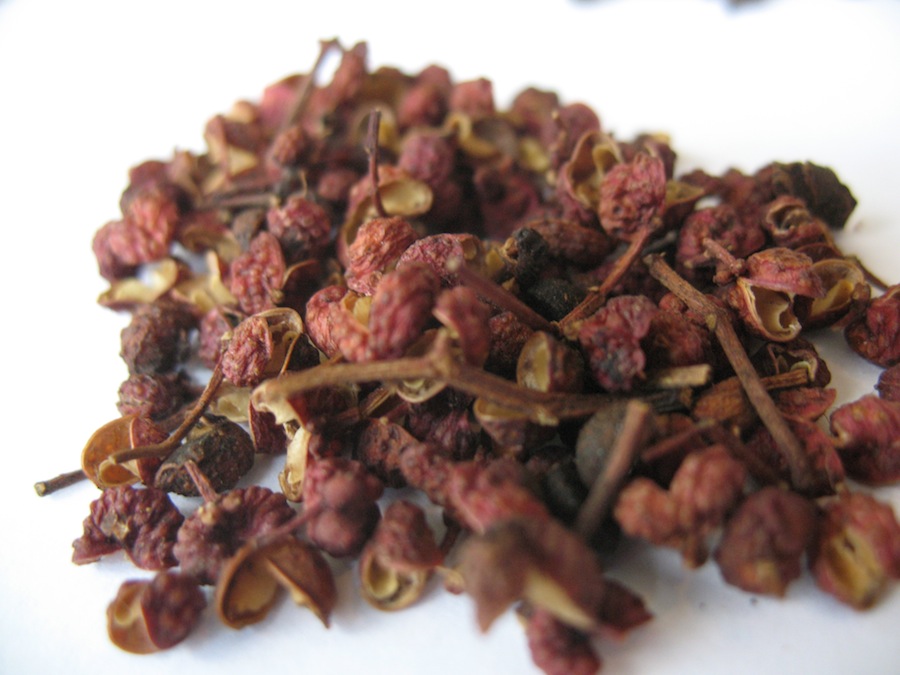
huajiao.

Huajiao 花椒 (Zanthoxylum simulans)

Other names: Sichuan pepper(corn), Chinese prickly ash, chuanjiao 川椒.  Commonly used in Sichuan dishes, mala flavor.  Some examples: mapo tofu 麻婆豆腐, Sichuan-style hot pot, Sichuan-style “water-boiled” dishes (shuizhu 水煮), etc.

Aside from Sichuan cooking, huajiao is also one of the 5 spices in Chinese 5-spice mixes (with the others being cassia bark, star anise, fennel seed, and clove).  This kind of mix is essential for making stewed meats.  See here for an expanded version of 5-spice for a master stock for Guilin noodles.

IMG_1635

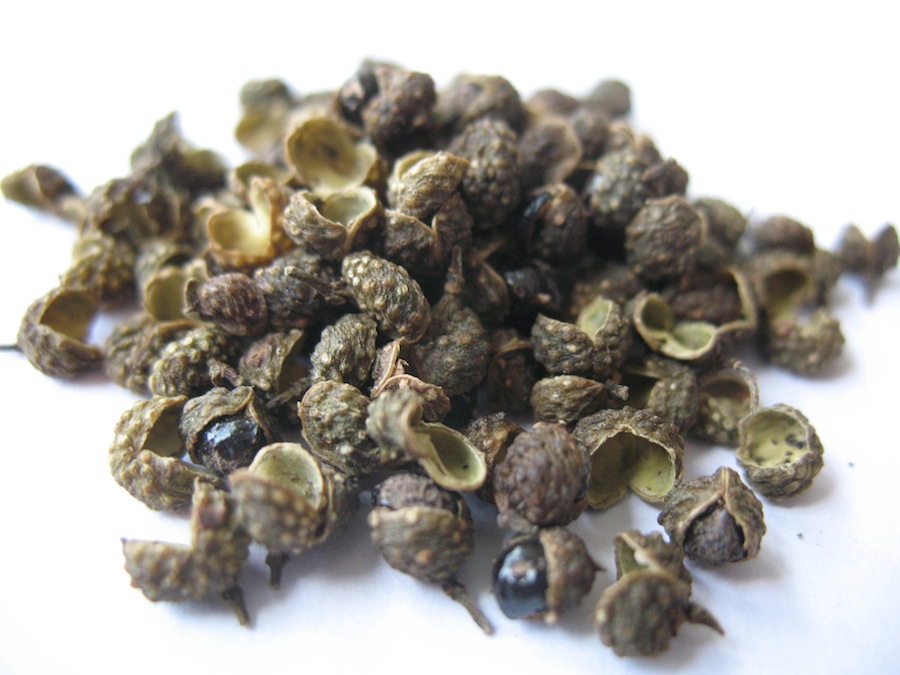
green huajiao.

“Green huajiao” 青花椒 (Zanthoxylum schinifolium)

Other names: majiao 麻椒, “wild pepper”, xiang jiaozi 香椒子, inu-zansho “dog sansho”.  This one has a slightly more intense cooling and numbing sensation along with it.  Commonly used in cooking, mixed with the purple-pink variety, in spicy hot pot, and other aggressively spiced dishes.  Here is another place where I’ve encountered a mix of both kinds of huajiao: Huang fei hong spiced peanuts from the checkout isle at almost any East Asia focused Asian market in Philly.  If you would like to test out huajiao and/or green huajiao (and if you can tolerate moderately spicy food), I suggest you pick up a bag of these peanuts.

IMG_1636

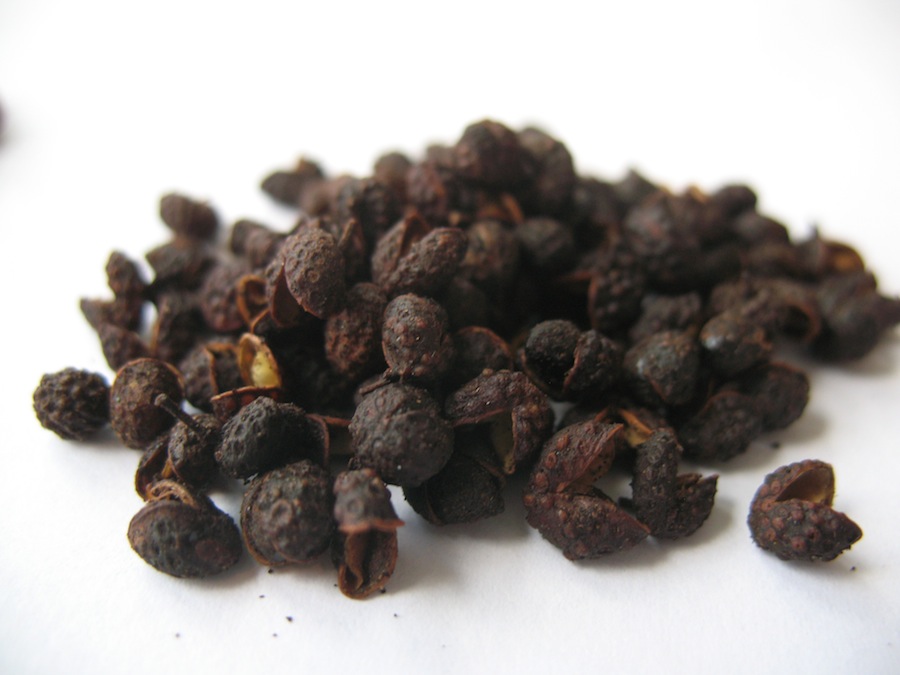
Nepali timur.

Timur टिमुर (Zanthoxylum alatum)

Timur is used in pickles and chutneys in Nepal, and most notably for many, for the tomato and cilantro chutney served with momos.  Its flavor and aroma seems to be a bit more intense than the Chinese varieties, and there is another flavor there that is hard to describe.  I would say immediately it smells like bad BO, but that would be off-putting I am sure.  It’s not unpleasant.  Seems to be a stronger “tingle” than the Chinese varieties (I am tasting these one by one by the way).

timur1

Bag of Nepali timur.  “Nepal’s No. 1 Sichuan Pepper”.

Sansho 山椒 (Zanthoxylum piperitum)

I don’t have any of this with me today.  This spice comes from Japan, and is usually sold in a bottle, pre-ground.  I haven’t yet gotten to our [nearly] local Japanese market, Maido, but I would bet they sell it there.  In Japan it is used for the well-known broiled eel, and also in the “7 spices” (七味唐辛子) mixture.

Here you can see an image of sansho, in whole spice form: http://www.thespicehouse.com/spices/japanese-green-sansho-pepper-whole-or-ground

IMG_1638

Makhwaen from Thailand.

Makhwaen มะแขว่น (Zanthoxylum limonella)

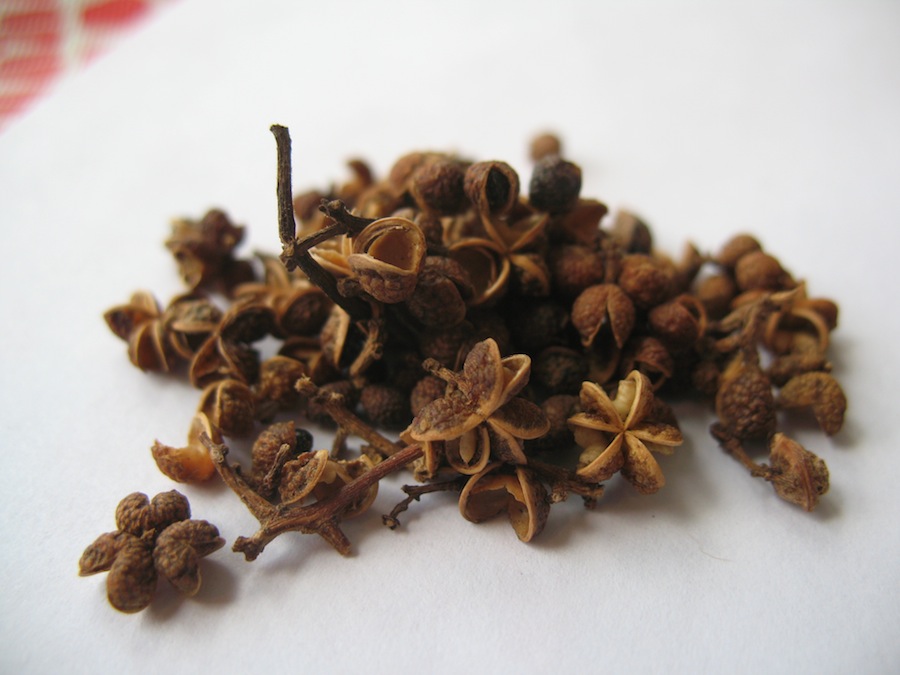
This spice can be hard to find outside Thai and Lao-focused markets.  Like the scientific name implies, it has a slightly more lemony, or fruity flavor.  Fruity and woody, along with that characteristic numbing.  This spice is used in Thai cooking, primarily in “Northern-Style” dishes, often together with long pepper.  For example, for the laab spice mix, and sometimes used to flavor salads and stews.  Notice the characteristic shape, and how it is different from the other species above, with seed pod triads as opposed to individual seed pods.  In Lao the name for this is more like “McKen”, or “bak-ken”. Update 13Dec2014: I finally put out a post for a dish in which this is an important ingredient, Yam jin gai.

Posted in - Featured Food Discoveries, Chinese food, Nepali food, Thai/Lao food | Tagged , , , , , , , , , | 9 Comments

Bike trip to Turkish Delran, NJ

Today I decided on a whim (and sadly, without sunscreen) to ride my bicycle to Delran, New Jersey.  I already knew of the well-stocked Turkish shops and restaurants that exist there.  I had a craving for lahmacun and it was time for a return visit.  From Germantown, the trip took just over an hour.

So far, from what I’ve seen, Queen Village Market is the best selection of specialty foods from Turkey in Philadelphia.  Cross the bridge however, and you can stumble in to an area of shops and restaurants where Turkish is the primary language and specialties from Turkey are abundant.

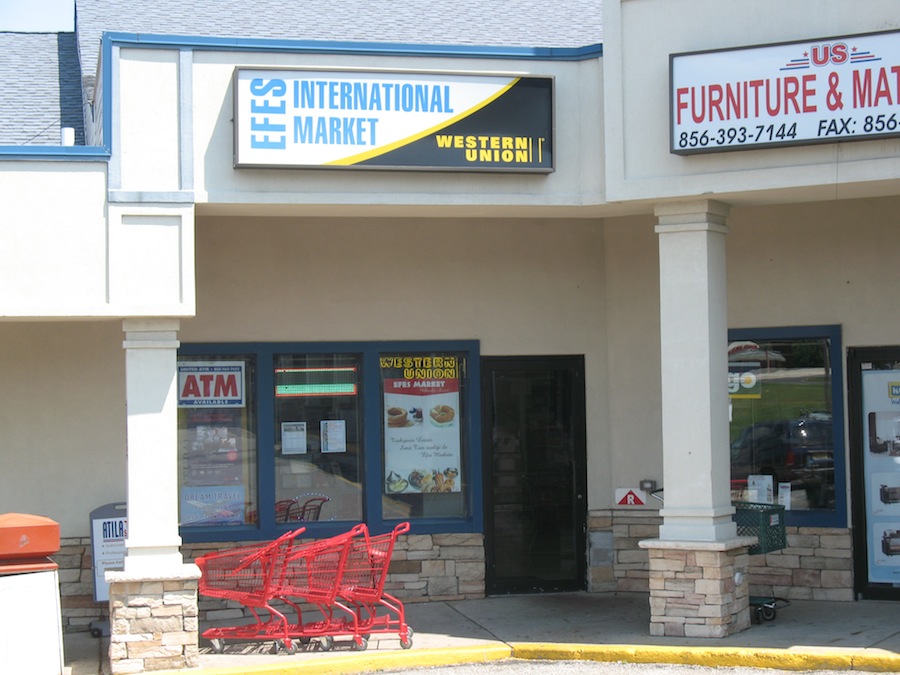
EfesI started at Efes International Market (“Efes” is the Turkish name for Ephesus, the historical city near present-day İzmir).  As usual, all of my explored markets can be found on my map.  This market is well stocked with standard dry ingredients and preserves.  You can find Uluğdağ sodas in large quantities, sausages, cheeses, coffee, tea, preserves.  Red pepper paste, and dried foodstuffs. Breads are freshly baked into giant poofy loaves, like you might find in Eastern Turkey, and there is also a substantial meat market. There are also locally prepared Turkish sweets: baklava, talumba, among others.

efescafemenuThere is also a “cafe” menu.  I was shocked to find kokoreç (popular in the Balkans, Greece, and Turkey, this is roasted or fried inside parts of goat or sheep–intestines, hearts, lungs, and other things–spiced and made into a delicious sandwich).  Unfortunately they were out of needed ingredients today.  Bummer. I bought some Turkish pine nuts and some tarhana soup mix.  I knew there was a nearby bakery that also does lahmacun (aka “Turkish Pizza”–of course this became popular in Turkey after its popularity in the east, aka “Arabic Pizza”), and opted to go there next.

There is also a mantı restaurant!  I have yet to try it.

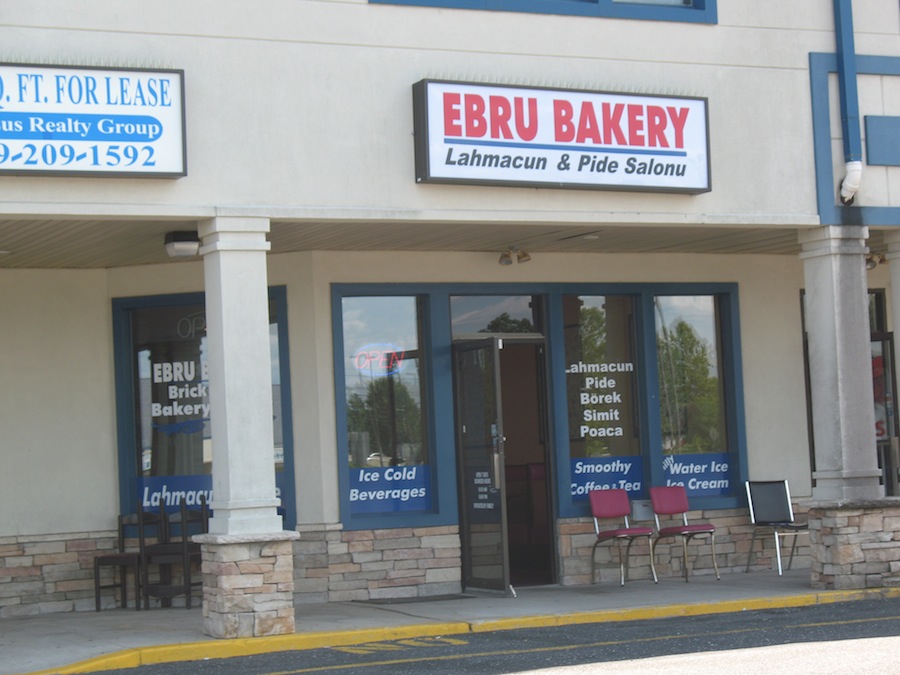
bakeryEbru Bakery has a variety of items for sale.  Of note you can find fresh simit, pastries and breads with various fillings: beef, olives, feta cheese. They also have a place to sit down and enjoy pide or lahmacun.  The staff is very welcoming, but they have very limited English.  Fortunately for me, I  was a liberal arts major and studied Turkish in college.  The lahmacun was pretty tasty.  Wasn’t the best I’ve ever eaten, but it was very nice for three bucks a piece after an hour on the bicycle.

lahmacun1

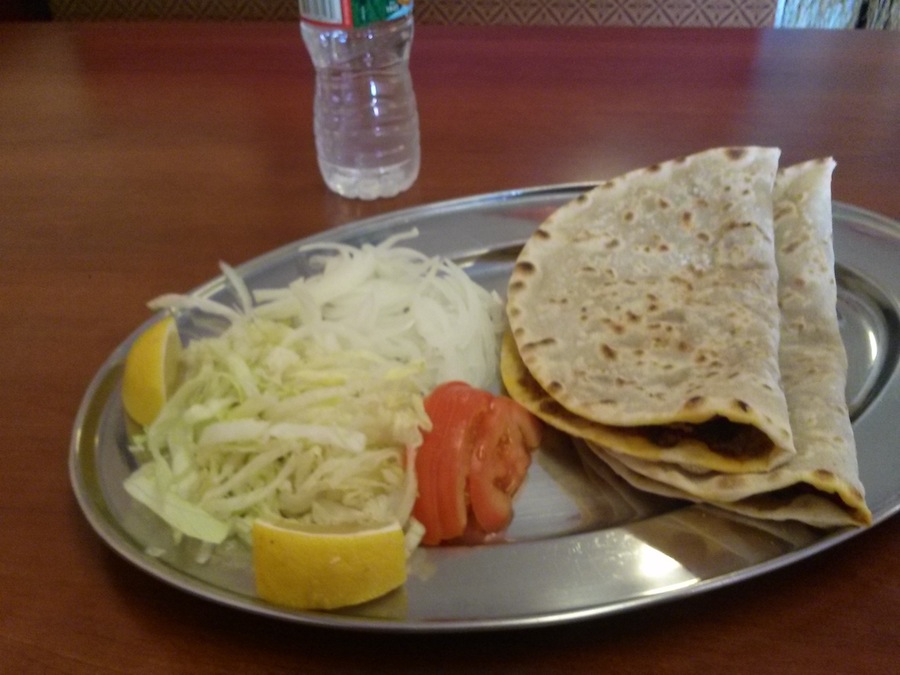
Lahmacun is served.

lahmacun2

Filling the Turko-Arabic soon-to-be pizza-burrito.

Great lahmacun restaurants in Turkey are an absolute joy.  Again, wood-fire ovens are best.  A very thin dough is prepared with a thin topping of ground meat and spices.  It is baked for a short time on high heat, and the result is a fully cooked topping with a pliable yet crunchy base.  It is served often with onions, lettuce, and lemon.  Pile on the cold veg, and roll it into a pizza-burrito.

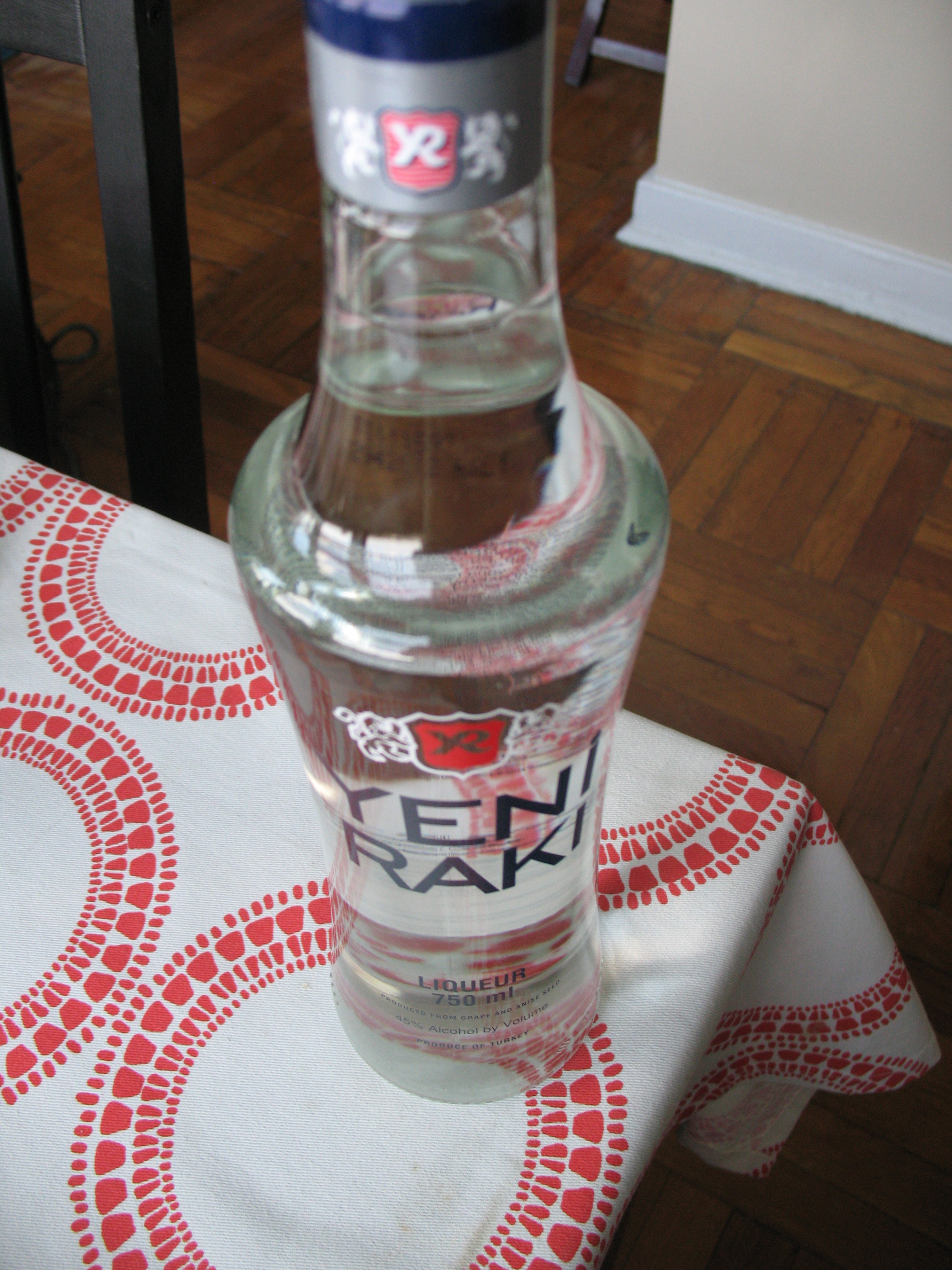
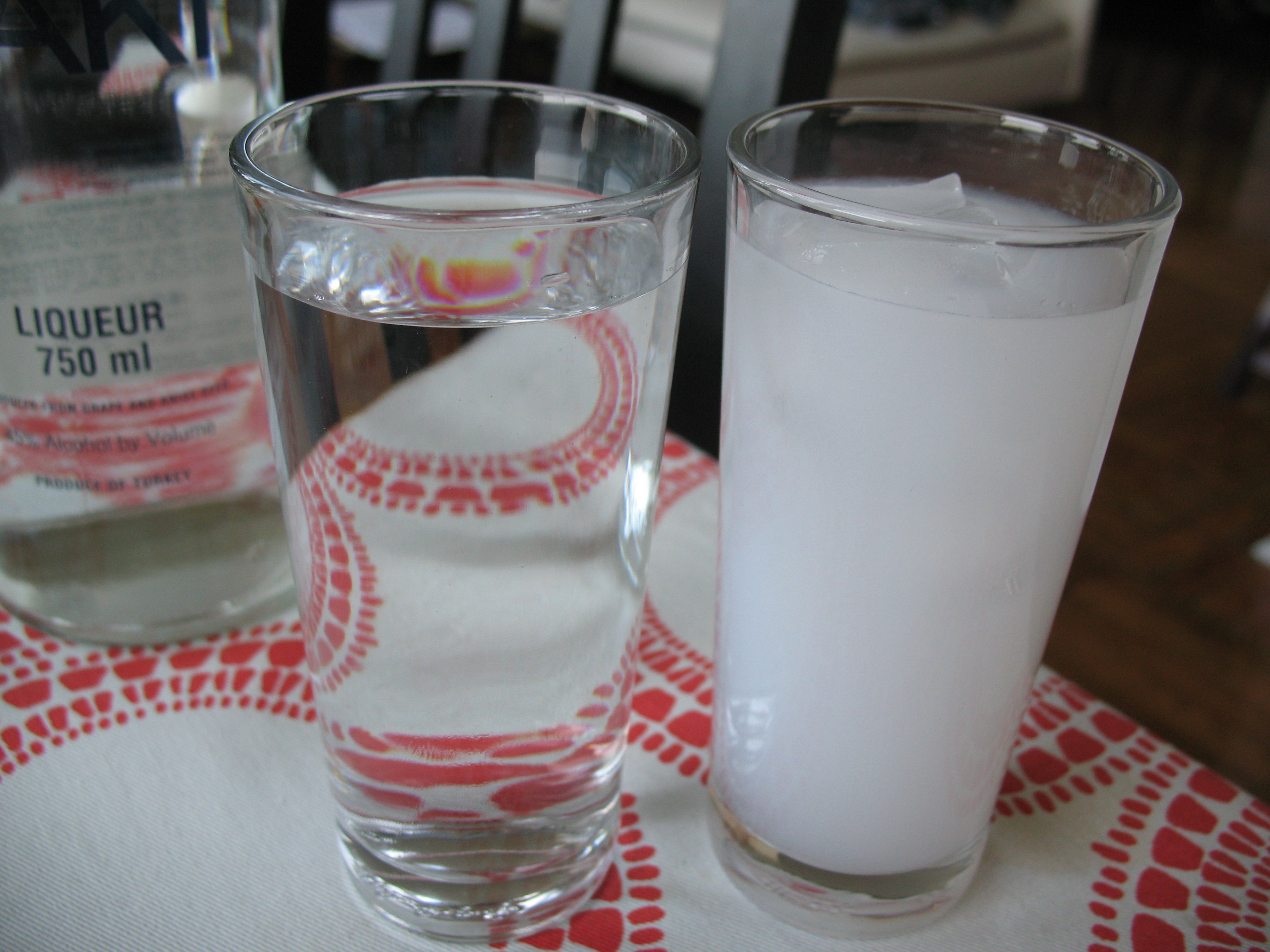
raki1One item that I have not yet seen for sale in Philadelphia (due in part to limitations with the state monopoly of liquors that can be legally sold) is rakıRakı is a popular liquor in Turkey, anise-flavored and very similar to ouzo in Greece.  It is often served with a pair of glasses, one for water, and one for rakı mixed with cold water and/or ice.  When you mix this clear spirit with water or ice, it becomes cloudy.  Hence the nickname “lion’s milk”.  See figure 2.  Rakı can be found at Joe Canal’s in Delran.

raki2

Figure 2.

Drinking rakı also requires–according to my friends who apparently are authorities–a variety of meze for accompaniment.  At the very least there should be some white cheese on the table (similar to feta).  Other classic pairs would be cantaloupe melon, stuffed grape or cabbage leaves (dolma), babaganoush, etc.

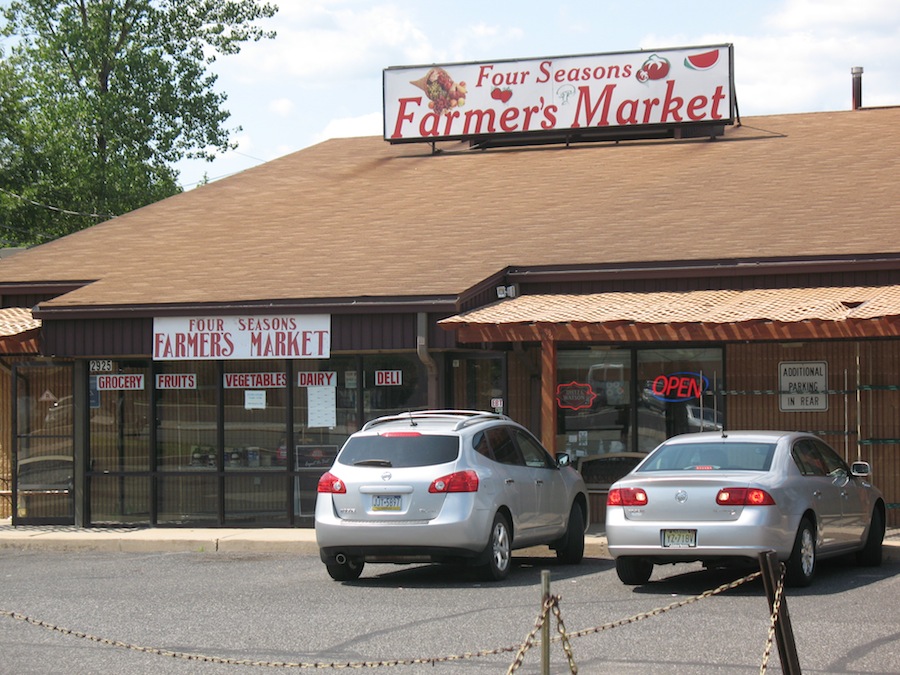
farmersMarketFinally, I learned about another Turkish market in Delran, after speaking with a girl at the bakery: Four Seasons Farmer’s Market.  This market, next to “Ricky’s Army & Navy Store”–complete with field cannon in the parking lot–is a pleasure.  There is an excellent variety of non-perishable items, great fridge/freezer section, a fresh vegetable section, and a deli counter that does döner sandwiches.  There is also a nice selection of cheeses and sweet pastries.

Another notable highlight is they also seem to specialize in Croatian items.  There are several non-perishables, cheeses, sausages from Croatia that catch my eye.

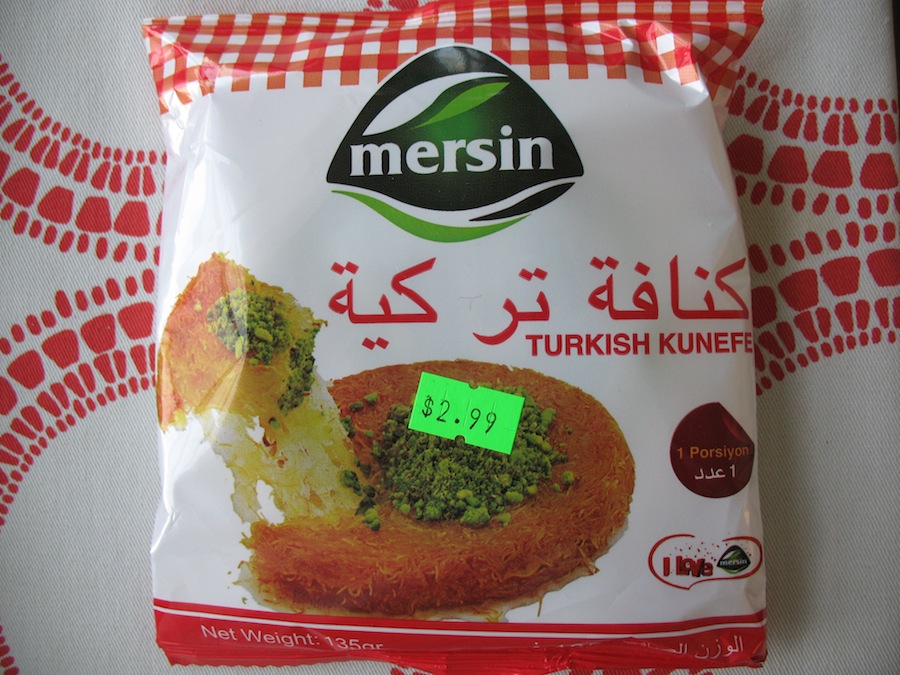
IMG_1616From the freezer section, check this out:  instant künüfe, to be prepared at home (hopefully it will last my long journey home).  Künüfe is a really interesting pastry enjoyed in Turkey and the Middle East, made from finely shredded dough, filled with a fresh unsalted mozzarella-like cheese, it is baked, and finally drenched with syrup.  In Turkey it is amazing.  We’ll see how this one turns out…

IMG_1618

Mersin’s Künüfe. Not bad for $3.  You have to make your own simple syrup.  Caution, baking temps on the bag are in Celsius!  Perhaps the browning would have been more uniform if I had caught that.

Posted in - Featured Food Discoveries, - Featured Markets, Turkish food | Tagged , , , , , , , | 1 Comment

On the growing popularity of “Xi’an” and “Northwestern Chinese” cuisine

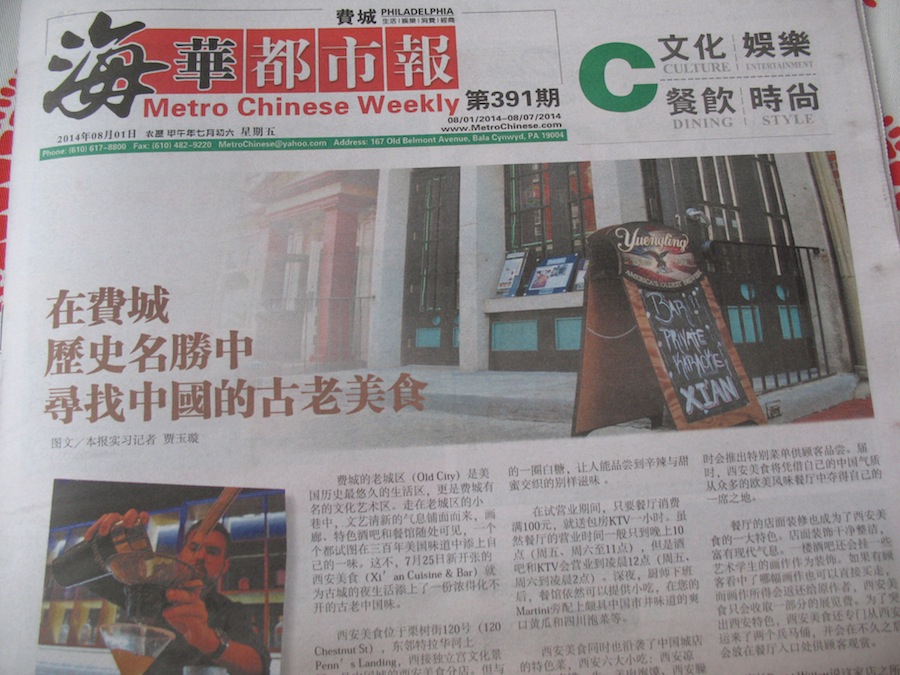
I picked up the new “Metro Chinese Weekly” today while in Chinatown.  For those who are unfamiliar, this is a thick (eat your heart out, Village Voice), free, and weekly Chinese language newspaper, printed for Chinese communities in the Philly region.  Each issue has an assortment of stories based on local and national news, along with substantial pull-out sections devoted to real estate, finance, and culture–including entertainment and food.  And of course half of the paper is taken by loads of advertisements for local Chinese businesses.  Today I see that Xi’an Sizzling Woks (西安美) has spawned a second location in Philly, Xi’an Cuisine & Bar. [Update 25Nov2018: Since at least earlier this year, this Old City location has been closed–though the Chinatown locations and a newer branch in University City are still going strong]

IMG_1564

This week’s Metro Chinese Weekly, featuring the new Xi’an Cuisine & Bar in Old City.  Surely “Yeungling” and “Xi’an” have never been on the same sidewalk sign before…

The headline of this week’s cultural section is, “Seeking Ancient Delicacies of China Among Philadelphia’s Historical Sites.”  Based on the article and accompanying advertisement, this new location for Philly’s mini-chain promises “Up Scale Bar & Food” in a new three-story establishment located at 120 Chestnut St in Old City.  The first floor is the bar area, the second is the dining area, and the third floor has KTV rooms.  This is meant to be a place to party.  The menu builds off the basic successful foundations of the Arch Street location menu:  “Chinese hamburger” (肉夹馍)–featured as “2014 Best of Philly Not-a-Burger Burger prize”, “Biangbiang noodles”, and the Xinjiang-inspired favorites “Sauteed Spicy Chicken and Noodles” (also known as “big plate chicken“), and cumin-spiced lamb kebobs.

This growing interest in Xi’an and Northwestern Chinese cooking is not unique to Philadelphia.  Those of you who follow New York’s food scene will know about the mini-chain of restaurants there, Xi’an Famous Foods.  Menu items are very similar to our beloved Xi’an Sizzling Woks.  Beyond New York and Philly, even before I left Madison, Wisconsin, there was a new food cart that opened up, serving “Chinese hamburgers” (肉夹馍).  Clearly this is a phenomenon.  But who is it catering to?

If “Northwestern Chinese” food (西北菜) is something of a new concept for you, you are not alone.  Even in China, famous regional cooking styles have long been focused on the “eight greats” (八大) of Cantonese, Fujianese, Hunanese, Sichuanese (Szechuan), and also foods of four regions lesser-discussed in the US: Shandong, Jiangsu, Zhejiang, and Anhui (粤、闽、湘、川、鲁、淮扬(苏)、浙、徽).  When people talk about the great Chinese culinary traditions (even in China), they are generally referring to these cuisines, largely based in the far east, far from the Chinese heartland of the Yellow River Valley and the ancient capital city of Xi’an.

China is, of course, huge.  Far-western regions like Tibet, Xinjiang, Inner Mongolia, Qinghai, are logically not included into the “Great Chinese” culinary tradition, because they have only very recently become “Chinese” (politically anyway).  When people in the US (or even in China) talk about Chinese food, the intention is not to refer to food of the minority-dominated autonomous regions of the Mongols, Tibetans, Uyghurs, Hmong, etc.  People are thinking of stir-fry dishes with rice, noodle dishes, steamed dim sum, (i.e. dishes of the “eight great” traditions).

Still, there is a sizable heartland of traditional China (i.e. the Central Chinese plain) that is also not represented among the “Eight Greats”.  The Xi’an region falls into this area, where wheat–not rice–is the primary staple food.  Foods of this region have a fascinating history and legacy in China, but they are not seen in China as haute cuisine.  They are more “home-style”.

Foods from this region are, however, widely known in China, such as the “Lanzhou Lamian” restaurants popular in big cities all across China.  Previously, I obsessed over this fascinating tradition of Lanzhou-style hand-pulled noodles.  This is truly a great legacy of the Northwest, and restaurants are now popping up throughout major US cities.  I now know of at least 4 restaurants in Philly that do “Lanzhou pulled noodles”, with one even in University City.  If we include lamian restaurants, then the cuisine of the interior is popular to the point of hipster.

Who is Northwestern Cuisine catering to?  These restaurants are catering to two primary audiences, both coming from Mainland China.  One group will actually be Mainland Chinese who come from Western China, likely reminiscing about these notable foods.  Others will be coming from other parts of China, where many of these food items have become well-known as night market street food specialties.  Many of Philadelphia’s Chinatown restaurant offerings are starting to change to reflect these night market-style foods (I’m thinking of the shops that now specialize in roasting things on sticks). A third column may be curious Philadelphians and hipster foodies who read the New York Times.

When I moved to Philly, I was totally blown away with our Xi’an Sizzling Woks.  There were so many unusual items on the menu, bringing back memories of travel in Shaanxi and Gansu.  The staff, though, are from all over, with some even speaking Cantonese.  At first I was taken aback by this.  “What, is ‘Northwestern Chinese’ now some sort of gimmick?!”  Perhaps it is.  That said, the Chinese restaurant business is not like I fantasize it to have once been: a singular family from one region running the whole place.  Nowadays it starts with an idea, and employees come second.  High quality food should be the most important element, and these “Xi’an chains” have some some good things going on.  At the very least we have some interesting new food diversity in our Chinatown line-up.

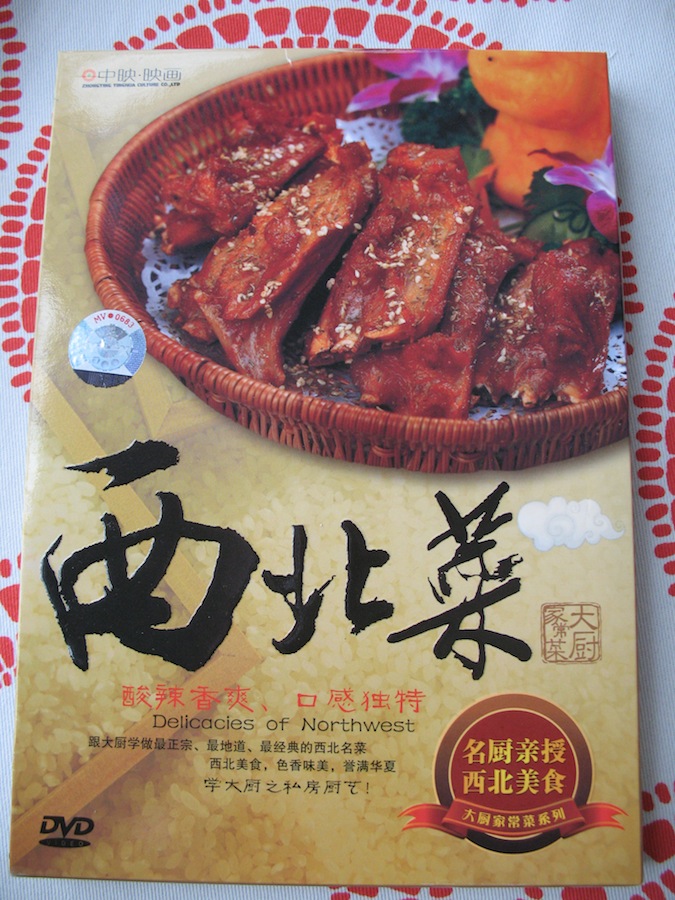
Separate but related story #2: review of “Northwestern Cooking” how-to DVD.  Recently I visited Philadelphia Chinatown’s New China Bookstore (新华书店), the huge bookstore above the “Shanghai Bazaar” on Race Street with the incredibly random selection of books, music, and videos.  I was surprised to come across this “how-to” cooking DVD:

IMG_1565

“Northwestern Cooking”, a step-by-step cooking DVD

Many of these dishes I have already had experience preparing, but I wanted to see if there were variations with how this TV chef prepared his dishes.  Among the dishes included on the DVD were the aforementioned “Chinese hamburger”, as well as several Xinjiang favorites: “Xinjiang lamb kebobs”, “Big plate chicken”, “Rice to be eaten with hands” (手抓饭, i.e. rice pilaf, Central Asian style) and others.

I was immediately impressed with the production quality and soundtrack.  Some nice funky lounge music was produced by studio musicians to accompany this chef from the Northwest, providing a proper food-porn ambiance.  For me, the chef’s dialect was hard to follow, and fortunately there were Chinese subtitles.  As you might imagine, many of the recipes were dumbed-down for the “Easterner” intended audience.  The Xinjiang dishes only faintly resembled the originals.  Kebobs were actually microwaved on skewers, the “Rice to be eaten with hands” was basically lamb stir-fried rice, and the big plate chicken was again, more of a stir-fried simplified dish, unlike the rich stew popular in Xinjiang.

Granted, these kinds of DVDs are meant for home cooks, without the luxuries of a wood fire grill, or whatever unusual kitchen implements or ingredients that are used for these specialty cuisines.  I still found the DVD very enjoyable.  There were a few dishes that looked really good that I might like to try: Lamb and winter melon soup, and Lamb pao mo (Lamb with bread dumplings).

Posted in - Featured Food Discoveries, Chinese food | Tagged , , , , , | 3 Comments

Fermented tea leaf salad

salad

Fermented tea leaves and crunchy bits mixed with cabbage, peppers, tomatoes

I started to notice fermented tea salad packs from Myanmar about 2 years ago in Wisconsin.  In Philadelphia, these packages can be found at markets that cater to Southeast Asian tastes.  The best selection will be from South 7th St’s Friendly Market.  You can also find this at Rising Star market, also on 7th St.

This salad, known as Lahpet Thohk လက်ဖက်သုတ်, is a much beloved food in Myanmar.  It is delicious as an accompaniment to rice and other dishes.

The ready-to-mix packs that can be found in Philly Asian markets have two packages inside, one is the fermented tea/garlic/oil, and one is the fried crunchy nuts/beans/seeds.  The bags are often double or triple wrapped, to try to prevent oil from leaching out (often unsuccessfully).  You can find these in single-serving sizes, or family-size, like the one I picked up:

IMG_1429IMG_1431IMG_1432

There is another similar salad that you can find in similar packaging that is pickled ginger instead of tea.  Here is a creative commons image of both tea and ginger, ready to be mixed with crunchy bits.  That is also delicious.

For those of you concerned with global corporate powers and influence, I should point out that the Yuzana brand is a conglomerate with close ties to the former ruling powers of the junta that controlled Myanmar until 2011.  This conglomerate continues to hold much power and influence in Myanmar.  There are other brands out there for fermented tea leaves, but depending on your shop you might be limited to one or another.  So far, I’ve only tried one other brand (with no English on the label), but that one had really mushy and gritty tea leaves.

IMG_1541

About 1/3 of the box’s contents, crunchy bits and fermented tea

The salad is delicious on its own, mixing together the crunchy bits with the tea.  Even better, you can add a few more things to make a larger salad that is really delicious and more substantial (like what I did above with cabbage).

To make this delicious salad, finely chop some cabbage and a chile pepper, and dice a tomato.  Put this in a larger bowl for mixing, and add the crunchy bits and tea leaves.  Season with a splash of fish sauce and lime juice.

If you would like to try this salad in a restaurant setting, try Rangoon Burmese Restaurant on 9th St in Philly’s Chinatown.

Posted in - Featured Food Discoveries, - Featured Markets, - Recipes, Myanmar/Burmese food | Tagged , , , , , , , | 2 Comments

Follow up on “Big plate chicken”

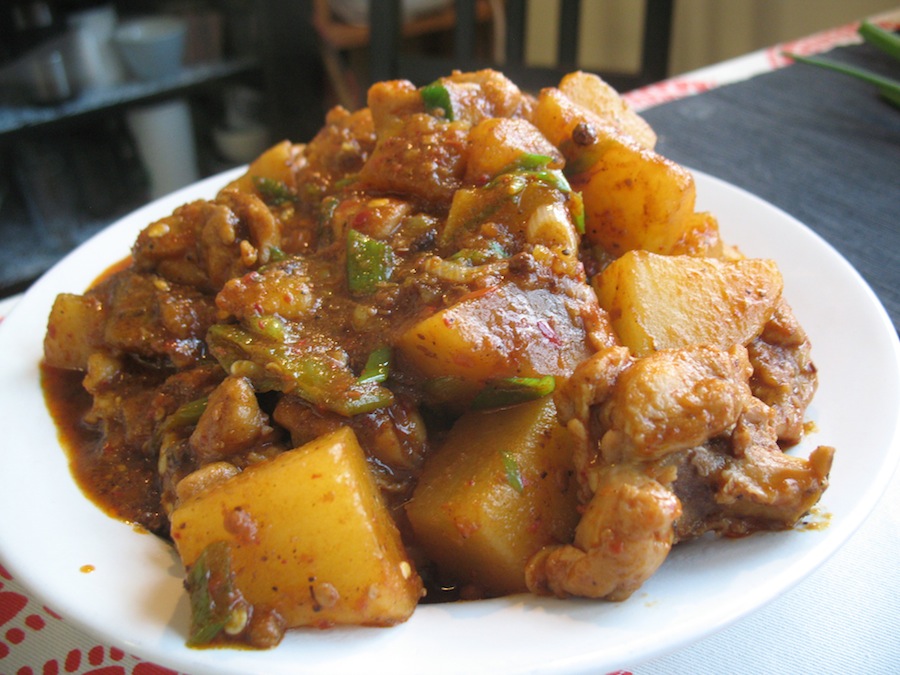
instant_dapanjiFor those of you who were maybe curious about that unusual “Old Yang family shop Big plate chicken” spice packet I bought several weeks ago, I finally decided to give it a try.  Above is my a less than photogenic effort.  In addition to the spice paste–which was basically dried chilies, oil, Sichuan peppercorns (huajiao), garlic, ginger, msg, salt, and Sichuan bean paste (doubanjiang), I used chicken thighs, hacked into big chunks, a big potato, and some long green chiles and green onions.

I have to say it wasn’t bad.  There was a lot of spice though, so maybe more fresh ingredients would have balanced that a little bit.  The numbing spice of the huajiao was pretty heavy.

The packaging also had something printed on it that I didn’t highlight in my previous post.  It is under the brand name “Old Yang family shop” (扬家老店), implying some sort of famous recipe.  I wasn’t able to find anything in a cursory search regarding any real entity behind this name.  If you know, please let me know.

Posted in - Featured Food Discoveries, Central Asia/Uyghur food, Chinese food | Tagged , , , | Leave a comment

Tagine of lamb and peas

Mmm, tagine.  That slow cooked earthy goodness of clay pot magic that is commonly in the form of savory meat stews.  But what a minute… isn’t this a blog about Asian ingredients?

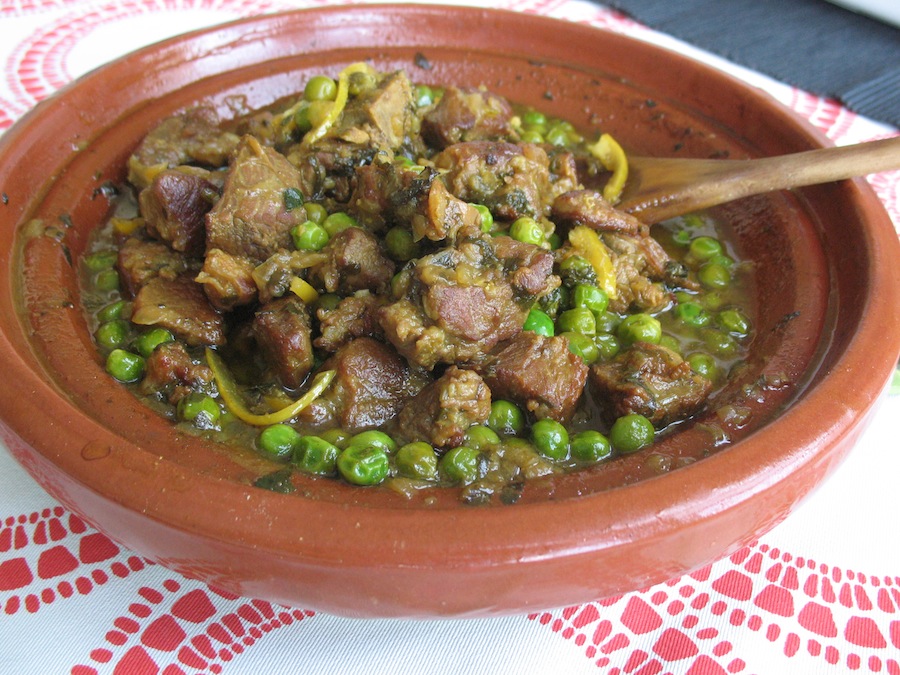
Today's tagine: Lamb and peas with preserved lemon

Today’s tagine: Lamb and peas with preserved lemon

Yes, I know that this is really kind of outside this blog’s intent–to showcase unique and non-typical Philadelphia food finds of Asian origin.  Let’s set that aside for today.  Moroccan tagines are fun to cook in and are delicious; I am cooking and I want to share.

This is my tagine

My tagine cooking today’s recipe–notice heat diffuser

About the name tagine.  Tagine can refer to the cooking vessel, a clay/terracotta/ceramic plate with a lip, and its conical lid.  This is a traditional cooking vessel in Northwest Africa.  If you visit restaurants in Morocco, you can see tagines of various sizes cooking outside over coal fires.  The word tagine can also be used to describe a stew.  So, if you cook a popular Moroccan tagine in a skillet, it can still be called a tagine.  Restaurants that specialize in fish stews, for example, might cook a delicious giant tray of fish, onions, tomatoes and olives, and that shares the same name.

Some argue that earthenware cooking  imparts a better flavor to the foods.  As far as I’m concerned, the jury is still out on that, but I do love the idea of cooking in clay, and  slowly simmering stews.

I immediately regretted not buying a tagine while in Morocco several years back.  Fortunately for me, you can find (an albeit smaller selection of) tagines online.  The one that I’m using I bought for around $30 on Amazon, made in Morocco.  There are high-end versions out there, but I like basic.  If I ever buy another, I’d try the unglazed one, perhaps the Atlas mountain Berber variety.

Note on using a clay/ceramic tagine: Tagines can break easily with heat shock.  After I broke my first one, I now always use a heat diffuser.  This will make the tagine take longer to heat up, but it will act as a mediator between the flame or electrical element and the tagine.

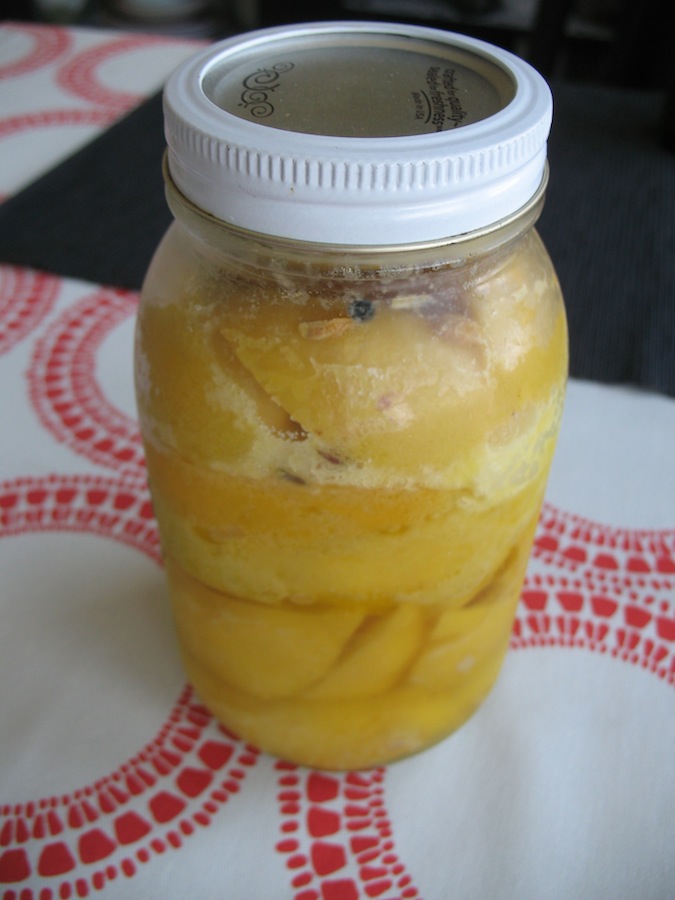
homemade preserved lemons

homemade preserved lemons

Today’s tagine is Lamb, peas, and preserved lemon.  All of the ingredients will be easy to find in any grocery store, except one: preserved lemon.  I am behind in my explorations of Philly’s several African and Middle Eastern markets, but I haven’t yet found a place that sells them.  I’ll update this when I find it.  That said, it is pretty straightforward to make your own (which is what I do).  Basically you buy a bag of unwaxed (can be hard to find, co-op might be best bet) lemons.  If you can’t get them unwaxed, do your best to scrub the wax off before drying and using. Cut the lemons into fourths, down to the stem end (keeping them together).  Pack the insides of the lemons with sea salt.  Finally, pack the lemons into a jar, tightly.  They will give up a lot of juice.  Ensure there are no air bubbles, top off with some olive oil, and let sit in a cupboard for a month.  Then they are ready to use.

Inspiration for this recipe came from the huge and beautiful The Food of Morocco: A Journey for Food Lovers, with recipes by Tess Mallos.  My recipe is adapted because my tagine is a little smaller.  I cook according to what it can hold.

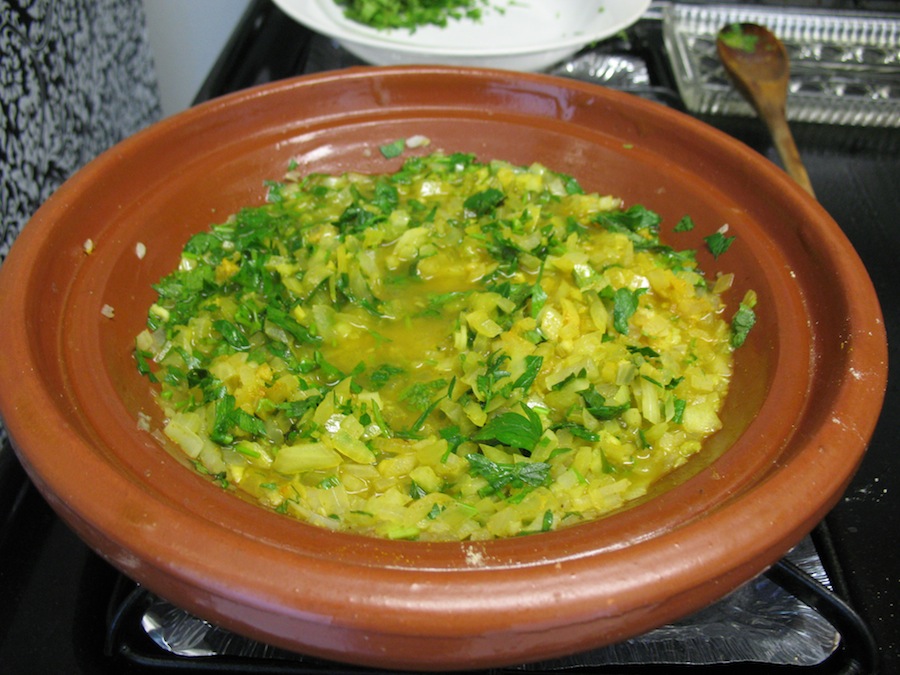
tajine031. Heat your tagine (takes a while on low to medium heat), with olive oil ready to begin the frying process. In go your finely chopped onion, garlic, and after onions soften add ground spices: cumin, ground (dried) ginger, tumeric. When things start to stick or brown, add a little water. Add equal-part bunches of chopped cilantro and flat-leaf parsley, and oregano or thyme.

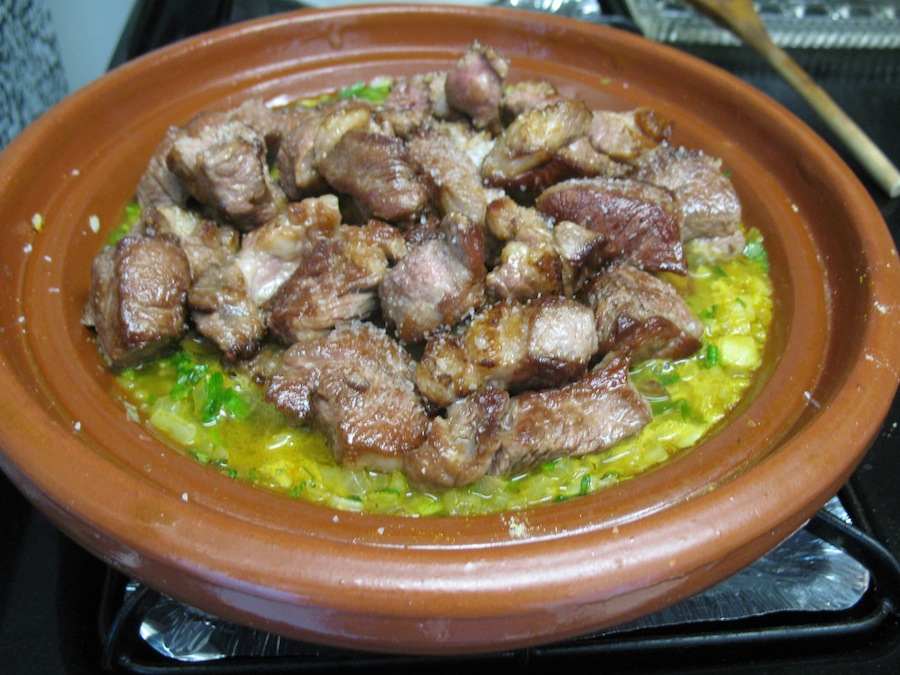
tajine042. Nicely brown your chunks of lamb in a separate frying pan in batches.  This is kind of optional, but it will be more delicious with all of that dark fond included.  When nicely browned, add lamb to the mix.  Deglaze your pan with some water, and add that in too.  Salt and pepper the tagine, and give it a stir.  Cover and let simmer for an hour and a half, or until meat is nice and tender.

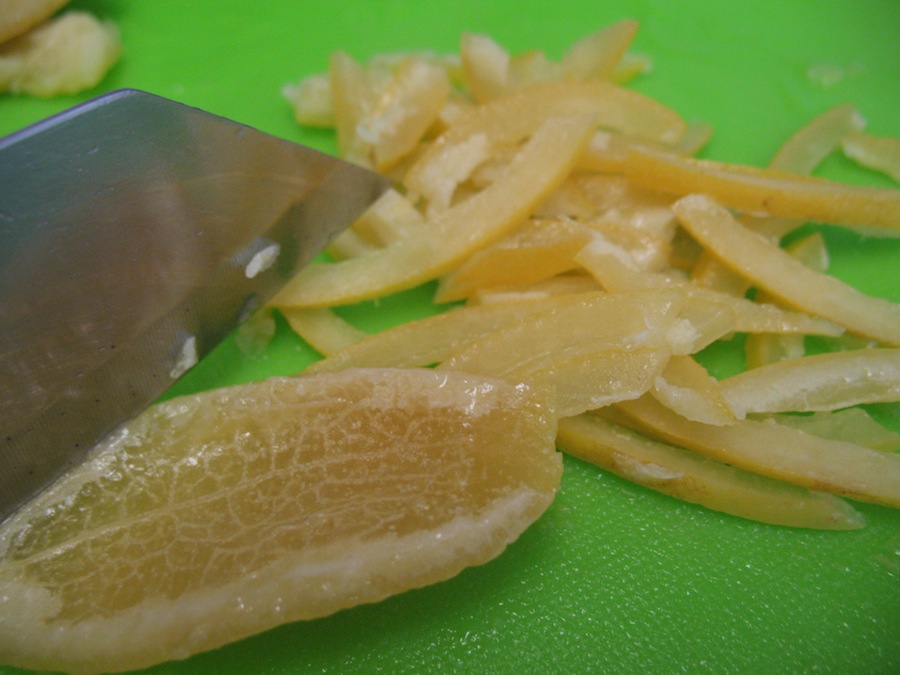
3. tajine06Prepare your final ingredients.  Chop a small handful of mint, prepare your peas (I used frozen peas), and prepare your preserved lemon.  Rinse the lemon well and scoop out the flesh inside and discard it.  The rind is the part to use.  Cut the rind into thin matchsticks.

tajine07

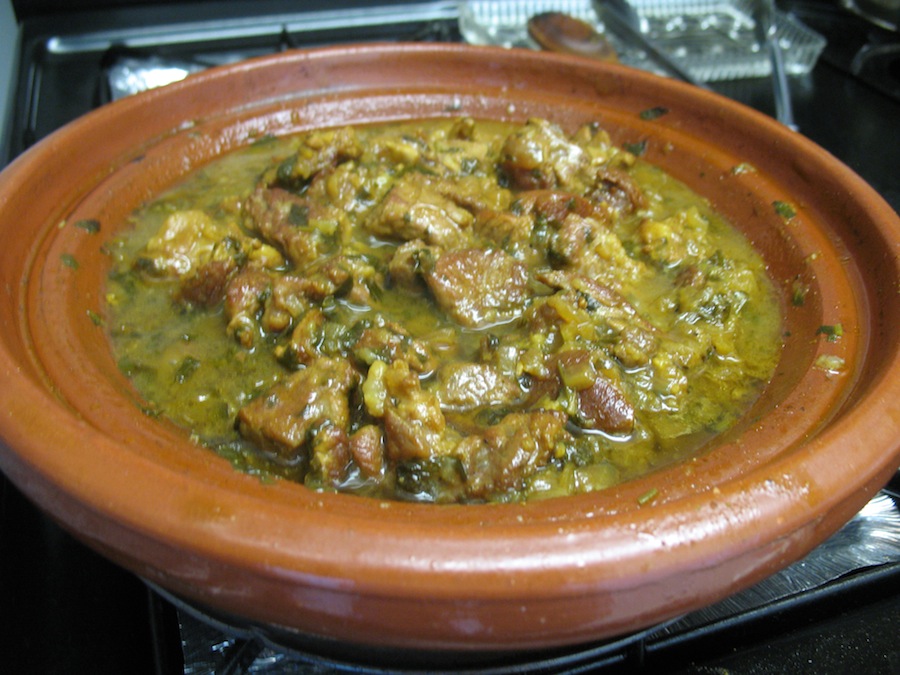
Lamb tagine just before adding final ingredients

4. Finally, add in the chopped mint, peas, and preserved lemon.  Cover and cook for another 10 minutes or so.  In Morocco, this would likely be eaten with flat bread, or couscous.

The preserved lemon gives a very unusual and enjoyable flavor.  It is not sour like a fresh lemon, but is sweet, almost candied.  Nice pair with spiced lamb and mint.

Ready to eat

Ready to eat

Posted in - Featured Food Discoveries, - Recipes, Non-Asian | Tagged , , , , , | 5 Comments

Happy Eid!

Huhhot market

Market stalls outside the Great Mosque with lots of goodies for entertaining guests during the month of Ramadan in Huhhot, Inner Mongolia. Cookies, deep fried wheat doughs, sweet things for dunking in tea.

Today Muslims around the world celebrate Eid al-Fitr (“Roza heyit” in Xinjiang), the feast  day that marks the end of Ramadan, a month of fasting from dawn to dusk (if it is allowed, anyway).  Excellent feasts will be had today.

I wish my friends around the world a safe and happy celebration!

Posted in - Unique food traditions, Central Asia/Uyghur food | Tagged , , , | Leave a comment

Cold jelly noodles, the way I like them

Liangfen 凉粉, or cold jelly noodles, are creeping onto Sichuan menus in the US, at places like Philly’s beloved Han Dynasty.  Unlike the thick jelly noodle variety found there, this is how I best like them:

liangfen12

My version of liangfen, based off my Guangzhou Sichuan model

The way I first experienced this unusual dish, was as a flat, rubbery kind of chili oil-laced treat.  That was via a Guangzhou hole-in-the-wall restaurant near my school (as I first experienced Guilin mifen).  Back in the ’90s, Guangzhou was a sprawling metropolis that contained one-story shop neighborhoods of recent-arrived migrants.  People from all over China flocked to Guangzhou to take advantage of the booming economy of the coastline (Deng Xiaoping’s reforms provided for easy overland and overseas investment opportunities, and restauranteurs supported the workers of those establishments).  A lot of people were in the small restaurant business. I and my classmates thoroughly enjoyed the variety of skilled cooks in the neighborhoods near our school.  These days, those interesting small shops and restaurants have been pushed even further to the outskirts of Guangzhou as the city has been reborn and rebuilt.
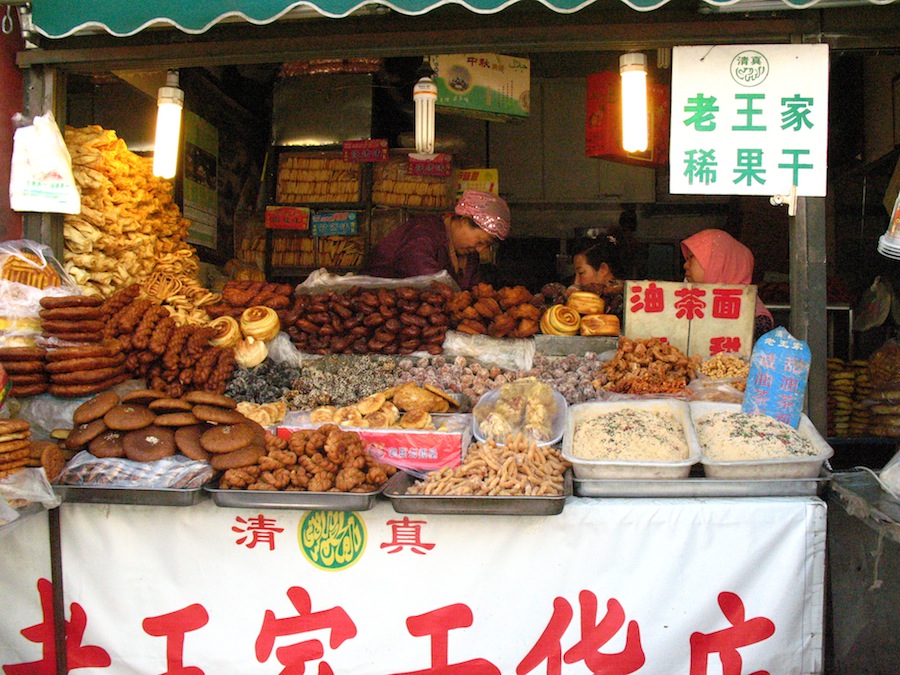
For me, a student with no income, cheap regional cuisine restaurants were the best place to be.  Each tiny shop had its own delicious specialty, and they did mostly (if not only), that.  For a consumer, that kind of restaurant setup is so much easier to navigate.  Do I feel like Lanzhou style beef noodles, Guilin style rice noodles, Sichuan style cuisine, clay pot-rice, dim sum, jiaozi, or something else?  If you choose, you don’t have to “settle”.  You know it’s going to be good.  And, back then, it was dirt cheap.  I miss that so much.

Now, in the US, we are faced with so many restaurants that strive to be the end all restaurant for all consumer desires.  What that amounts to is amazing mediocrity.  Some actually do very well with some dishes, but that is not maintained and not promoted as a unique specialty.  Too bad.

Back to the cold jelly noodles.  Let me show you how I make those refreshing, surprisingly well flavored noodles.

1. Find (or make) mung bean starch.  The kind I use I find at Southeast Asian markets.  liangfen02This starch is meant to be used for Thai specialty deserts.  It is “Thai brand mung bean starch” or แป้งถั่วเขียว.   Measure out 1/4 cup of this starch and add it to 1/4 cup of water.

liangfen05

whisk boiling starch mixture vigorously, for 5 minutes

2. In a separate small pot, bring 1.5 cups of water to boil.  Whisk the starch and water mixture until incorporated, and slowly pour this into the pot of boiling water, whisking all the time. Whisk for about 5 minutes, while it bubbles away.

3. Take the mixture off heat, and pour it onto  the largest cookie sheet that you have that will fit into your refrigerator (prepare ahead of time to make sure of that fit).

liangfen074. Quickly, tilt the cookie sheet continuously, so that the jelly coats the whole surface.  Let this rest on the counter until it is cool enough to put in the refrigerator.

5.  Make the sauce.  In a small bowl, combine huajiao oil (1 tbsp), along with chili oil sediment (1 tbsp), soy sauce (1 tsp), a little salt (1/2 tsp), some garlic that has been pressed (3 cloves), some sugar (1/2 tsp).  Mix well.  Finely chop some small cucumber (optional) and some green onion and cilantro (optional).

6.  Remove from refrigerator after cooled, as soon as 10-15 minutes, and roll the jelly up.

liangfen087. Use a spatula or something plastic to cut the roll into slices.  You can then unroll each noodle to the serving dish.

liangfen108.  Lay noodles in the serving dish, add cucumber (if using), and green onions and cilantro.  Then spoon the sauce over the top.  You don’t have to use it all, adjust to taste.

liangfen11

Finished product. My liangfen.

Posted in - Featured Food Discoveries, - Recipes, Central Asia/Uyghur food, Chinese food | Tagged , , , , , , , , | 3 Comments